

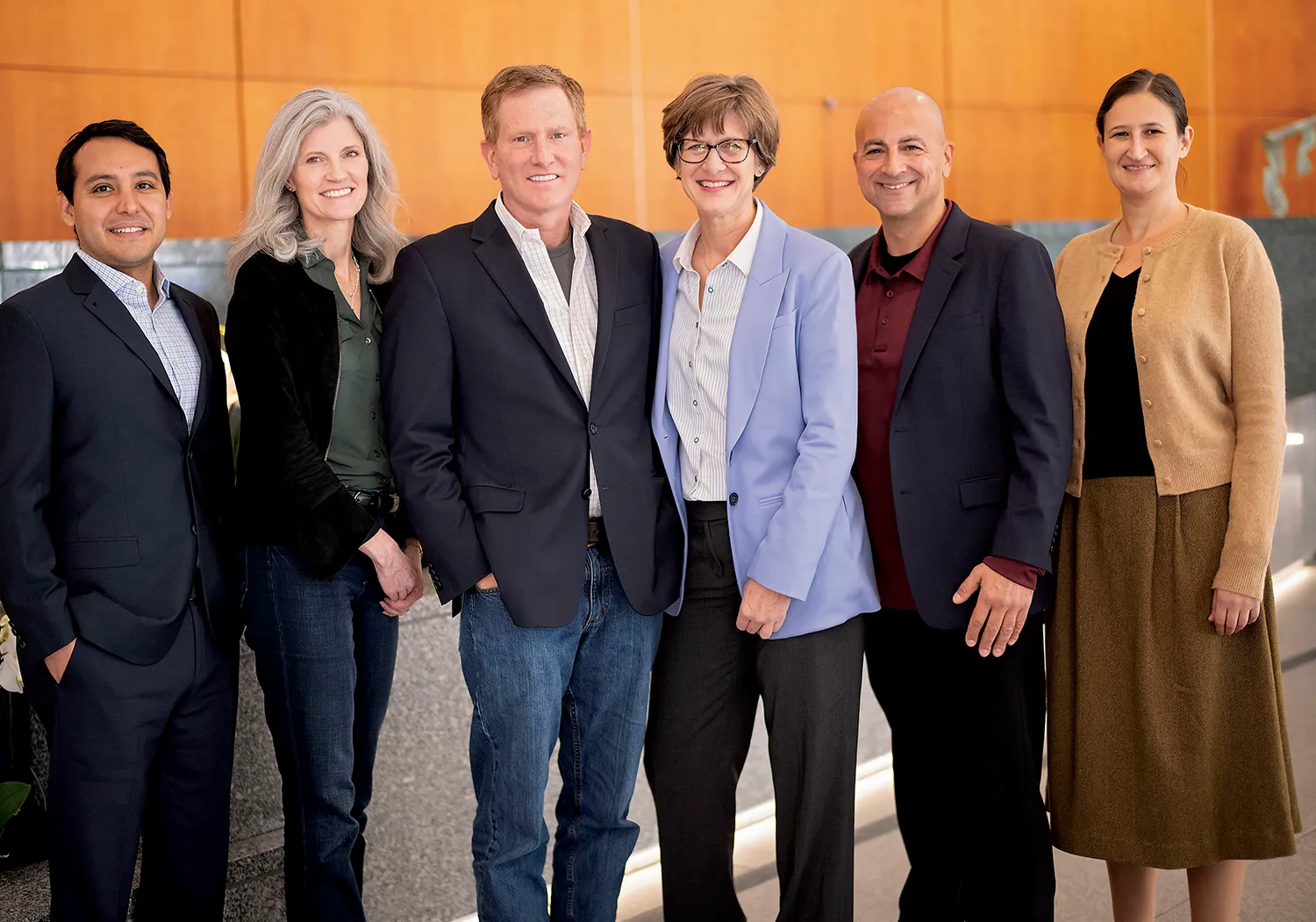
Trying a New Model
hristine Lehman ’90 has an explanation for why her law firm, Reichman Jorgensen Lehman & Feldberg (RJLF), won a $236 million verdict in its very first trial: “Nobody saw us coming.”
With barely more than a dozen lawyers at the time, the scrappy boutique shop stunned the legal world in 2020 with one of the year’s largest jury awards, beating tech giant VMware in a patent infringement case.
The verdict put RJLF squarely on the legal map, but it shouldn’t have come as a surprise to anyone familiar with the firm’s founders.
Courtland Reichman ’90 and Sarah (Newland) Jorgensen ’90 met on their first day at Swarthmore, and went on to work together at the The American Lawyer-ranked litigation giant King & Spalding and litigation powerhouse McKool Smith, along with Reichman’s college roommate, Peter Mastroianni ’90.
There, a shared frustration with the legal industry — and an idea about how to fix it — began to crystallize.
“We had this vision for practicing law in a different way,” says Mastroianni, a document-review expert with a philosophy degree who joined as an electronic stored information partner.
“We weren’t interested in replicating the same broken model,” he says. “We wanted to build something fundamentally better.”
The partners spent a weekend in the fall of 2018 drafting a manifesto for a new kind of firm. “We put it up on a website,” says Reichman, “and opened for business on Monday.” Their model rejects many of the standard metrics of prestige law: no billable hours, no up-or-out partner track, no rigid hierarchies. They charge flat fees for clearly defined work.
“The billable hour is killing the legal profession,” says Reichman. “It’s bad for clients, bad for lawyers, and bad for mental health. It rewards inefficiency. If you’re fast and good, you get penalized. We want faster and better lawyers.”
It didn’t take long for the model to prove itself.
Litigation prep that should have been spread over five years was targeted for completion in five months, leading to nonstop 16-hour days.
“We were only 13 lawyers at the time,” Reichman recalls. “But we out-hustled and out-thought them. And they completely underestimated us.”
Since its first surprising verdict, RJLF has continued to win national accolades, including “Elite Boutique” status from The National Law Journal, and Silicon Valley “Firm of the Year” three times from Benchmark Litigation, which also named Reichman as one of the top 100 trial lawyers in the U.S. and one of the top 20 in California.
Last year, Jorgensen was named “Attorney of the Year” by Law.com and Daily Report’s Southeastern Legal Awards. (She is married to Dennis Jorgensen ’92: Reichman is married to Sarah’s sister, Emily Newland ’93.)
In 2024, RJLF further cemented its status with a $673 million jury verdict against Amazon Web Services on behalf of Kove IO, a Chicago-based company that had developed much of the technology that undergirds cloud computing, only to see it used without permission by the tech behemoth.
Reichman and Lehman co-led the trial team, while Jaime Cardenas-Navia ’07, an engineering and economics major at Swarthmore who joined the firm shortly after its founding, conducted the pivotal 10-hour direct examination of the case’s lead expert witness.
“We all have these arguments and theories,” says Cardenas-Navia. “But when you go to court, it gets real. You’ve got the jury and the judge, the evidence and your arguments — and you see what actually moves people.”
That clarity and storytelling instinct is a hallmark of the firm’s approach, cutting through the mind-boggling level of detail in technology-based cases.
“Even in technical cases, it comes down to persuading people,” Reichman says. “You ask what a case is about, and I’ll say: It’s about stealing. And people get that.”
The unique combination of analytical rigor and empathetic storytelling is no accident, say the firm’s lawyers, who share a common intellectual language honed from their college years.
“Swarthmore cultivates a kind of restless curiosity,” says RJLF counsel Sara Edelstein ’03, who also worked with Reichman at McKool. “It teaches you to keep digging — to challenge assumptions, to listen deeply, and to take ideas seriously no matter where they come from.”
The firm’s diversity — of background, identity, and approach — is central to that work. Some 30% of RJLF’s lawyers are from diverse backgrounds. It’s also majority women-owned.
Breakthroughs are expected to come from anywhere.
“We don’t have a hierarchy of ideas,” says Jorgensen. “Junior associates feel completely emboldened to speak their minds — or tell us we’re wrong.”
In the Kove IO case, an associate at her first trial with the firm persuaded Reichman to let jurors ask questions of witnesses — an experiment he initially hated and now uses frequently. “We’re not hung up on the rules traditional firms are,” adds Lehman, who manages the D.C. office. “That flexibility is part of what makes us effective — and what makes the work so rewarding.”
For Mastroianni, it’s the culture of trust that makes everything else possible. “The best part of this group is that it was a friendship first, and then a business,” he says. “We trust each other. That’s led to some terrific camaraderie — and some terrific results.”
And for all the complexity of the cases and stakes involved, that bond still drives the work.
“We’re able to do well,” Reichman says. “But in the hurly-burly of it all, to also enjoy it — to have joy in practicing this honorable profession. That’s rare.”