


Peace Corps Park
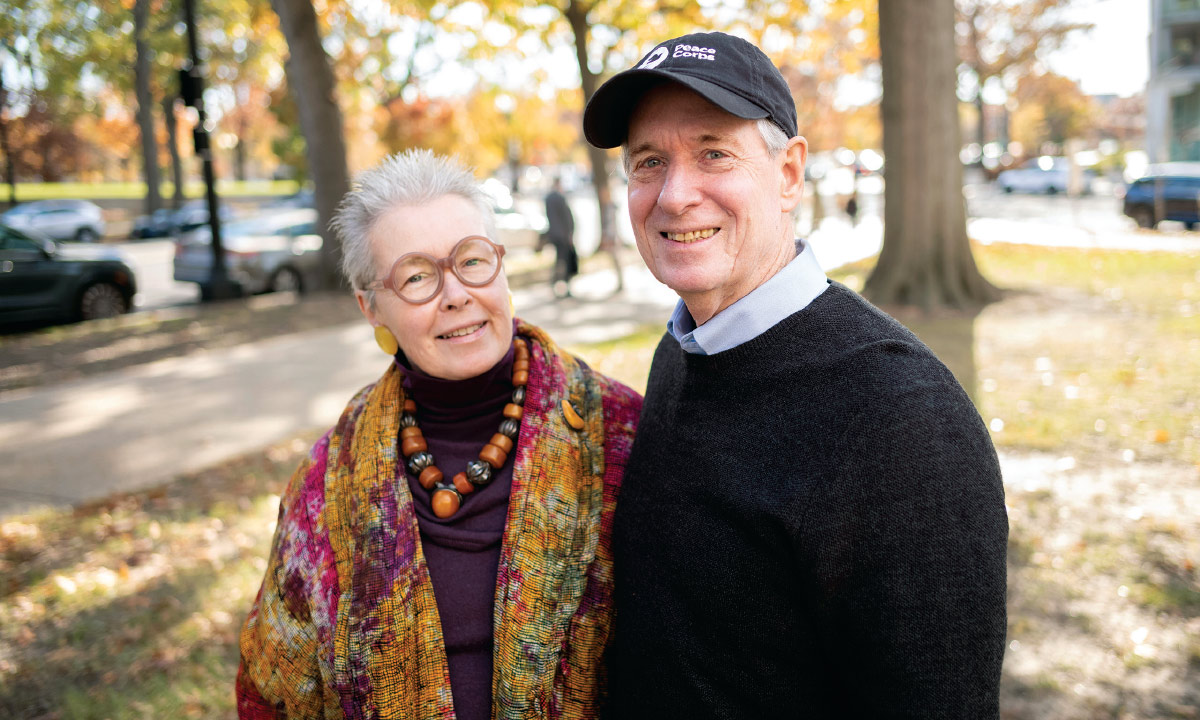
n Memorial Day 2001, Kevin Quigley ’74 and his wife Susan Flaherty were sitting on the Capitol steps enjoying a concert. Looking out over the National Mall, Flaherty thought, “We have a lot of stuff about war on this mall. We need something about peace.” Quigley agreed. For this purpose, in December of 2001, Flaherty, an attorney, created the Peace Corps Foundation, for which the couple served as founding directors.
Along with many others, the couple has now been working for 25 years to build a “commemorative” on the National Mall to honor the values of peace, understanding, and service represented by the Peace Corps.
Though both Quigley and Flaherty had lived and worked in D.C. for decades, they had no idea how many steps were involved in trying to get anything built on the National Mall.
Fortunately, Quigley had help from fellow alum, Alex Shakow ’58. The two originally met in one of the many D.C.-area Swarthmore book clubs. Shakow knew that the National Peace Corps Association was looking for a new CEO and recommended Quigley for the job.
He got the job, and used the position, in part, to lobby Congress to support the idea of a commemorative.
“To get real estate anywhere in the heart of D.C., including on the National Mall, Congress has to determine that what is being commemorated is of ‘preeminent historical significance,’” says Quigley. “A commemorative bill has to pass Congress and be signed into law by the president.”
In 2009, the commemorative bill passed in the House but stalled in the Senate. In 2011, it passed in the Senate but not the House. In 2013, it finally passed in both. It was signed into law by Obama as the Peace Corps Commemorative Act of 2014.
But there were more hurdles to clear.
“You have to get real estate assigned by the National Capital Parks and Planning Commission,” says Quigley. “The design has to be approved by the Fine Arts Commission and needs to meet the planning requirements of the District of Columbia.”
Fortunately, they were able to enlist the help of architect Roger K. Lewis after Flaherty heard about him on NPR. “He’d been involved in every memorial that went up in D.C. over a 30-year-period,” she says. “And it came out in [the NPR interview] that he’d been in the Peace Corps.”
“Roger was a terrific champion for this project, guiding it through the National Capital Parks and Planning Commission and various other bodies that had to give their approval,” Flaherty continues.
Sadly, just after final approvals were issued, Lewis died in 2024, and will never see the commemorative completed.

“One of the reasons I went into the Peace Corps was because of what I studied at Swarthmore,” says Quigley. “And what I did as a Peace Corps volunteer shaped the arc of my career.”
Quigley developed an interest in Theravada Buddhism while at the College, under the tutelage of Religion Professor Emeritus Don Swearer.
“One of my ambitions as a Peace Corps volunteer was to spend time in a Buddhist monastery,” says Quigley, who requested a placement in Thailand for that reason, and served three years there in the late 1970s.
While Quigley spent most of his time in Thailand teaching, he did get to spend time in a monastery, and was ordained as a Buddhist monk.
Though he returned to the U.S., his passion for Thailand and the Peace Corps never abated. Quigley served as CEO of the National Peace Corps Association from 2003 to 2012, as Peace Corps Country Director for Thailand from 2012 to 2015, and did Fulbrights in Thailand in 2007, 2022, and 2025.
To the couple, recognizing the 250,000 people who have served in the Peace Corps and the values of peace, service, and understanding they represent, is worth the work.
“Peace Corps is distinctive as a program because its participants are immersed in the culture,” says Quigley. “Peace Corps volunteers and staff understand the importance of this way of engaging the world: on their terms, not ours.”
“The initial ambition was really bold, a commemorative about how the Peace Corps seeks to engage the world based on respect and a museum to capture volunteers’ stories,” says Quigley. “For me, a lot of it ties to Swarthmore, and the Quaker values around peace and understanding.”