

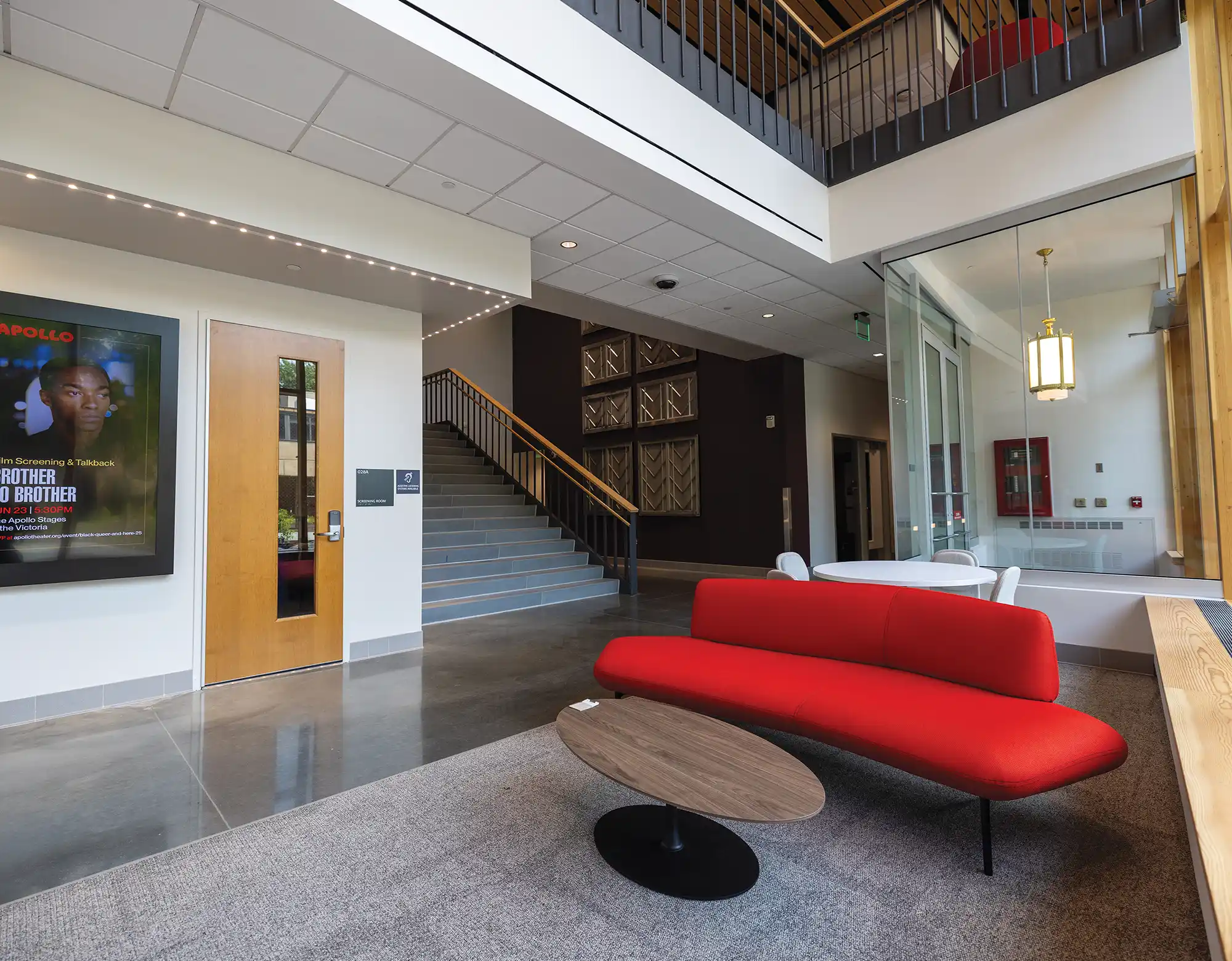
A bright and spacious seating area is one highlight in the updated Martin Hall study space.
Martin Hall Reimagined

artin Hall is back, and it’s nothing like you remember. After more than two years of construction, the building has been reborn as a bright and airy hub designed to spark connections between technology and the humanities.
The renovated building — now home to Computer Science, Film & Media Studies, and the Creative Media Commons — opened to students on Sept. 2 to start the fall semester.
“When we walked in, we gasped,” says Associate Professor of Film & Media Studies and Department Chair Bob Rehak, who helped guide Martin Hall’s renovation as a member of the Project Working Group. “The openness, the sunlight that washes through the building, the way it’s all come together — and it smells like a new car.”
It’s a sharp break from the building’s past. For decades, Martin Hall was home to the Martin Biological Laboratory. Built in the 1930s, it housed a greenhouse and an animal research laboratory. The building’s carved limestone art deco façade was a familiar and imposing presence on campus for decades.
Airy, modern, and eco-conscious, the space features salvaged wood, textures and patterns that echo the natural world, and metal panels that tip their hat to the art deco chevrons. Beneath it all, an underground system of wells heats and cools the building, part of the College’s To Zero By Thirty-Five energy plan that will help Swarthmore reach carbon neutrality by 2035.
“The building has been so carefully thought through,” says Rehak. “It’s a really interesting combination of the old and the modern. It has a strong identity. We’re very, very happy to be there.”
The academic infrastructure is equally ambitious: five state-of-the-art computer science classrooms, a film production studio complete with a green screen, editing stations, and informal “living rooms” for collaboration. A highlight is the 44-seat screening room — a gift from John P. Chen ’76, P’19 and Emily Tang Chen P’19, in honor of John’s parents and their love of film.
“I am honored to support the Martin Hall renovation, as it represents the best of Swarthmore,” says Chen. “This beautiful building celebrates our architectural heritage while affirming the enduring value of the liberal arts, bringing Computer Science and Film & Media Studies together under one roof.”
For the Computer Science Department, the transformation comes as a relief. Enrollment has surged in recent years, and its three teaching labs were spread across campus, leaving students and faculty scrambling for space.
“Often, we had so many classes scheduled that there was no place for students to go and work,” says Associate Professor of Computer Science Kevin Webb. “This is one problem Martin Hall’s now solved.”

Brandon Hodnett

Laurence Kesterson


A highlight of the reimagined Martin Hall is the 44-seat screening room — a gift from John P. Chen ’76, P’19 (bottom right) and Emily Tang Chen P’19, in honor of John’s parents and their love of film. The renovated building — now home to Computer Science, Film & Media Studies, and the Media Center — opened to students Sept. 2 to start the fall semester.
The Film & Media Studies Department, too, faced growing pains: cramped offices, scarce editing stations, and limited spaces for analyzing, screening, and creating media.
“We couldn’t really grow until we were in a new building,” says Rehak. “Now we have enough space, and everything has been made modern — and in some cases, more than modern. We’re still learning how to use some of our new equipment.”
Beyond all the new gear and the expanded square footage, though, Martin Hall promises new conversations. With the impact of AI on media, the two departments increasingly overlap. It is more important than ever, says Rehak, for computer scientists and media scholars to understand, and to learn from, one another.
“Bringing Film & Media Studies and Computer Science together creates many opportunities for collaboration,” says Provost and Dean of the Faculty Rich Wicentowski.
“This shared space will open up new ways for students and faculty to learn from each other, spark creativity, and explore how we can use the intersection of art and technology to tell stories and solve problems with innovative approaches.”

The collaborations will also be cultural. A series of film screenings, which will be open to the public, launched on the topic of computers in cinema.
The initial reaction to the transformed Martin has also been overwhelmingly positive from students in both Computer Science and Film & Media Studies.
“Having access to this new space is so exciting! The hall itself is really bright and open, but has lots of little private areas for studying, which I am a big fan of,” says Kathryn Young ’28, a Film & Media Studies major from Middletown, Del. “Most of all, I am excited to utilize all of the new spaces, particularly the green screen and screening rooms. I am certain that the accessibility of Martin Hall will attract more students to Film & Media Studies.”
Students have wasted no time in making Martin Hall their own.
“They’ve scattered themselves organically throughout the building,” says Webb. “And it already feels like a natural gathering place.”
That, says Rehak, may be the building’s greatest triumph. “I think we’re all looking forward to getting to know each other better,” he says, “and to seeing how our students are going to interact, mingle, and spark new ideas by rubbing shoulders in Martin Hall.”

Preserving a Landmark


