

Bountiful Harvest

“Either of those two stances is fatal,” says Weinstein, Emeritus Alexander Griswold Cummins Professor of English Literature, whose book, Time’s Bounty (David R. Godine), was released in October.
“Everyone complains about getting old, but nobody wants a lot of organ recitals,” a list of complaints about one’s aging body, he says. “And a Hallmark card is even worse. That cheapens reality by bypassing it and pretending it’s not what it is. I thought the only worthwhile challenge was to go there and try and articulate what is interesting about it.”
The result is a profound, funny, and often poignant meditation on old age and death, in conversation with some of the world’s greatest literary figures. Weinstein, now 85, starts the book with the proposition that “old age could be a world less of depletion, than one of vital surprises.”
Instead of a time of fading into irrelevancy, he contends, getting older represents a new blossoming of experiences and wisdom — “not dead time, but life time.” And yet, most people are afraid to look at old age, given its proximity to death.
“It’s just the most frightening daily thing we live with,” he says. “I wanted to open up the imagination a little bit, to see what’s coming and reveal the beauty in it.”
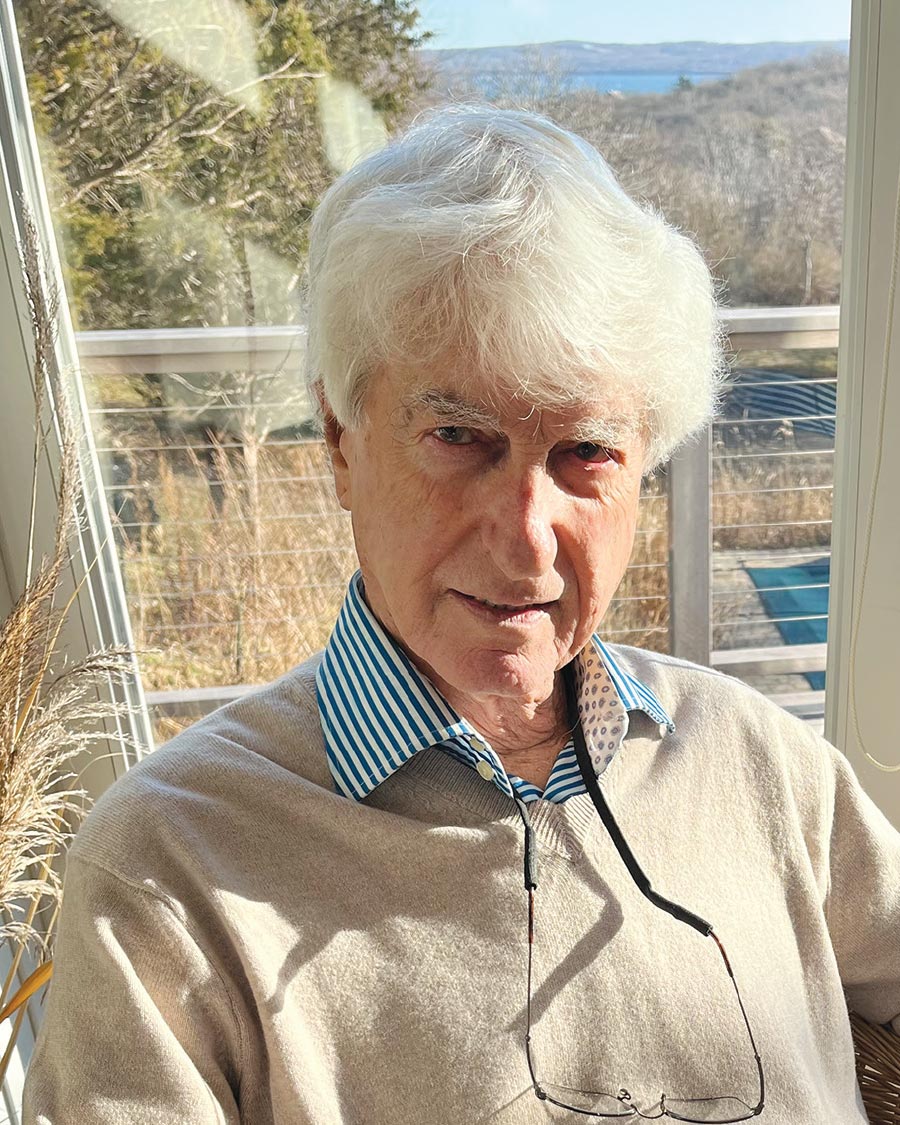
Weinstein discovered literature with the help of an 11th-grade English teacher, who jolted him out of his sleepy public school education in Memphis.
“He was electric — he made me realize that reading is living into other worlds,” Weinstein says. “I was bit by him, and it lasted my whole life.”
He discovered Faulkner in college at Princeton University and was immediately captivated by how he evoked the tragedy of the post–Civil War South.
“I have a tenderness toward tragic fiction,” Weinstein says. “You get inside a world that has used up its resources, and you see their plight, and there is so much heart in that.”
He also gravitated toward Faulkner as one of the few white writers of his generation to powerfully tackle issues of race.
After he joined Swarthmore’s faculty in 1971, Weinstein wrote eight books of literary criticism, half of them about Faulkner, making him one of the world’s foremost experts on the author. (His twin brother, Arnold, also an acclaimed Faulkner expert, became a professor at Brown University.)
During Weinstein’s career, he expanded his own understanding of race and identity, which was transformed in the 1980s when he met Toni Morrison at a conference where she read the first chapter of a book that would become Beloved.
“I was spellbound by how beautiful it was,” says Weinstein, who began teaching a signature course on Morrison and Faulkner, which developed into a book on the two authors. He hosted Morrison to speak at Swarthmore in 2014, his last year on campus and the College’s Sesquicentennial. “It was a high point of my career.”
As he approached retirement, however, it gnawed at him that many of his friends and family would never read his books of criticism and access the power of literature he’d come to know.
“I realized I would disappear in a number of years, and I wanted to talk about what’s in here and in here,” he says, pointing to his head and his heart.
The result was Soul-Error (2022, Humble Essayist), a compilation of essays that weave moments of his personal life with stories from literature. Time’s Bounty, picks up where that book left off. A slim volume of five chapters, it examines the paradox of aging, in which after a lifetime of achievement, you become invisible to other people, just at the time you begin to understand life the most.
Perhaps the most poignant moment of the book comes in the last chapter, “Free,” in which he unfolds the simple ritual he and his wife have, sharing moments together every morning in their home on Martha’s Vineyard, Mass.
“To me, that’s the sweetest chapter in the book,” he says. “I’ve never written quite as openly about my marriage.” While he realizes the privileges he has — not everyone has a home on the Vineyard and a loving partner — he hopes he can capture something about enjoying the preciousness of those simple moments in life as it enters its final chapter. “I’m not pretending it’s an answer for everyone. But it’s a blessing for us — and I think more than just us,” he says.
“Often in old age, people miss their work, they miss being important to other people. I was trying to open up this sanctuary, where we’re lucky to have each other every day, and yet this ritual was invisible to me before I wrote about it.” When he pitched Time’s Bounty to his publisher, Weinstein stressed that it was not a “how-to” book about aging. But by writing about his own experience with openness, honesty, and humor, he hopes other people can appreciate his world to better understand their own.
“There’s no ‘how-to’ about getting old,” he says. “But there is joy in it, and there is discovery, and there is adventure.”