


A Shared Mission to Develop the Craft of Teaching
t begins with a simple walk around the neighborhood. Each fall, school kids across Philadelphia venture out into their communities, looking critically at what they like and what they don’t.
“What are they proud of? What would they like to see change?” asks Janet Chance ’87, associate director of the nonprofit Need in Deed, which engages students through action-learning projects in their own neighborhoods.
Over the next few months, the students choose a topic of neighborhood concern, learning about the issue and ultimately developing a project to address it.
“It’s about making students agents of their own learning, beginning with gaining confidence in who they are as individuals and members of a community,” says Chance, who joined the organization eight years ago, seeing it as a natural outgrowth of the social justice-focused pedagogy she learned at Swarthmore.
Soon afterward, she reached out to Swarthmore to discuss ways the organization might collaborate, meeting with an enthusiastic response from Lisa Smulyan ’76, Henry C. and Charlotte Turner Professor Emerita of Educational Studies.
“I just thought what they did was amazing,” says Smulyan. “This was the best professional development opportunity I had ever seen for teachers.”
Smulyan joined the organization’s board, while Chance audited her course, Qualitative Methods for Educational Change, beginning a unique partnership between the two institutions. Over the past three years, Swarthmore has provided research and resources to strengthen the program, at the same time Need in Deed has served as a hands-on training ground for Swarthmore students to learn from some of the best urban teachers in the area.
Teaching can be an isolating profession, says Chance, who was a teacher for many years before transitioning into teacher education. In addition to connecting teachers and students with members of their community, Need in Deed also connects them with teachers across the city who share their community-centered philosophy.
“If we can provide cohorts or networks of teachers who can share ideas with each other,” she says, “they feel more engaged in the process of learning, to keep developing their own practice.”
Most teacher-development opportunities are one-offs, says Smulyan, where a teacher might join colleagues for a day to learn new skills, with little follow-up. By contrast, Need in Deed supports teachers’ learning with monthly meetings and regular classroom visits for at least a year — and many continue for three years or more.
“They get a learning opportunity that is continuous — that’s really unusual,” says Smulyan. “If you don’t provide an environment where teachers learn and grow, they can’t provide an environment where students learn and grow.”
Teresa Kelley Rugiero ’07 has been involved in the program for four years. In an assignment at Swarthmore to articulate her own reason for teaching, “I remember talking about wanting to encourage young people to critically see their world, and then work to change the world,” she says.
“Need in Deed is a really excellent framework for doing that. I have been teaching for 18 years now, and this feels really like what attracted me to teaching in the first place.” She now teaches in a bilingual fourth grade classroom in Kensington, a culturally diverse neighborhood along the Delaware River.
In Rugiero’s first year with the program, students were concerned with the impact that litter in their neighborhood had on animals, but worried that if they just picked up trash, it wouldn’t provide a long-term solution. After interviewing members of their community and reading articles on the topic, they created a project to turn trash from the neighborhood into an art project to draw attention to trash impact on marine life.
“They made an aquarium into a glass display case, painting trash to look like fish and sea turtles, along with signage on the issue,” says Rugiero. In another year, her class addressed homelessness and drug addiction, interviewing community activists and then leading a fund drive to raise money for local organizations addressing the issue.
“The final project the kids come around to is less important than the process of doing the thinking and having questions that lead to more questions,” she says.
As part of the Need in Deed and Swarthmore College collaboration, Smulyan and student Lucia Navarro ’24 conducted research, surveying and interviewing first- and second-year teachers with the program about how it affected their teaching. The research showed that participation in Need in Deed positively changed both their perceptions of themselves as teachers as well as their teaching practices.
“They realize that giving kids a little more voice and power within the classroom is risky, but incredibly valuable,” Smulyan says.
The findings also helped Need in Deed make changes to the program, updating language to focus more on issues around social justice and equity. In addition, Swarthmore has been able to bring Need in Deed teachers to campus in the summer for their annual training, and to place Swarthmore students in classrooms with Need in Deed teachers.
Laurence Kesterson
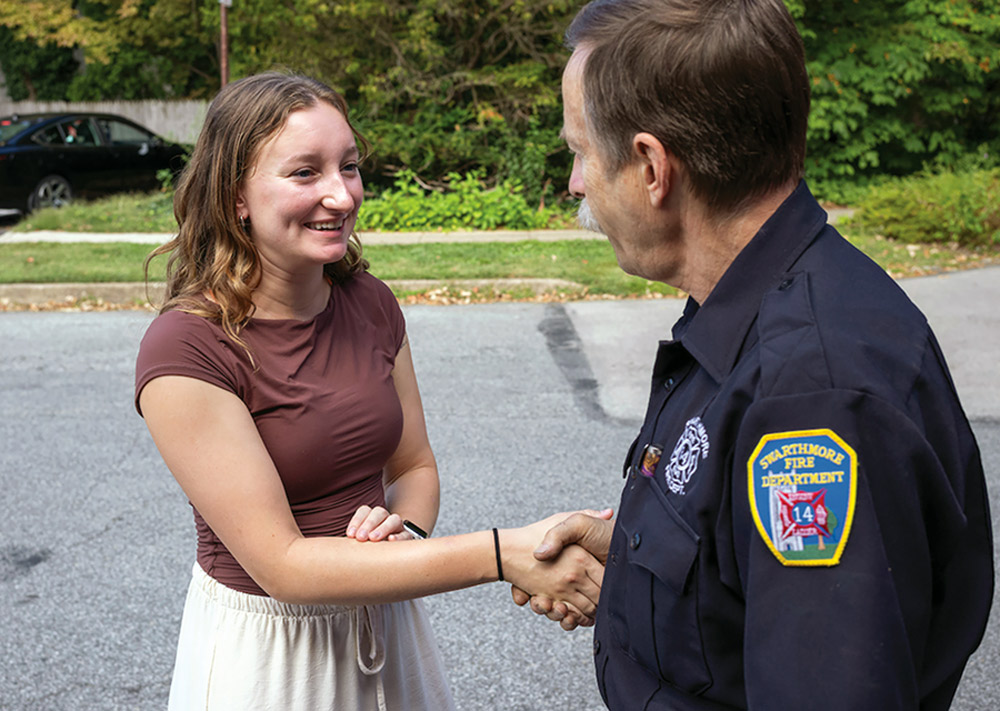
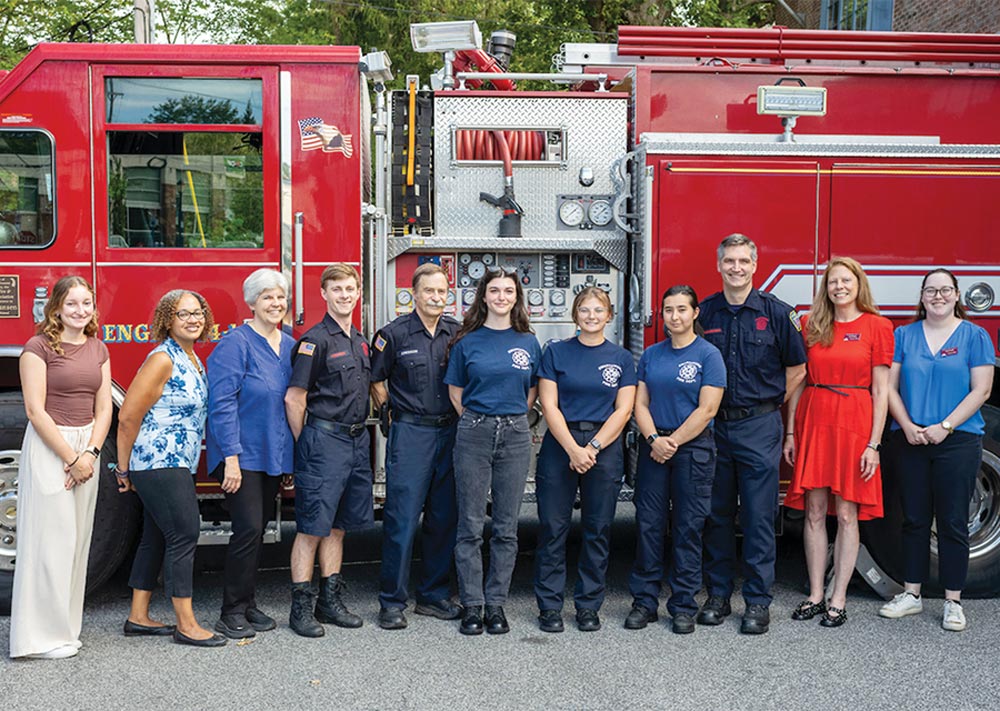
Forging Partnerships. Swarthmore College students, Hope Partnership Middle School students, and Need in Deed collaborated to mark the September 11 National Day of Service and Remembrance. The initiative honored first responders and provided care for those experiencing homelessness. Janet Chance ’87 worked with Lisa Smulyan ’76 to coordinate the event. That included partnering on campus with Cassandra Conklin ’26 (bottom), who invited community members to create handmade gratitude cards. Then on September 11, Conklin, Chance, and Need in Deed Executive Director Kyra Atterbury delivered the cards along with potted plants and lasagna to the Swarthmore Fire & Protective Association.
“The students in Need in Deed were able to learn something new, and connect with someone closer to their own age,” says Newkirk, who has since worked with the Americorps GO Foundation and is considering a career in education law. “It also exposes students to different areas of focus and career paths that might not be typically highlighted in schools.”
The Swarthmore students were powerful speakers, says Chance. One student, for example, talked about their own experience with housing insecurity, presenting it in terms of intergenerational trauma. Another, Cassandra Conklin ’26, was able to speak about her work on environmental issues, connecting it to environmental racism.
Last year, Swarthmore and Need in Deed received a grant to create a day of remembrance around 9/11 with fifth- and sixth-grade students from Hope Partnership Middle School. Conklin helped Swarthmore students write cards of gratitude delivered to local firefighters and EMTs with the Swarthmore Fire & Protective Association. The middle school students also wrote gratitude cards and assembled care packages for a local shelter, while also hearing presentations from Swarthmore students Sylridge Wah ’27, a biochemistry major from Sioux Falls, S.D., and Claire O’Brien ’18, who work as first responders.
“The theme was around sustaining hope, health, and wellness in our communities,” says Chance, “showing we really need to be there for each other, looking out for each other.”
In many ways, that’s what the partnership between Need in Deed and Swarthmore has achieved, connecting teachers and students in both communities across lines of race, class, and geography, to forge meaningful connections.
The groundwork that’s been laid will fortify the partnership.
“I reached out to Swarthmore to form a partnership because I had the sense that many Swarthmore students demonstrate a deep commitment to social justice,” Chance says. “We have a shared understanding that it’s important to prepare teachers to be reflective professionals, who develop and deepen their craft over time.”