

The
1875:
150 Years of International Students at Swarthmore

Michael Ugwe ’25 tells this story about himself with a smile. The sweltering heat for which he was unprepared prefigured deeper questions about the international student experience that he went on to explore through a collaborative storytelling project — one to which he hopes many international Swarthmore alumni will contribute.
When Kathryn Melvin came to Swarthmore in 2022 to take on the role of international student coordinator (she is now the College’s student and scholar immigration specialist) she was curious about the history of international students at Swarthmore. Melvin wondered whether their stories might serve as a bridge to strengthen connections between past, present, and future students.
She submitted a project proposal to the Inclusive Excellence Fellows Initiative (IEFI) to fund student fellows who could begin to unearth this history.
Through his work as an IEFI fellow, Ugwe learned that the first international student, Frank Bernardo Harrah, arrived from Brazil in 1875. This discovery inspired the name for the project, The 1875, as well as the idea for a sesquicentennial commemoration during the 2025–26 academic year.
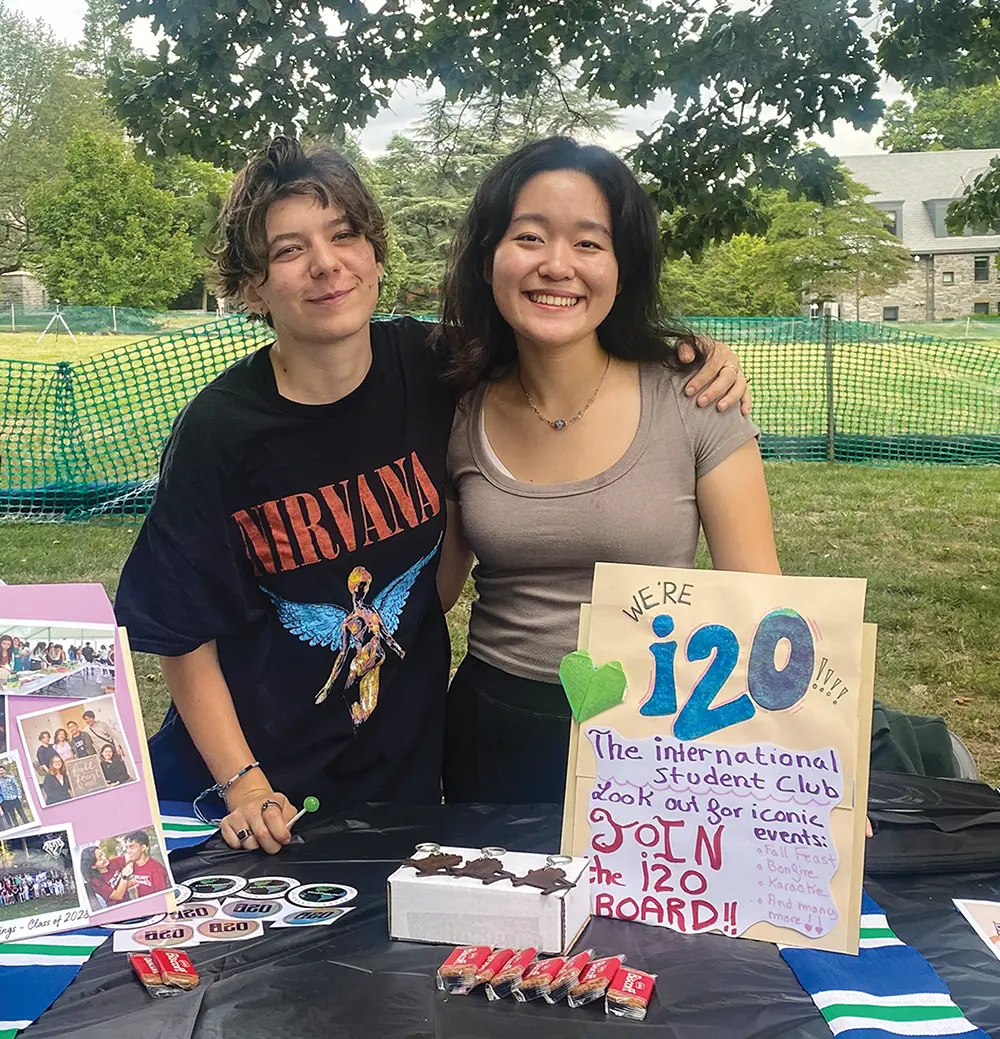
Highlights of this yearlong celebration included a campuswide Fall Feast, showcasing flavors from around the globe, as well as a special exhibit at McCabe Library that International Student Center (ISC) intern and International Student Club co-president Andrea Cheah ’27 co-curated with the ISC team and her fellow interns. Cheah, who is from Singapore, found the experience of sifting through the archives to meet these students from the past both humbling and inspiring. Artifacts like old yearbooks, campus photos, and event flyers connected her with the rich heritage of international student life.
“We have these traditions — like cultural evenings and faculty dinners — that we take for granted,” Cheah says. “But seeing how novel they were for previous students made me realize we can’t assume these opportunities will always be there. We have a responsibility to maintain this community, with its intercultural reciprocity, understanding, and respect, for future generations of students.”
A cultural showcase in February served as the culmination of the yearlong celebration. Melvin encourages alumni to check the ISC’s website for photos of these events and, eventually, a virtual reality “museum” experience of the “Celebrating 150 Years of International Students at Swarthmore” exhibit.
Melvin, Ugwe, and Cheah are passionate about honoring and preserving the legacy of past, present, and future international students through the storytelling project Ugwe created as part of his fellowship.
The framework for a living archive of stories on The 1875 site, Ugwe says, “Depends on narrative building, on a sense of understanding that goes beyond self-seeing.” It’s easy to look in the mirror, but forging the kinds of connections that are vital for all students, from around the world and across generations, depends on being able to reflect on other people’s experiences and build a larger global perspective.

From fond memories to navigating challenging or even painful circumstances — all of these shared experiences build community and help students feel seen in other people’s stories and know that they’re not alone, Melvin says. While she says her own cultural adjustment — coming to the U.S. from London as an adult — was relatively easy, she still found it difficult. Many students, like Ugwe, step off a plane onto U.S. soil for the first time, on their own, having committed to four years at Swarthmore.
“I think they’re incredibly bold and adventurous,” Melvin says.
The stories of international students also bear witness to the bonds of friendship.
“If you really want to know the experience of being an international student, stay at school during winter break,” Ugwe says. “You realize how alone you are. But then you find ways to make community.”
In bridging the gap between isolation and finding common ground with those who are very different, he says, “There is so much beauty.”
History has much to teach us, Ugwe says, about our assumptions, historical recurrence, and powerful interconnectivities. “Between Nations, Between Worlds,” for example, is a piece he researched and wrote for The 1875 about Yoko Matsuoka ’39.
Matsuoka’s time at Swarthmore, which was transformative for her, coincided with a wave of anti-Japanese sentiment that spread across American campuses. Her story is not only inspirational, but also connects international students across cultures and generations who experience “the exhilaration of learning in a foreign land, the trials of adjusting to unfamiliar cultures, and the complexities of returning home to a changed world.”
International alumni are excited to hear about The 1875 storytelling project, Melvin says, and its success is entirely up to them. Recognizing that alumni are just as busy or busier than they were as students, Melvin and her team are eager to provide support to make it as simple as possible for alumni to participate. From sharing an anecdote or idea to a mini-interview, an audio recording, or submitting a fully formed piece — in English or another language — Melvin says it is all welcome.
“I can’t emphasize enough how much current students love learning about others who were in their shoes. Where did you work? What was your major? What was it like for you here? It’s really valuable for them to know that they’re part of a huge legacy and aren’t starting from scratch, because someone has walked this path before them.”
“adapt and Thrive”
“It’s wonderful to see them arrive on campus,” says Marks-Gold, assistant dean and director of international student programs. “Students can be nervous or overwhelmed, but I get to watch them adapt and thrive. Many make friendships those first few days that last their whole time here at Swarthmore and beyond.”
Marks-Gold, who has spent more than 17 years guiding students through the thresholds of Swarthmore life, will retire from Swarthmore this year. As the College’s Principal Designated School Official, she was responsible for ensuring that students can legally study, work, and remain in the U.S. The role demands fluency in a dense and shifting landscape of federal regulations, but it’s as human as it is technical.
“Throughout the day, students pop into my office,” she says. “Some stop by simply because they don’t know how to sew a button back onto a shirt for a job interview, and they don’t know who else to ask. But the ISC isn’t just a place for crisis — it’s a place for celebration,” she adds. “I love those moments when a student drops by to share a piece of joy or a milestone they’ve reached. It reminds me that we’ve built a special community.”
The International Student Center (ISC), which Marks-Gold led, reflects that same breadth of care. Located in the Hormel-Nguyen Intercultural Center, the office serves a wide-ranging population: non-immigrant students, dual citizens, permanent residents, undocumented students, and Americans who have grown up abroad. From pre-orientation programming to weekly dinners, immigration workshops to alumni advising, the ISC is both a resource hub and a community anchor.
Orientation, which begins days before the rest of campus arrives, sets the tone. Students learn how to navigate academic expectations, employment rules, and daily life in the U.S. — how to open a bank account, read Fahrenheit, or order at Wawa. But just as important, they begin to build a sense of belonging. That early scaffolding extends throughout the year. The ISC offers ongoing advising, peer support networks, and social programming, while maintaining an open-door policy that encourages students to seek help, whether for paperwork or for something harder to name.
“Being a mother, I have an innate sense when someone might need to talk,” Marks-Gold says. “We collaborate with our Swarthmore community to make sure students get any support that they need.” Among the challenges of the role — navigating “ever-shifting regulations and the anxieties that come with them,” affecting travel, employment, and long-term plans, says Marks-Gold. She met those moments with vigilance and candor.
“Being proactive is important in keeping our students safe and legal in the U.S.,” she says. “We try to make immigration workshops and emails interesting and informative.” The role includes a demand for both precision and perspective: reviewing immigration updates, monitoring student records, and tracking policy changes that may affect undocumented students or those on visas. This includes issuing the Form I-20s that make study in the U.S. possible. Marks-Gold continued advising students long after graduation as they navigated post-completion work authorization. For the College, the impact of this work is both immediate and enduring. International students — hailing from more than 50 countries — enrich classrooms, challenge assumptions, and expand the horizons of their peers. The ISC ensures that they have the support necessary to thrive.
For Marks-Gold, the reward returns, again and again, to that first transformative week — and to what follows. “I want them to know that we recognize the weight of what they’re carrying,” she says, “and that they don’t have to carry it alone.”
A Richness of International Traditions
“The event had been dormant for a while, so it was wonderful to bring it back as part of the celebrations this year,” says Maggie Hussar, associate director of the IC. “We wanted to create the opportunity for students to showcase part of their cultural heritage and bring people together to celebrate our community.”
In addition to staff involvement, students also played a major role in preparing for the show. While the ISC and IC teams tackled the logistical aspects of the event, their student employees created promotional materials, flyered around campus, and promoted the event on social media. Kathryn Melvin, student & scholar immigration specialist at the ISC, notes that the three IC associates did “an amazing job emceeing the [showcase].”
“I was excited to see different students I see around campus perform intricate dances and music,” says Jean Michel Irankunda ’28, of Rwanda, who helped handle sound engineering in preparation for the showcase, adding his appreciation for the show’s “mix of cultural representation.”
The opportunity to celebrate international students at the College through cultural performance attracted many clubs and individual students. Among them was Rianne Maria Marquez ’29, of Guam, who is a member of Rhythm n’ Motion, a group that focuses on dance inspired by the African diaspora. For the showcase, they performed “African Opener,” a blend of traditional West African dance and Afrobeats.
“It was such a good opportunity,” says Marquez. “I like to perform, and it was a good way to show [African diasporic dance] to the audience.”
The showcase comprised a total of eight separate performances by individual students or organizations representing different cultures from four different continents, taking the audience on an intense journey around the world.
Opening with Swatinos’ Latin rock, the show guided the audience through a solo performance, an immersive poetry reading, and various forms of choreographed dance, ending resonantly with the swelling rumble of drums in the closing performance by Swarthmore’s Taiko Ensemble.
“To truly live in the moment” — A Watson FELLOW reflects
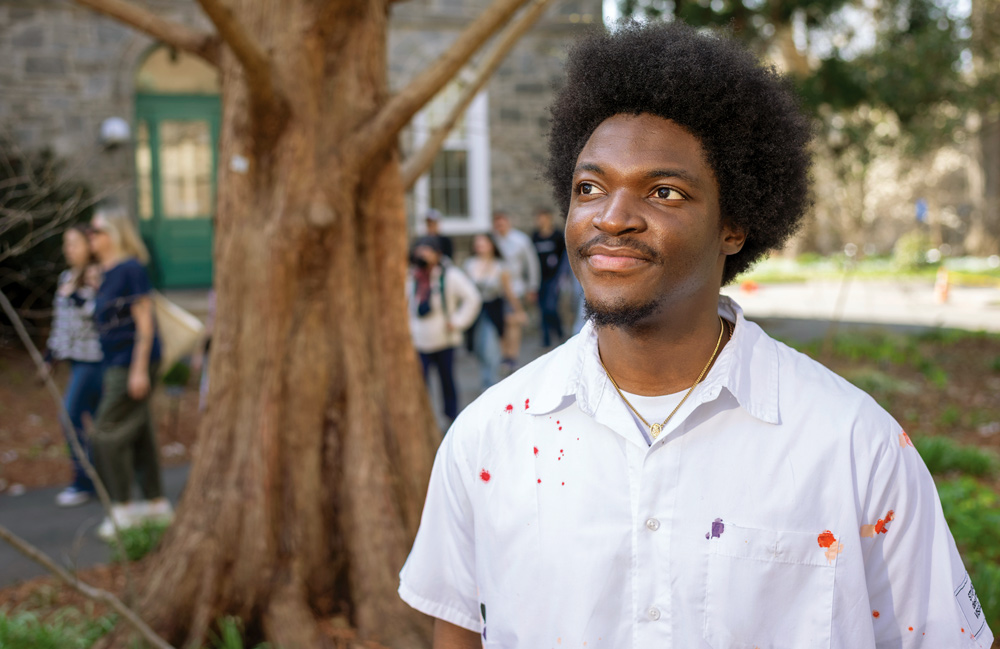
teven Mukum ’26 was named a 2026 Thomas J. Watson Fellow — the latest in a string of accolades he has earned while at Swarthmore.
Mukum will embark on a year of international exploration to investigate how internally displaced persons and climate refugees find visibility and agency in a world that too often overlooks them.
For Mukum, the fellowship is the culmination of years of research, community engagement, and deeply personal reflection on forced migration.
His project centers on a vital gap in international law: the millions of people displaced by conflict, climate change, and environmental hazards who fall outside the legal protections afforded to refugees. “Who speaks for those that the law does not recognize?” asks Mukum, an economics and international development major from Cameroon.
“My Watson year explores how internally displaced persons and climate refugees — largely unprotected under international law — find visibility and agency through local policies and organizations.”
Mukum joins the 58th class of Watson Fellows, a cohort that will collectively travel to more than 70 countries to pursue projects ranging from local theater to global cancer care, mountain communities to music technologies.
The Watson Fellowship — one of the most prestigious postgraduate awards in the country — provides graduating seniors the freedom to pursue an independent and fully funded project overseas. Mukum will travel to Benin, Mozambique, Martinique, France, and Australia — five countries offering distinct windows into how displacement is lived and navigated across vastly different political and geographic contexts.
When the Watson news arrived, he was working on his thesis in McCabe Library on a Friday afternoon during spring break.
“I saw the word ‘Congratulations’ and immediately broke down in tears,” he says. “Although I had put a lot of work into my application, I knew that the competition was immense, and that I could only hope.
“The first thing I did was call my mom,” he adds, “because I had been talking to her about this application since August of last year, and I wanted to share the news right away.”
Mukum’s Watson Fellowship project builds directly on work he has pursued throughout his time at Swarthmore. Through the Lang Center for Civic and Social Responsibility — which awarded him a Lang Opportunity Fellowship — Mukum developed the research and community-based foundation that now anchors his fellowship proposal. He has also been recognized through the Davis Projects for Peace program and received the John Lewis Leadership Fellowship and The Diana Award. Among his other achievements at Swarthmore was envisioning and organizing the African Is Rising symposium in 2024.
Reflecting on his time at the College, Mukum expressed gratitude for the community members who shaped him, including Carina Yervasi, associate professor of modern languages & literatures, French & Francophone studies; Kathryn Riley ’10, associate professor of chemistry; Emily Paddon Rhoads, associate professor of political science; Jen Magee, director of program development, implementation and assessment at the Lang Center; and Alexandra Gueydan-Turek, associate professor of modern languages & literatures.
“They have been more than professors — they have been guiding lights,” says Mukum, who also thanked the Lang Center for offering “a home for the kind of engaged scholarship I have come to value.”
During his Watson year, Mukum plans to speak with internally displaced persons, interview the people and the organizations that serve them, and pursue formal internship experiences related to migration. But he is equally committed to the personal dimension of the fellowship.
“My greatest challenge will also be my greatest assignment: to truly live in the moment,” he says. “I want to give myself permission to slow down, to be fully present, and to genuinely experience the places I will encounter.”
global citizens
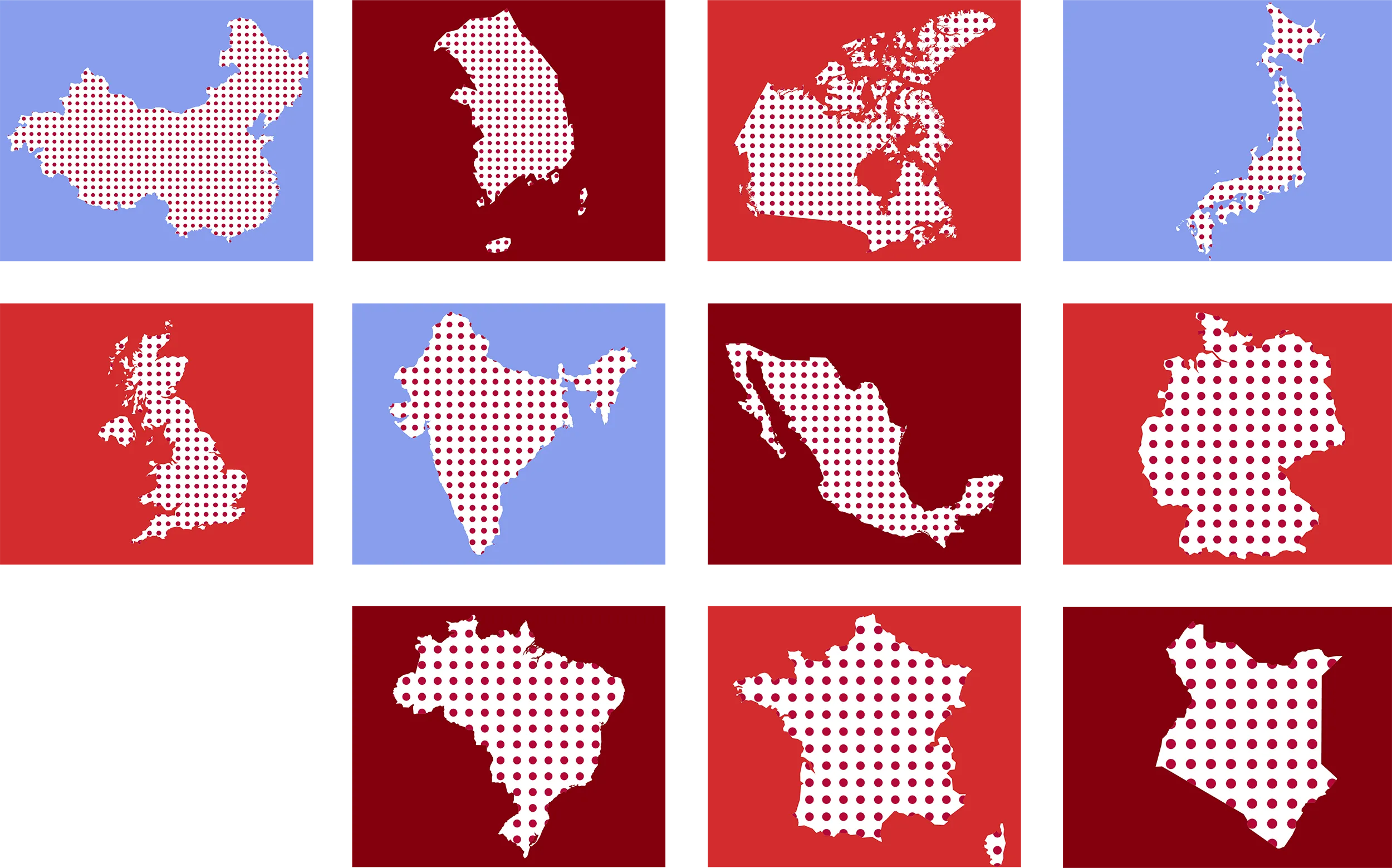
133 Countries represented
25 most represented countries

How Did Swarthmore Help to Shape You?
Petrina Dawson ’76: I will always be grateful
Soon after graduation, I also realized that I will be able to earn a living, eventually moving away from my Swarthmore major of physics and math into law. With gratitude, I built my life on the foundation of my Swarthmore experiences.
As for the fate part: I had to think of college within a year of coming to the U.S. I relied on high school friends in suburban N.J. and two library books to guide me through the college entrance process. When I visited the Swarthmore campus, I knew instantly that I belonged here! I considered myself fortunate to be accepted—my high school counselor was surprised and asked to see my acceptance letter. This made sense to me a few months later when the foreign student counselor set up an appointment with me. It was our one and only appointment, as, having lived in the U.S. for three years, the counselor thought that I could manage on my own.
I will never know whether I would have been accepted if I had been a U.S. citizen – I was in the right place at the right time – that’s all that matters, and I will always be grateful.

Tafadzwa Muguwe ’05: I wasn’t walking alone
The international students gave me a sense that I wasn’t walking alone (even as a Manchester United fan) and were my first community when I left home for the first time.
Anastasia Herasimovich ’06:
You remain a worthwhile person
Andrew Stobo Sniderman ’07:
The richness of the community kept us together
So many of us felt disoriented in similar ways as we adapted to living in the United States. That brought us together in the first place, and then the richness of the community kept us together.
The fact that my time also coincided with a major war (in Iraq) surely bonded us further, because we all had to grapple with a particular kind of discomfort.
We had chosen to come to this country, attracted by the promise of something great, and yet this very same country was sowing death and destruction in the most naked way.
Each of us had to figure out our relationship with this mix of bitter and sweet, and I suspect the common question brought us yet closer together.
Juan Victor Fajardo ’09:
A Swarthmore Story
Diego Garcia-Montufar ’10: a citizen of the world
The difference, perhaps, was that we assembled and affirmed our identity not only through friendships and discussions with fellow Latin Americans, but also with Latinos who had grown up in the U.S., who are just as integral to Latin American identity today. What was beautiful about Swarthmore was that this identity was not exclusionary, as illustrated by another international institution: the Swarthmore Mariachi band.
From a ragtag band founded after a night of somewhat disreputable enthusiasm in Willets and neighboring dorms, it became a fixture that included not only a troupe of Latin Americans (with a couple of Mexicans, for good measure), but also a German trumpeter, an accordionist from Kingston, Pa., a Chinese American violinist, another from Arizona, and a singer and front man from Canada.
In the end, we were not a group turned in on itself, but part of the larger Swarthmore community. Being an international student was as central to my undergraduate experience as my major in philosophy. At Swarthmore, I came to feel, if not quite a philosopher, at least a citizen of the world.
Maki Somosot ’12:
Swat held space for us
Two decades later, the friends I made during international orientation are still my ride-or-dies. Swat held space for us, challenged us, and pushed us to dream and achieve boldly—across journalism, advocacy, activism, diplomacy, engineering, and more.
Viktoriia Zakharova ’24:
My story truly mattered
My story truly mattered—more than just a distant headline or debate topic. I felt safe showing my culture without feeling like I don’t fit in. There was no invisible line between domestic and international students. We were all starting fresh, so not growing up in American culture wasn’t a disadvantage. If anything, I learned even more about myself and my origins while away.


Mya Chuluundorj ’26: excited to begin
At Swarthmore, I formed meaningful connections with professors, friends, EVS staff, and supervisors I worked with on campus. These people have shaped who I am today. They carry the spirit of Swarthmore and became my home away from home, supporting me and rooting for every step I take.
Swarthmore has given me a new way of thinking, one that dares to question systems, think critically about the world, and better understand the communities around me. I hope to carry this way of thinking with me as I step into the world.
Aashish Panta ’26:
A Sense of Belonging
Under the mentorship of faculty and staff who carry the same multicultural spirit, I have evolved into an aspiring scholar with a keen passion for rigorous policy research grounded in justice and inclusion in the developing world. I feel extremely grateful to Swarthmore for this transformative experience.
Nayla Punjabi ’26: especially supported
Your story is an essential part of Swarthmore’s international student history, and we would love to hear from you! bit.ly/SWATInternational