

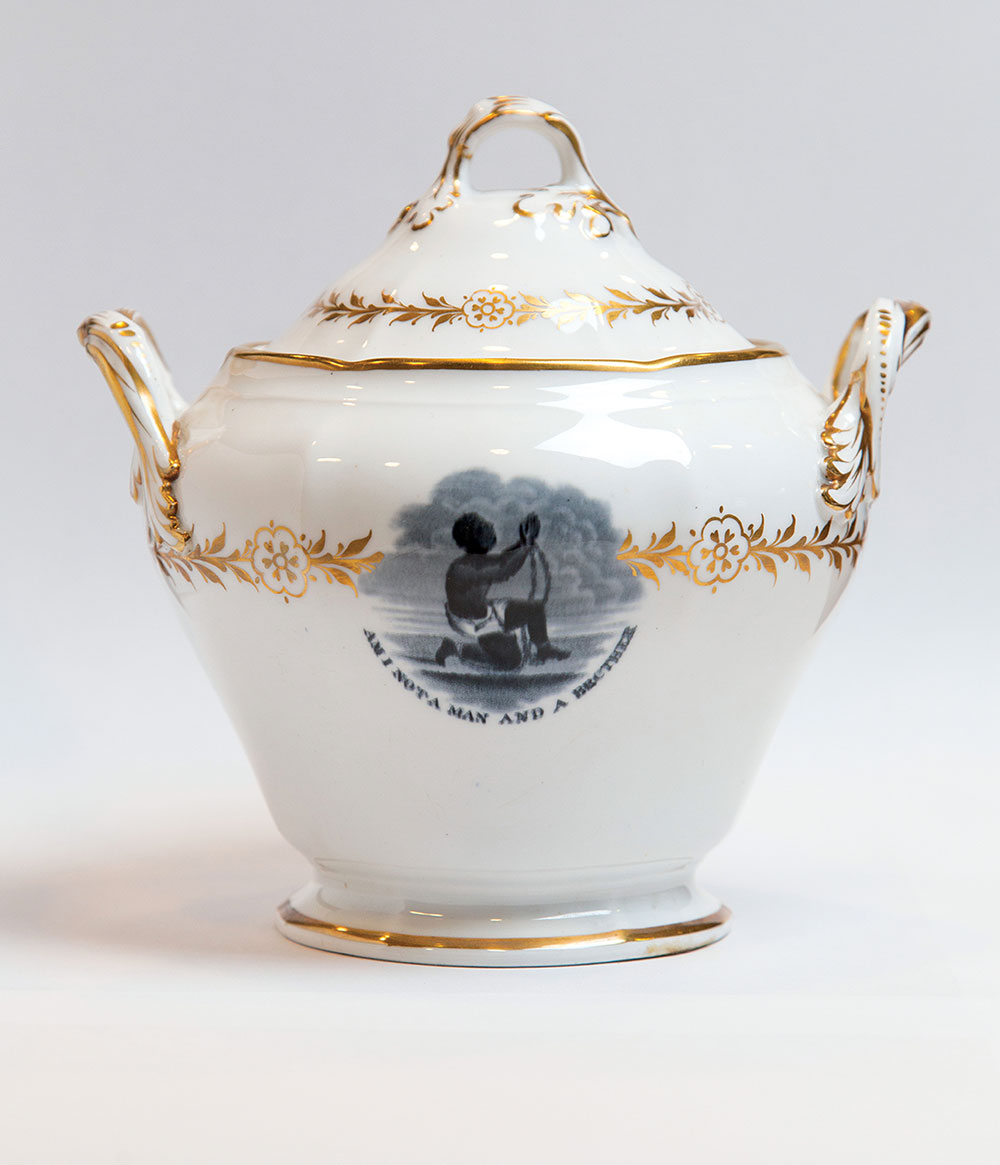
not only holding sugar
The Committee for the Abolition of Slavery, based in England, adopted English potter and entrepreneur Josiah Wedgwood’s design, which is featured on the body of this bowl. The phrase, “Am I not a man and a brother?” paired with an image of a Black person in chains became a central feature of many abolitionist objects after its coinage in 1787.
It was sent to a Philadelphia-based anti-slavery fair by Queen Victoria. It was then purchased by a Mrs. Thomas Jenkins. Anti-slavery fairs were very common in the U.S., being used by abolitionist communities as a way to disseminate political values and ideals.
“The abolitionist sugar bowl, a star object from the FHL’s collections, exemplifies the aspirations and contradictions of Quaker consumption practices: an object that takes a political stance on its contents, yet is also a luxury item made of gilt porcelain,” says Eberhard. The bowl reveals how abolitionist messaging became very entangled in domestic spheres as its purpose was to both hold sugar and signal to visitors in the home the politics of its owners.
This form of abolitionist work was exclusively associated with femininity, as most of the fairs were organized and put on by women. Looking closely at the sugar bowl, and the history embedded in it, reveals the values of anti-slavery work at this time.
While there is not much information available about both the actual making of the object and where the money that was raised from its selling went, it is evident how material culture can become explicitly infused with symbols and messaging as a way to further political agendas.
— NERIA SPENCE ’28