

Moving Through Meaning
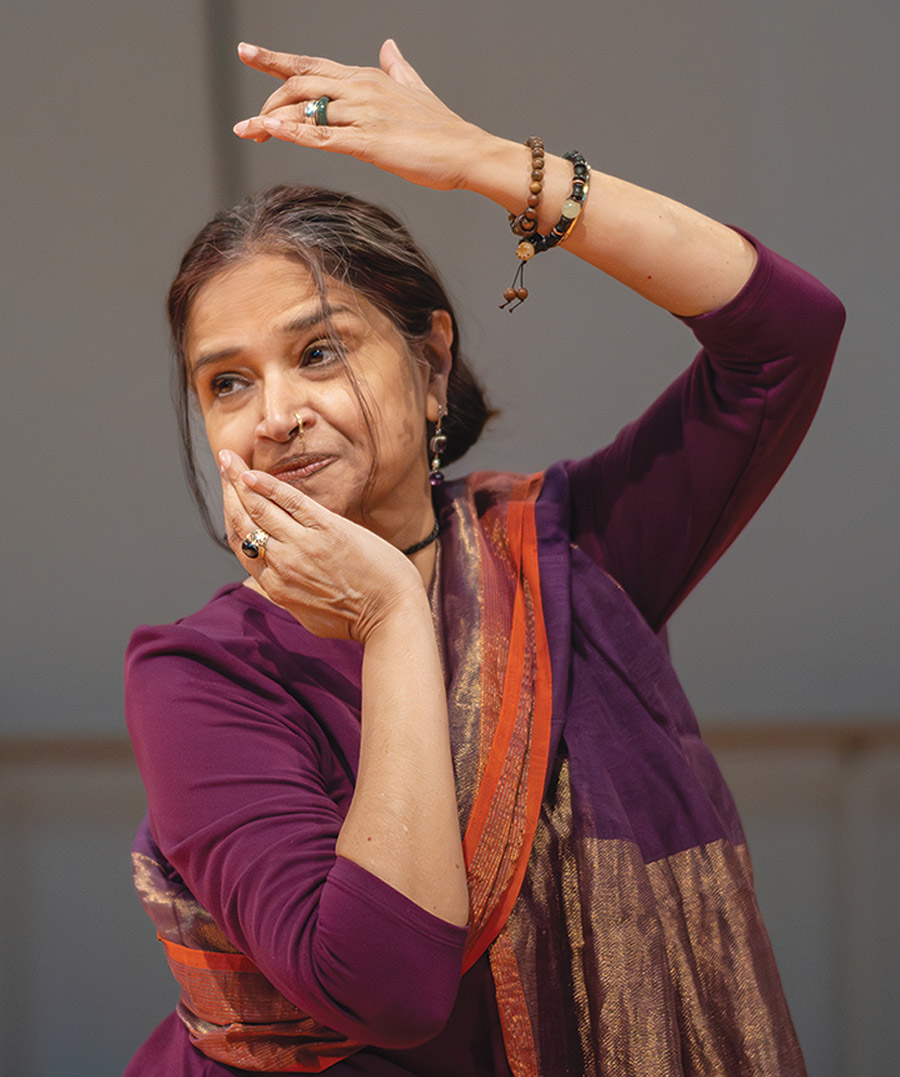
nthropologist, dancer, and choreographer Pallabi Chakravorty has spent her career tracing how movement carries culture — across borders, histories, and identities. A professor of dance at Swarthmore, Chakravorty fuses scholarship and performance, drawing on her training in Kathak, a classical dance form from northern India, and her work in visual anthropology. She also founded Courtyard Dancers, a Philadelphia-based nonprofit that builds community through South Asian dance traditions. Here, Chakravorty reflects on the intersections of dance and anthropology, the role of movement in shaping identity and belonging, and ongoing sources of inspiration.
How did your interests in dance and anthropology intersect?
Dance has always been part of my life. I grew up in Kolkata and trained in different styles before specializing in Kathak. As I learned, I became aware of histories, especially women’s histories, that had been erased. Anthropology gave me a way to study dance critically, connecting movement, culture, and history. At a time when non-Western dance was rarely studied in universities, anthropology — and later visual anthropology at Temple University, where I finished my dissertation — offered the ideal interdisciplinary framework, allowing me to explore ritual, performance, and ethnographic film as vital expressions of culture.
What inspired you to found Courtyard Dancers, and what drives that work?
I became increasingly interested in how dance could address broader questions of culture, politics, gender, and identity. I also saw that many younger members of the Indian diaspora were not always connected to these histories. I wanted to create work that could communicate those ideas through performance. Courtyard Dancers began informally with friends and collaborators and gradually grew into a community-centered organization. It became a space where people from different backgrounds — Indian, Pakistani, Bangladeshi, and beyond — could come together. It’s been about 25 years of building community, creating work, and using dance to share and interrogate cultural issues.
You’ve described dance as a way for young people to “occupy space.” What does that mean to you?
Dance is a deeply physical and sensory experience. When you enter a studio, you immediately become aware of your body in space — you are present, moving, listening, and responding. It’s very different from sitting in a classroom because all of your faculties are engaged at once. That kind of presence creates a powerful sense of self-awareness. Over time, I’ve seen how it fosters self-affirmation: a feeling that “I am here, and it is OK to be here.” Dance creates emotional connection and intimacy, even in very different environments, and that can be incredibly grounding for people, especially young learners.
How does dance shape identity and belonging, particularly for immigrant communities?
What is powerful about dance is that identity and belonging emerge through experience rather than through words. You’re not being told that you belong — you are feeling it through movement, music, and shared space. That creates a much deeper emotional connection. For many immigrant communities, especially in difficult or uncertain times, dance can offer both safety and joy. It becomes a space where people connect to something tangible while also building community. That process often happens almost unconsciously, but it can have a lasting impact on how young people see themselves and their place in the world.
What continues to excite you about teaching and working at Swarthmore?
Dance at Swarthmore has evolved significantly, and one of the most exciting developments is the growth of dance studies as an interdisciplinary field. Students are increasingly combining dance with other areas — anthropology, literature, even neuroscience — which opens up new ways of thinking about movement and culture. I’m also inspired by the international scope of the program. Both faculty and students are deeply engaged with global perspectives on dance. At the same time, we are still working toward greater resources and visibility for the field. Creating space for dance, both physically and intellectually, remains an important goal.