

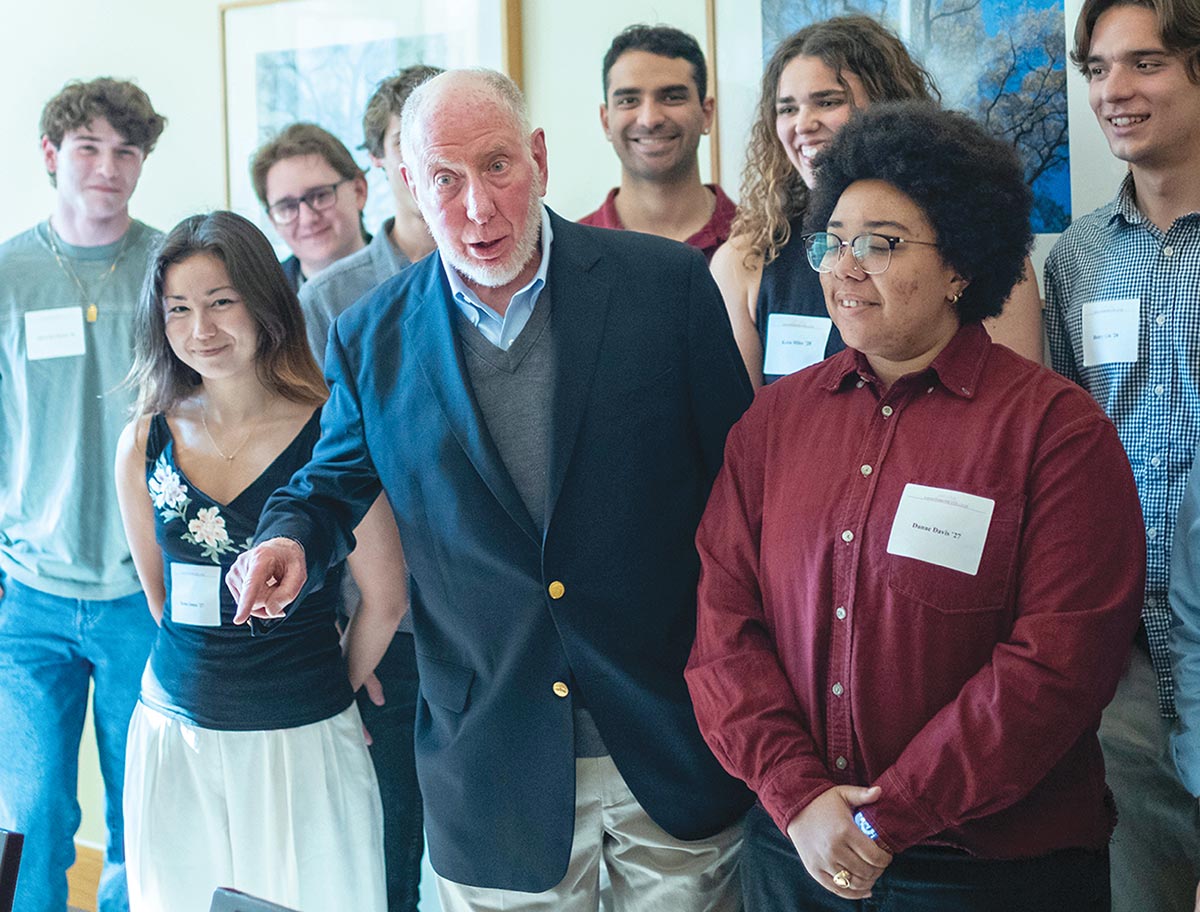
Democracy’s Scholar
The award, presented to Putnam by the American Philosophical Society, is in recognition of his “rigorous empirical research to identify and analyze central challenges facing democracy in the 21st century.” The Thomas Jefferson Medal is the Society’s highest award for the arts, humanities, and social sciences.
“To be put in the same class as Toni Morrison, I.M. Pei, Albert Hirschman, Daniel Patrick Moynihan, and George Kennan is not merely an honor, but a surprise almost as great as having been admitted to Swarthmore 67 years ago,” says Putnam.
The recognition is the most recent in a litany for Putnam, one of the most widely read, cited, and respected social scientists in the world. His research focused on social capital — the value derived from social networks that impacts the shape and health of a society and its institutions. He has earned 21 honorary degrees, as well as the Skytte Prize and National Humanities Medal. Putnam met with classes and spoke on campus the same week he was honored, presenting a talk titled “Long Run Changes in America: Society, Politics, Economics,
and Culture.”
The bulk of his career was spent at Harvard, where Putnam was the Peter and Isabel Malkin Professor of Public Policy. He’s written or co-authored 15 books, with his fifth book’s title encapsulating his primary interest: Making Democracy Work (1993). He is also the author of Bowling Alone (2000), and the more recent Our Kids (2015).