


A Story
of Welcome
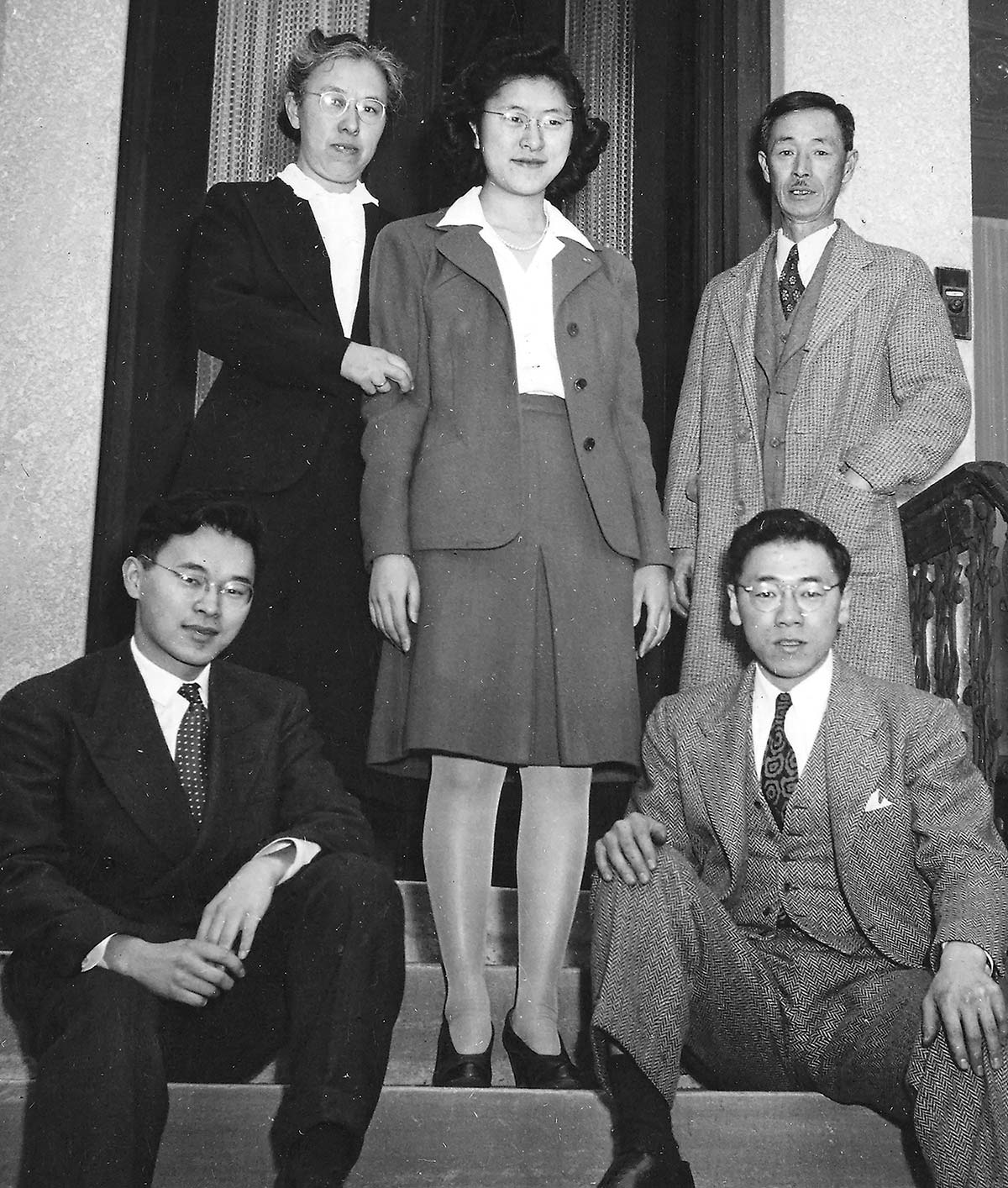
This Chestnut Street hostel has deep ties to Swarthmore, Quaker activism, World War II, and three generations of alumni.
A Story
of Welcome
This Chestnut Street hostel has deep ties to Swarthmore, Quaker activism, World War II, and three generations of alumni.
“People have no idea,” says Celia Caust-Ellenbogen ’09, a curator at the Friends Historical Library who initiated the College’s support for the effort to recognize the site with a state historical marker.
Today on the 3200 block of Chestnut Street stands a glass and concrete landscape. A massive building, housing a student center and a series of storefronts, dominates the block. It’s the type of place Penn and Drexel students go for a hamburger or a haircut. The new historical plaque soon will make clear there’s more to the story.
The Inouye Family
About 127,000 Japanese Americans lived in the continental U.S., almost all along the West Coast. Among them was Saburo Inouye and his wife, Michiyo.
Just two months after Japan bombed Pearl Harbor, President Franklin D. Roosevelt issued Executive Order 9066, which allowed the military to evict Japanese Americans living on the West Coast. By March, he’d created the War Relocation Authority (WRA), a new federal agency tasked with imprisoning people of Japanese descent.
Everyone was evicted: citizens and non-citizens, babies, children, teens, college kids, adults busy with jobs, and grandparents.
Saburo Inouye was born in Japan in 1888. Economic times were tough, and he was not the first-born son, so he struck out on his own. At age 18, he immigrated to California as a laborer. It was 1907, a time of high anti-Asian discrimination, but ironically also opportunity for a young Japanese man. The Chinese Exclusion Act had been passed and then extended indefinitely in 1904, which stopped new immigration from China, so many businesses were eager to hire Japanese laborers instead. Saburo was part of that first generation of immigrants, an Issei, born in Japan. He worked at whatever jobs he could, from railroad worker to farm laborer.
Twelve years later, Michiyo joined him in 1919 in an arranged marriage. She was also born in Japan, the daughter of a prominent physician in the Tokyo area. She initially resented leaving Japan, but obeyed her parents, and soon discovered that she had married a good man. Michiyo flung herself into her new country. She became Christian, declaring she would take “the religion of California.” Though Michiyo embraced her new country, the family was prospering, and all three children were Nisei, second-generation U.S.-born citizens, everything changed on December 7, 1941.
Just hours after the Pearl Harbor attacks, local police and federal agents began arresting Japanese Americans, calling them “enemy aliens” under the Alien Enemies Act of 1798. They raided homes, rounded up community leaders, and crashed events like wedding parties. The arrests and raids targeted Japanese American men.
Michiyo did everything she could to protect her family. She told her husband: “You are joining my church. It might help us stay together.” Her son George was a ham radio enthusiast. His mother broke his radio in hopes that he wouldn’t be accused of spying for Japan. William (Bill) was a budding photographer; U.S. officials confiscated his camera and a ceremonial sword.
The Inouyes were evicted from their home in May 1942 and sent to Tule Lake Relocation Center, located in California in a desolate, dry lake bed near the Oregon border. Tule Lake eventually became the largest of the 10 WRA internment camps. It was a 7,000-acre prison complete with barracks, barbed wire, and 28 guard towers patrolled by armed guards. The Inouye family was assigned one small room: 2414-C. Block 24, barracks 14, unit C. It was a 15-by-20-foot space in tar paper-covered barracks. A similar camp room can be seen today at the Smithsonian’s National Museum of American History, but Miyoko Inouye remarked that the re-creation was “much nicer than we had.”
Everything moved fast. By May 1942, 112,000 Japanese Americans had been forcibly incarcerated in camps around the West.
But Quaker hearts moved quickly, too.
“Within a few months, American Friends Service Committee and others jumped into action opposing incarceration,” says Caust-Ellenbogen. “They formed the National Japanese American Student Relocation Council.”
Finding College Homes
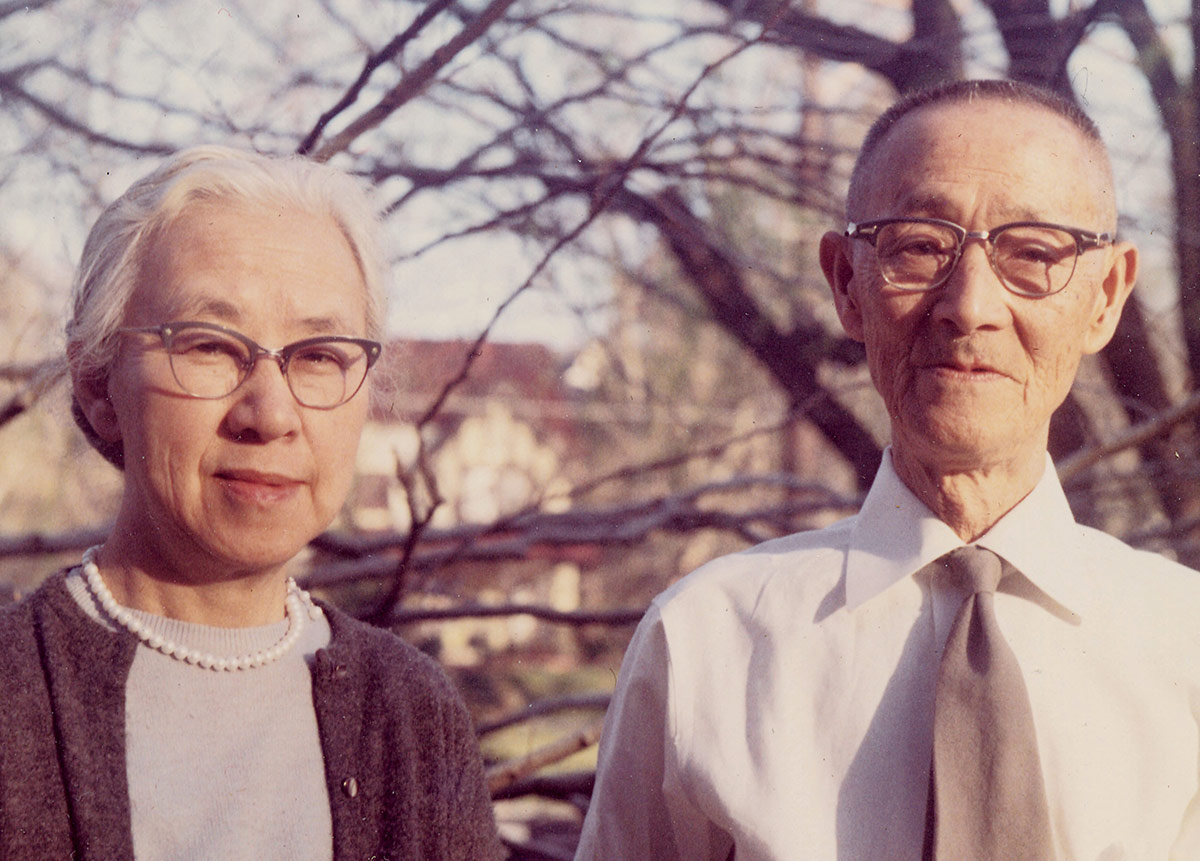
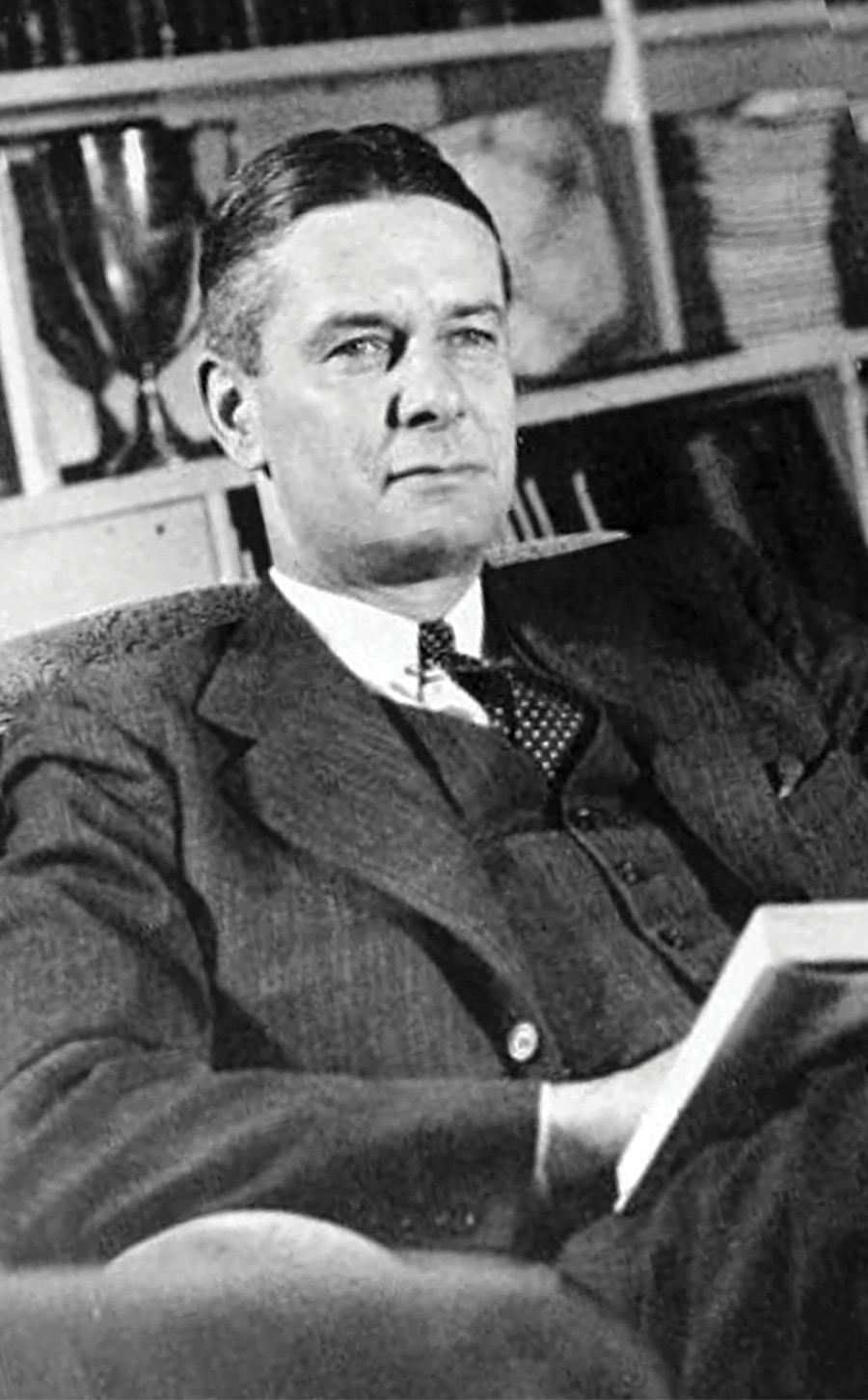
John Nason, Swarthmore’s president, was chosen to lead the effort.
Nason, a Quaker and philosophy professor, had studied divinity at Yale and philosophy at Harvard and succeeded Frank Aydelotte as College president in 1940. Aydelotte then led the Institute of Advanced Studies at Princeton and served as an NJASRC member.
Nason chaired the student relocation council from 1942 to 1949. Because of its efforts, close to 5,000 Japanese American students were able to leave the camps and attend Midwestern and Eastern academic institutions.
“It gives a flavor of where Swarthmore has stood in the past,” says Roger Inouye ’83, George’s son. “It reflects well on Swarthmore’s stance on social injustice, because not all colleges did that.”
In the first year, 112 colleges and universities worked with the NJASRC. It was an arduous process. Each student had to be personally cleared by the Navy, the Army, the FBI, and the War Relocation Authority, and then obtain a travel visa. Each school had to be approved, and sometimes that took some wrangling. The process involved writing upwards of 25 letters per student.
Swarthmore hosted at least 11 students from internment camps. The first arrived in September 1942.
George Inouye was among them. His older brother Bill arrived in January 1943, soon followed by Miyoko that September.
“For three siblings with practically no financial resources, to be enrolled at Swarthmore College was something that would not even have been considered a dream,” writes Bill in a typewritten account of the war years.
Bill and George lived in Wharton Hall. To supplement their scholarships, they washed dishes in the dining hall and worked at the College bookstore and post office. They also took jobs as busboys at The Ingleneuk restaurant in the Ville, and George repaired radios at the College radio station WSRN.
“It was frowned upon for Japanese Americans to be involved in broadcasting, so he did repair work,” Roger says. “He was a budding electronics nerd.”
They were expected to be model students. One of the council’s goals was to increase public acceptance of Japanese Americans, so they selected high-achieving students who could act as “ambassadors of goodwill.”
“One of my jobs out here is to set them [fellow students] right on some of the notions they have about us,” writes George. “When I tell them that (about) 75% are American citizens, they’re really surprised.”
The figures back him up. Approximately 80,000, or two-thirds of Japanese Americans imprisoned in the camps, were second-generation U.S. citizens.
While the brothers were at Swarthmore, the Inouye family was moved from Tule Lake to Jerome War Relocation Center in a remote part of Arkansas; it housed 8,000 people. Miyoko graduated from high school at Tule Lake, then moved with her parents to Jerome. When it was her chance to board a train to Swarthmore in the summer of 1943, Miyoko was unsure which restroom to use at the railroad stations because the bathrooms were segregated, says her nephew David Inouye ’71. So she avoided using the station restrooms at all during the journey from Arkansas to Swarthmore.
All three children wrote letters and penny postcards “home” from Swarthmore to Jerome Camp, where their parents were still incarcerated. They wrote about food in the dining hall (not enough rice), movies in Clothier, pep rallies before games with Haverford, and first holidays apart from their family (George described Thanksgiving with the Nasons). They also explored thoughts about the war and its tremendous impact. George also taught Sunday school with another Japanese American student, Ruth Dohi ’44. Their Sunday School class sent Christmas presents to children in relocation camps. “I sure hope our 10-year-olds don’t become cynical and hard because of the evacuation,” George writes to his parents. “There couldn’t be a worse tragedy.”
“Technically, they were still enrolled in the camp,” explains Brian Inouye ’91, Bill’s grandson. “My grandfather talked about going to Swarthmore as basically being on parole. They would get on the train and ride into Philly regularly because they had to report to their parole officer.”
“My father didn’t want to go back to Camp Jerome,” says Bill’s son, David. The Inouye children found housing and jobs nearby for the summer breaks, often living with Robert Enders, a Swarthmore biology professor, and his wife, Abbie. Bill worked for a time as a gardener for a Quaker family in Media, Pa., after graduation.
The Inouyes thrived at Swarthmore. Two became doctors, and one a high-level physics researcher. Miyoko roomed with Eleanor Ward ’47, who ended up marrying Bill just after graduation. Bill graduated Phi Beta Kappa with a double major in chemistry and math and made notable contributions as an inventor, clinician, and educator (an award at Penn Medicine is named for him). George majored in engineering, earned a Ph.D. in physics at Harvard, and worked in aerospace, including on projects involving the Voyager, Pioneer, and Jupiter missions. Miyoko became a pediatrician and married physician David Bassett. They became Quakers, worked abroad for the AFSC, and settled in Ann Arbor teaching medical students at the University of Michigan. Bill and Eleanor Inouye were also active Quakers.
“Ironically, it opened up doors for them,” says Roger. “In one of his letters, my dad stated that otherwise he would have been lucky to attend a community college.”
“A couple hundred years ago,” writes George to his parents in Tule Lake Camp in 1943, “only kings, and princes and other royalty, could get an education; now, even I have this privilege. It is up to us three to capitalize on your efforts and become worthy of you.”
Hostels
Adults who could find jobs and housing could be released from camps as long as they stayed away from their former homes on the West Coast. The War Relocation Authority set up a system of hostels beginning in 1943 to act as halfway houses to ease this transition. The first hostel was in Chicago. Soon other hostels sprang up in Midwestern and East Coast cities. Boston, Cincinnati, Cleveland, and Columbus all had hostels. So did Des Moines, Detroit, Kansas City, Milwaukee, Minneapolis, Pittsburgh, Rochester, and St. Louis. New York had several.
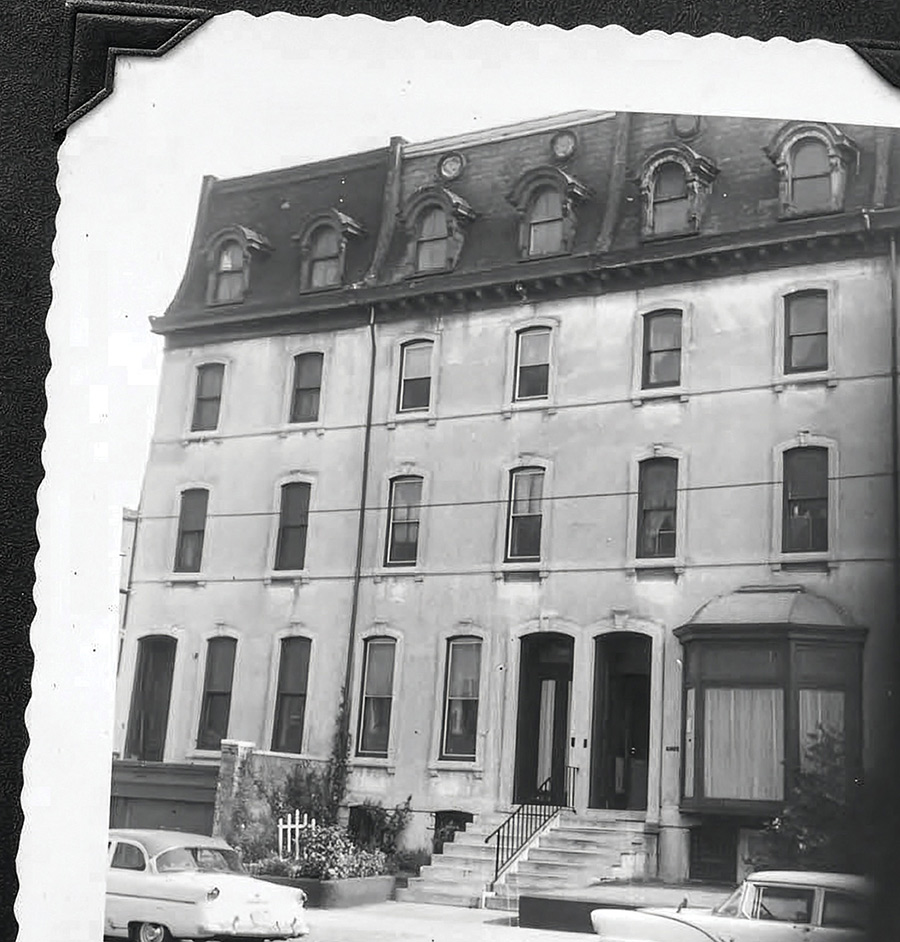
The Philadelphia hostel was established at 3228 Chestnut St., a multilevel row house in West Philadelphia a few blocks from 30th Street Station. “The hostel is near railroad stations and the local WRA Relocation office,” reads a pamphlet promoting the hostel. This was important. People arrived by train from the camps and hostel board members often met them at the station.
The Chestnut Street hostel was a four-story, 10 bedroom affair that formerly served as student housing for Drexel University and University of Pennsylvania. Like most of the hostels, it was designed to host 20-40 guests. The goal was to keep the hostels small to fit into residential neighborhoods and not attract unwanted attention.
Still, anti-Japanese sentiment was strong during wartime America. The hostel board tried several locations, but neighbors rejected a boarding house that served Japanese Americans. Finally, they settled on Chestnut St., a predominantly Black neighborhood at the time. “The project met with some opposition from neighbors who misunderstood the Japanese,” Michiyo wrote in reminisces in 1949. “Never losing hope, members of the Hostel Board made house-to-house calls, spreading goodwill and understanding.”
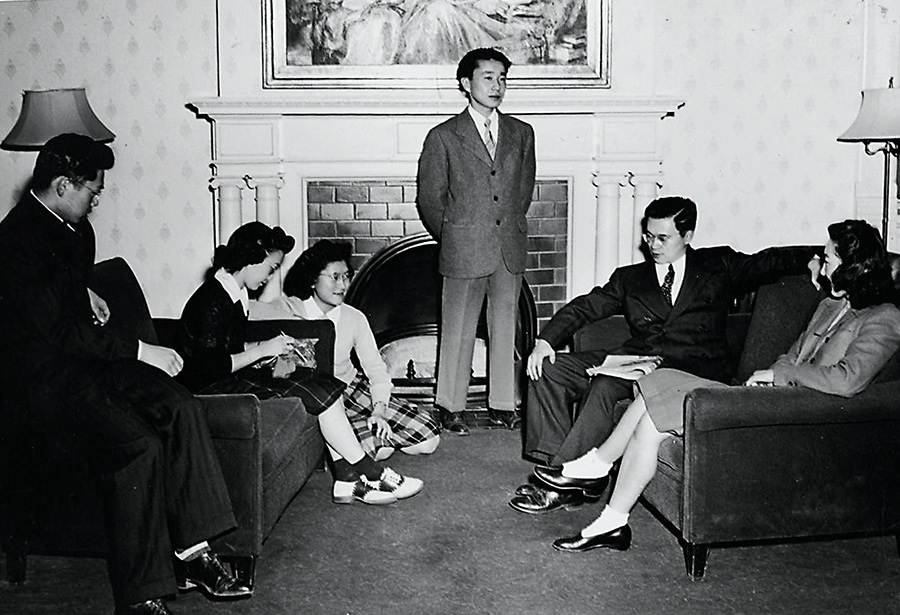
The hostel opened March 27, 1944. Quaker activist Katherine Arnett, with The Women’s International League for Peace and Freedom, was a key leader, together with the Philadelphia Federation of Churches and The Citizen’s Cooperating Committee for the War Relocation Authority. Everyone pitched in to fix up the building. They held painting parties, stocked the living room library with books and newspapers, and sewed drapes and sofa slip covers to make it homey.
With the doors open, students, engineers, and doctors arrived from the camps. There were chemists, dental students, watchmakers and X-ray technicians — all manner of people hoping to make a new start in Philadelphia. Guests paid $1 a day for food and lodging, children 50 cents, and guests who already had jobs were charged $1.50. Everyone pitched in to help with hostel chores.
“You wouldn’t wanta move out here would you? The whole family,” George writes in a letter to his parents dated Nov. 29, 1942. He explains how he met a man who might help them find employment.
A year and a half later, the Inouye parents left Jerome Camp and landed a job at the Cincinnati Friends Hostel in 1944. The post at the Philadelphia hostel was initially held by Victor Goertzel. When he left after only a few months, Saburo and Michiyo jumped at the chance to be near their three children and run the Philadelphia Hostel. Michiyo did the cooking (both Japanese and American-style meals), and was officially “House Mother.” Saburo took care of building maintenance as “House Manager.”
During its heyday in 1944-45, the hostel was bursting at the seams. Sometimes up to 51 people crammed in, and overflow guests lodged with board members. Many guests found initial work at Seabrook Farms in Cumberland County, N.J., which processed canned and frozen vegetables. Another popular job source was the American Chick Sexing School in Lansdale, Pa.
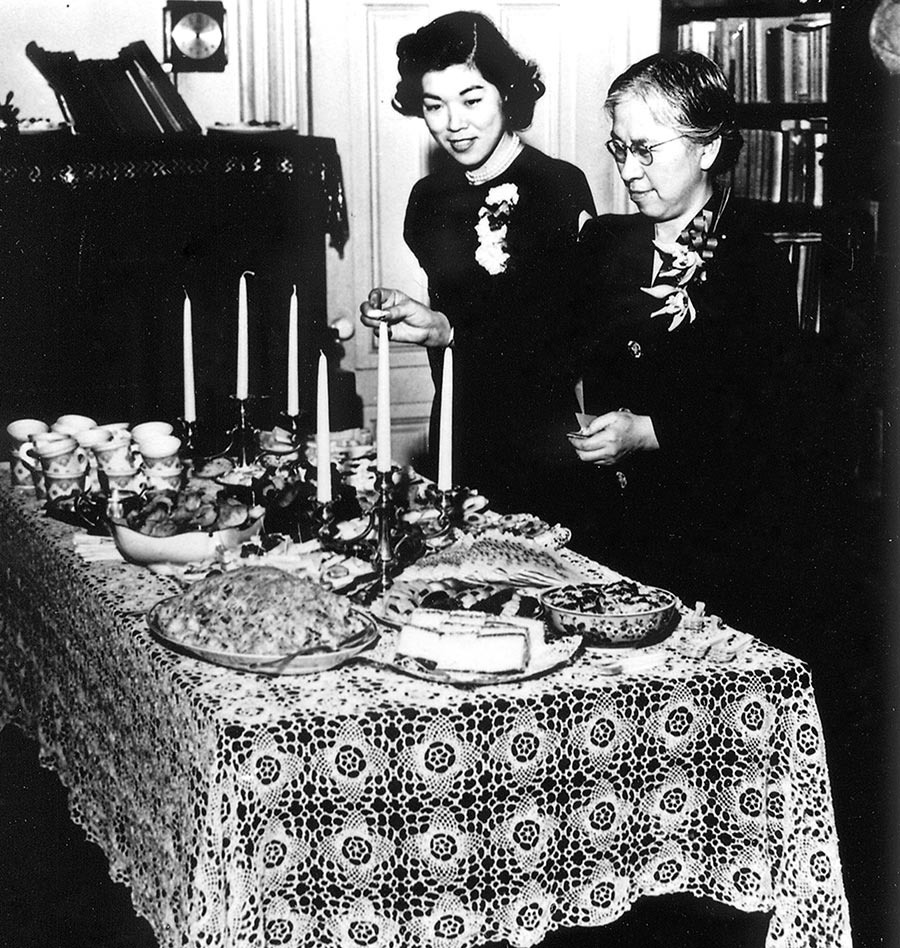
At the Philadelphia Hostel, the Inouyes hosted more than 1,140 Japanese Americans who had lost everything as a result of internment. By 1949, it was the only wartime hostel still operating. The Inouyes held a “Thank You Tea,” and invited John Nason and his wife, Bertha, Class of 1926.
“The war caught us unawares and we suffered much,” writes Michiyo in her remarks for the tea. “But through our experience we have discovered much kindness in many people which we would never have known otherwise.”
“It is in this spirit of love that we wish to carry on the Hostel in the future,” writes Michiyo in 1949. “‘And now abideth faith, hope, love, and these three; but the greatest of these is love.’ (Corinthians 13:13).”
Post-War Years
The Spruce Street location still stands, but the hostel building on Chestnut Street was demolished in the 1960s along with many other blocks in West Philadelphia as part of urban renewal. It remained a grassy plot for about 50 years until the present eight-story commercial building went up in 2013.
John Nason never forgot the Inouye family. In a letter to Michiyo in 1949, he writes: “I look back on my work with the National Japanese American Student Relocation Council with deep satisfaction. I can still grow angry when I think of the unnecessary hardship… and am glad that I could play a small role in correcting some of the evil.” He later says in a June 1994 oral history interview: “I look upon the work I did with the NJASRC as the single most satisfying piece of work I’ve done in my career.”
When World War II ended in 1945, the U.S. government allowed Japanese Americans to return to the West coast and set up hostels there. But most families had nothing to go back to. Their homes and livelihoods were gone. Their communities were gone. There were flare-ups of violence, too, with arson, vandalism, and terrorist threats targeting returning residents.
“Everything had been stripped away,” says Associate Professor of Music and Coordinator of Asian and Asian American Studies Lei Ouyang. “Anti-Asian racism was so rampant at the time that many Japanese Americans fled the West Coast.”
The government’s goal of breaking up Japanese American communities drastically changed the landscape. The Philadelphia population of Japanese Americans grew from 50 in 1940 to 7,000 by 1946, due to resettlement. Japanese immigration to the U.S. closed in 1924 and would not open again until 1952.
Hidden History
“I was really quite unaware of what my father and his two siblings went through until he passed away,” says George’s son, Roger. After his father’s death in 1983, Roger’s Aunt Miyoko handed him a bundle of letters and postcards that George had written to his family at Tule Lake and Jerome Camp. Roger has donated some of these letters to the Special Collections in McCabe Library.
“Go into McCabe and turn left. You’ll be here in Special Collections,” says Caust-Ellenbogen. “We have lots more history and stories about resistance to Japanese incarceration and the American Friends Service Committee.”
“I would love it if Swarthmore students would use them as primary resources,” Roger says.
“Asian American history is so absent from U.S. education,” says Ouyang. Raised in Minnesota, she is the daughter of a Chinese immigrant mother. When she was in high school, her mother gave her a VHS tape of the 1990 historical drama Come See the Paradise, a story of Japanese internment. Her mother said: “‘Watch this movie. This is what Americans did. You need to know this part of American history.’ That was my introduction to this time period,” she says.
Although Roger and others are quick to point out that Japanese Americans shouldn’t be solely defined by internment history, that history does linger. Bill’s life and death at age 65 is a stark example.
“My grandfather died in the 1980s indirectly because of racism related to the internment and World War II,” says Brian.
When Bill graduated from Swarthmore in 1944, he wanted to become a doctor. He applied to graduate school in chemistry at Northwestern University and was accepted. But a week later, Bill received a letter retracting his admissions offer based on his “Japanese-American ancestry.” He was forced to change plans and took a job as a research chemist at the Owens-Corning lab. His job involved working with asbestos, which he did for five years before entering Penn Medical School. He died from mesothelioma, a cancer caused by asbestos exposure.
university of california, berkeley
“I’m always surprised when I meet people who are not aware of what happened,” says Brian, the third generation of Inouyes to attend Swarthmore. “I see parallels to today. My grandfather didn’t have freedom of movement … the government denied that based on racial identity.”
Honoring a Place of Welcome
The University City Historical Society led the effort to erect a plaque, along with students and Asian American faculty from the University of Pennsylvania. Swarthmore sent a letter of support signed by faculty and staff.
“This is huge,” says Ouyang. “I was absolutely floored to read that announcement that it passed. In our current political climate, this is exactly the kind of thing that is under attack.” Most of the 10 WRA internment camps are currently designated national historical monuments, sites or landmarks. This could change. “There have been threats about removing markers across the West,” says Ouyang. “Japanese American incarceration history is absolutely being erased.”
Roger Inouye agrees. As an infectious disease physician focused on vaccine research, his work is in the vortex of current politics. He’s dismayed by directives to edit and downplay difficult parts of history. “It’s a missed opportunity to make humanity better,” he says.
For the Inouye family, internment and resettlement was a mix of trauma and opportunity. The trauma hit first-generation Japanese Americans like Saburo and Michiyo the hardest, erasing years of hard-earned financial security, “blasted away,” as George put it. Yet Bill, George, and Miyoko were given the chance at a Swarthmore education, which led to illustrious careers in physics and medicine.
Their family’s story and the Philadelphia Hostel’s legacy lives on.
David Inouye, Bill’s son, still has the dinner bells from the Philadelphia Hostel in his cabin in Crested Butte, Colo. They hang in a stack of four bells, descending in size. He also keeps some of his grandfather’s tools nearby, including a hammer and pipe wrench. From his grandmother Michiyo, he has chopsticks, a kitchen cleaver, and recipes.
Above all, the hostel served as a place of welcome and refuge. As Michiyo writes in notes for the “Thank You Tea,” the hostel opened its doors to “innocent victims of the war and total strangers to the city, to find new life and hope.”
“Nowadays West Philadelphia is seen as a center of activism,” says Caust-Ellenbogen. “That tradition of seeking justice stretches back. It’s a story of welcome.”