

Across Borders and Disciplines
Weeks later, Vasquez was inside another institution charged with turning policy into practice — the U.S. Tax Court in Washington, D.C.
The two stops made for an interdisciplinary summer for the environmental studies and peace & conflict studies major, linking climate justice, international policy, federal law, and public service, and sharpening her interest in environmental law.
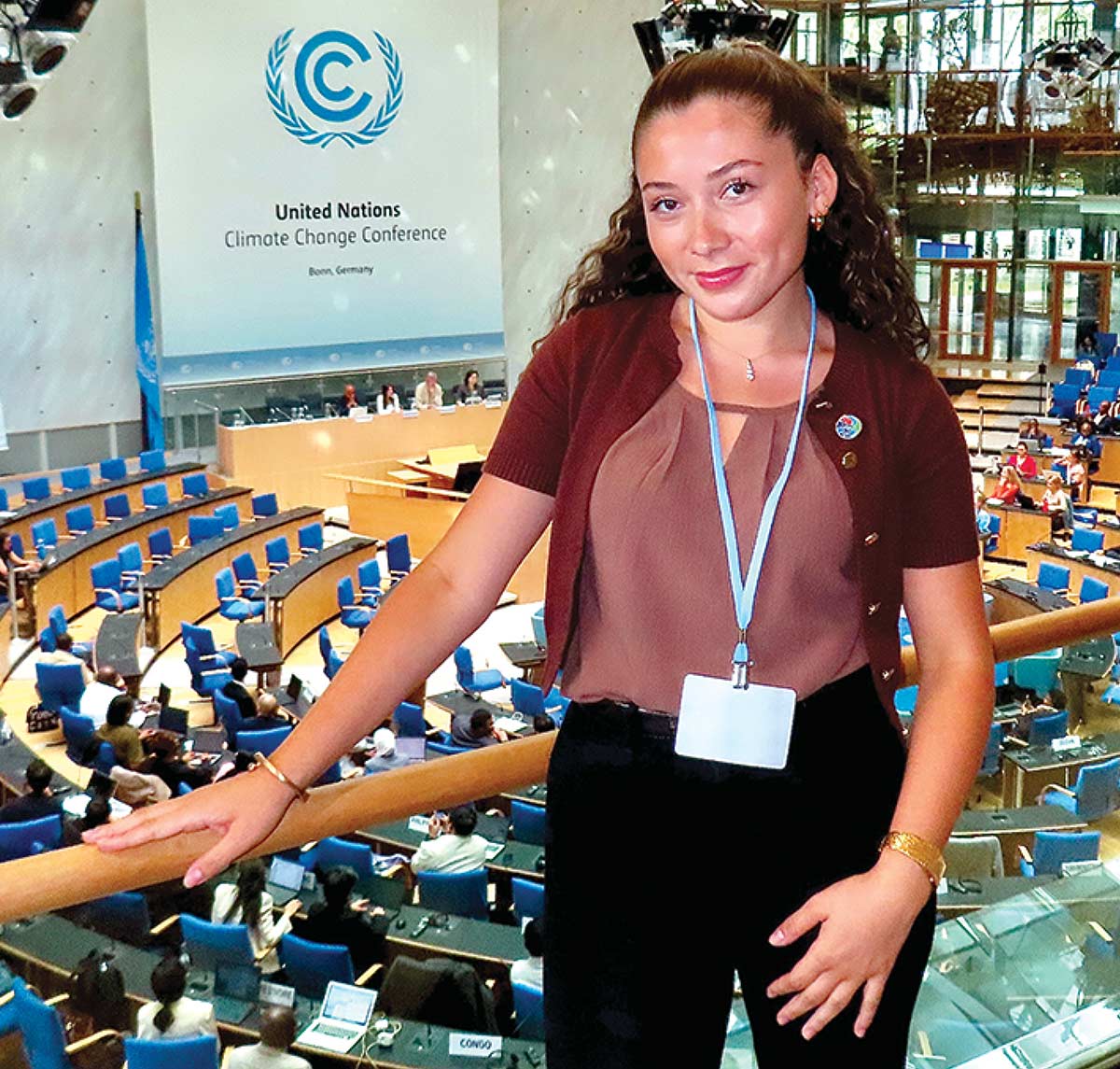
That relationship grew into a summer internship, and when Balance Eco traveled to the U.N. climate meetings in Bonn for SB64, the Environmental Studies Program funded Vasquez’s attendance.
“What made Bonn particularly meaningful was that I was no longer experiencing negotiations only as an observer,” Vasquez says.
Through Balance Eco, she helped support meetings with government representatives and climate organizations from countries including Chile, Somalia, Nigeria, and Colombia. Hearing officials speak candidly about obstacles to climate finance and implementation brought her academic interests — climate justice, extractivism, and the gap between promises and implementation — into focus.
Her summer then shifted from international negotiations to the federal judiciary. Through Swarthmore’s Richard Rubin Scholar Mentoring Program, Vasquez connected with Chief Judge Maurice B. Foley ’82 and worked with Foley and Judge Landy at the U.S. Tax Court.
The experience carried a striking Swarthmore connection. Foley, who was mentored by Professor Richard Rubin, gave Vasquez a copy of the November 1995 Swarthmore Bulletin containing “A Near Miss,” an article about Foley and the mentorship that shaped him.
“Reading about how important that mentorship was to him while realizing that he had now become such an important mentor to me felt incredibly full-circle,” Vasquez says.
Moving between Bonn and Washington helped Vasquez see two institutional worlds she may someday bridge herself.
“I am interested in pursuing law, particularly environmental law and policy,” she says. “Being able to move between the international climate negotiations in Bonn and a federal court in Washington in the same summer allowed me to see two very different sides of the kinds of institutions I hope to work within someday.”