



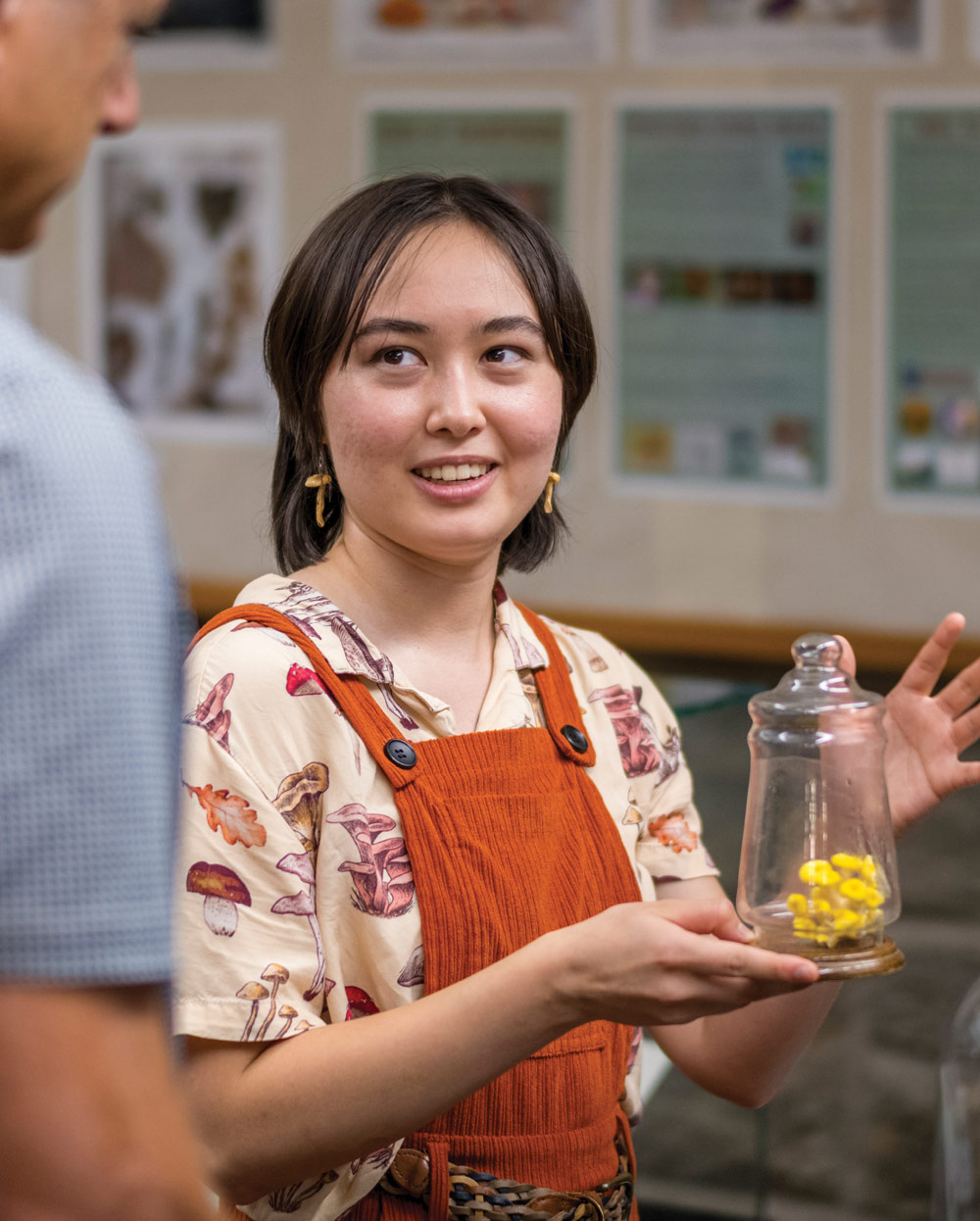

Josie Low ’27 holds a glass jar of bright yellow mushrooms. She wears mushroom earrings, a collared shirt with a mushroom print, and burnt orange overalls.
laurence kesterson
leaf icon

Fungi fest!

Josie Low ’27 teamed up with Maria Aghazarian, the Libraries’ head of scholarly communications, for a fungi festival that welcomed students, faculty, alumni, neighbors, seasoned mushroom hunters, and intrigued newbies. The fall festival connected biology and conservation to food, art, literature and history. “We have many kinds of mycorrhizal fungi in this region that partner with trees to exchange nutrients,” says Low. Story p. 24
laurence kesterson
table of contents / Fall 2026
Features
A packed-to-the-gills festival welcomed seasoned mushroom hunters and intrigued newbies to explore the wild and wonderful role of fungi.
By Tomas Weber
Evening stillness settles across the campus.
Photos by Laurence Kesterson
For 25 years, attorney Michael Barasch ’77 has fought to get victims of toxic exposure from 9/11 the compensation they deserve.
By Michael Blanding
He felt most at home in Swarthmore’s art studio, so he made a career as a ceramics artist.
By Emily Halnon
Understanding international trade and the global economy.
By Tomas Weber
The story behind the College’s date with history as the birthplace of “Born to Run.”
By Dave Scheiber ’76
dialogue

A tribute to retired Associate Vice President for Alumni Relations, Publications, and Public Relations Maralyn Rose Orbison Gillespie ’49, who died July 17.
mind & Muse
A test of endurance, and some fun, too.
New releases by Swarthmoreans.
Common good
Working for the World Food Programme means you think about food incessantly — what people eat, when they eat, how they eat.
Her role as a model has survived decades. Now 96, she recently visited Old Tarble, which houses the Hicks fresco that bears her image.
The question of enslaved people’s money soon led scholar Justene Hill Edwards ’04 to a larger one.
On campus
Pathfinders
From McCabe to the Mayor’s Office.
Philip Decker ’18 receives the Porter Ogden Jacobus Fellowship.
Decoding Dress.
Harold (Koof) Kalkstein ’78 reflects on his Swarthmore legacy.
on the cover:
A view of Eldridge Commons and Science Center at twilight by Laurence Kesterson.

Masthead

Swarthmore logo
Bulletin / Fall 2026

Vice President for Communications and Marketing
Andy Hirsch

Director of Content Strategy
Mark Anskis

Editor
Kate Campbell

Managing Editor
Ryan Dougherty

Editorial Specialist
Nia King

Class Notes Editor
Heidi Hormel

Designer
Phillip Stern ’84

Photographer
Laurence Kesterson

Administrative Coordinator
Lauren McAloon

Editor Emerita
Maralyn Orbison Gillespie ’49

swarthmore.edu/bulletin
Email: bulletin@swarthmore.edu
Telephone: 610-328-8533
We welcome letters on articles covered in the magazine. We reserve the right to edit letters for length, clarity, and style. Views expressed in this magazine do not necessarily reflect the opinions of the editors or the official views or policies of the College. Read the full letters policy at swarthmore.edu/bulletin.
Send letters and story ideas to bulletin@swarthmore.edu

Send address changes to records@swarthmore.edu

The Swarthmore College Bulletin (ISSN 0888-2126), of which this is volume CXXV number 3, is published in fall, winter, and summer by Swarthmore College, 500 College Ave., Swarthmore, PA 19081-1390. Postage paid at Philadelphia, PA, and additional mailing offices. Permit No. 129. Postmaster: Send address changes to Alumni Records, 500 College Ave., Swarthmore, PA 19081-1390.
Printed with agri-based inks.
Please recycle after reading.

©2026 Swarthmore College
Printed in USA.

FSC Recycled
dialogue / editor’s column

Transformations

A

new season is unfolding on campus, and with it comes a multitude of transformations.

As President Valerie Smith concludes her tenure this academic year, she travels across the country to visit with alumni and friends of the College. Meanwhile, the search for a new president is fully underway.

In this fall issue, we share stories of other transformations, including a dreamlike photo essay on what Swarthmore’s campus looks like when night falls and a lively feature on how a web of mushroom species across the campus is continually changing and influencing the natural landscape.

The Swarthmore Stone Dam as seen through fall foliage.
Brandon Hoodnett
the historic swarthmore stone dam: A peek from the drone camera on the Crum Creek.
Also in this issue, stories of alumni who are leaders — as advocates, civic leaders, researchers, writers, and artists.

Whether working in labs, courtrooms, studios, or unearthing ancient texts, Swarthmoreans continue to make meaningful changes in the world.

Kate Campbell
Editor
2
Swarthmore College Bulletin/Fall 2026

On Our Radar

DIALOGUE / ON OUR RADAR

In Honor of Maralyn Orbison Gillespie ’49
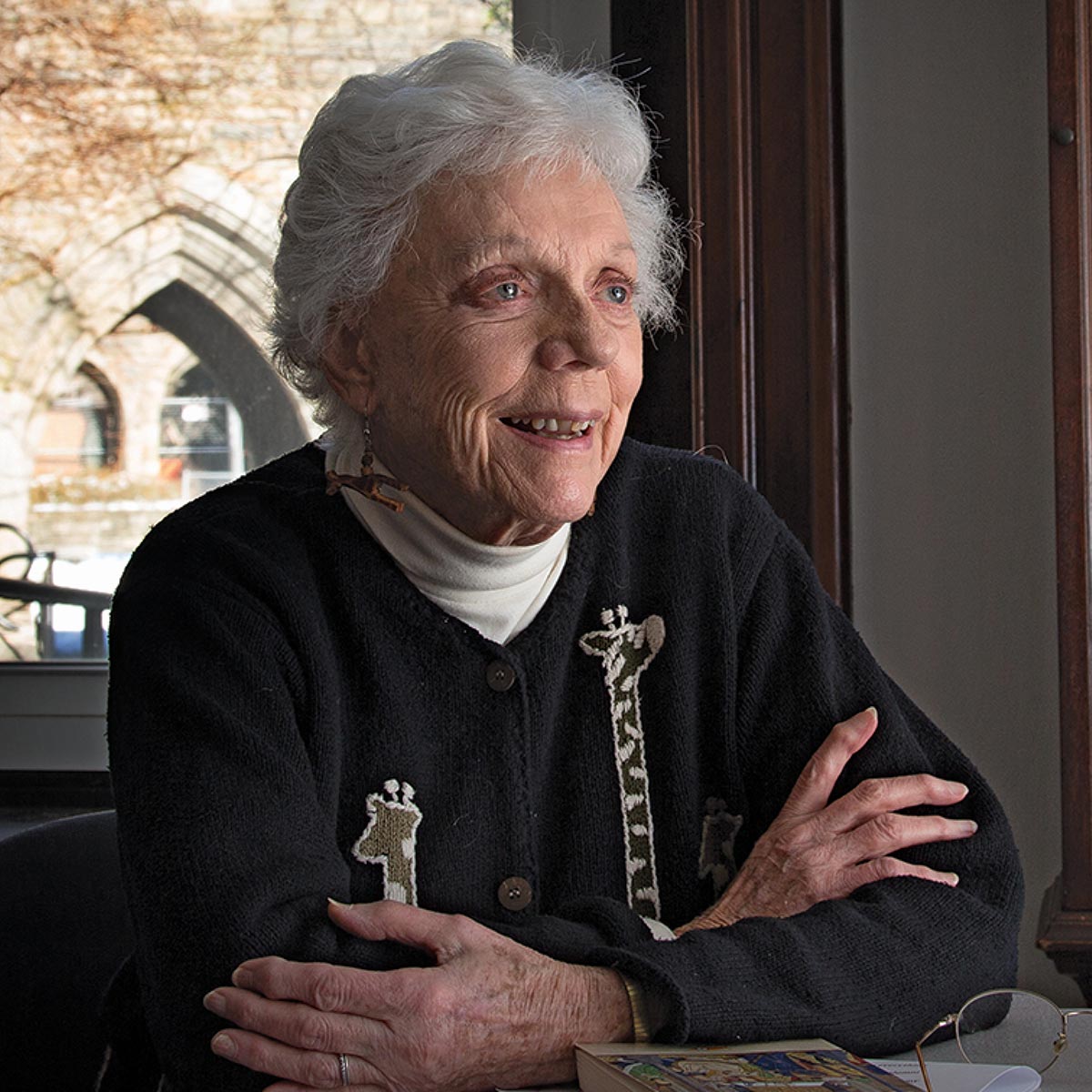
Head shot of Maralyn Rose Orbison Gillespie ’49
laurence kesterson
bulletin editor emerita: Retired Associate Vice President for Alumni Relations, Publications, and Public Relations Maralyn Rose Orbison Gillespie ’49.
Retired Associate Vice President for Alumni Relations, Publications, and Public Relations Maralyn Rose Orbison Gillespie ’49 died July 17 at 98.

At Swarthmore, Orbison Gillespie majored in English literature and minored in history. After a brief stint in publishing, she returned to the College in 1955 as assistant dean of women.

The following year, vocational counseling and placement services, a precursor to Career Services, were brought together in one office for the first time, under her leadership. At the time, the College’s alumni magazine was more of an irregularly published newsletter. Under Orbison Gillespie’s skilled direction, the Bulletin grew to report broadly on the College’s impact on the world at large. She served as editor for 35 years.

Upon Orbison Gillespie’s retirement in 1992, a faculty travel fund was established in her name, as well as a rhododendron in her honor benefiting Scott Arboretum & Gardens.

Her Bulletin colleagues appointed her editor emerita, a designation that has appeared on the masthead for nearly as long as she served the College.
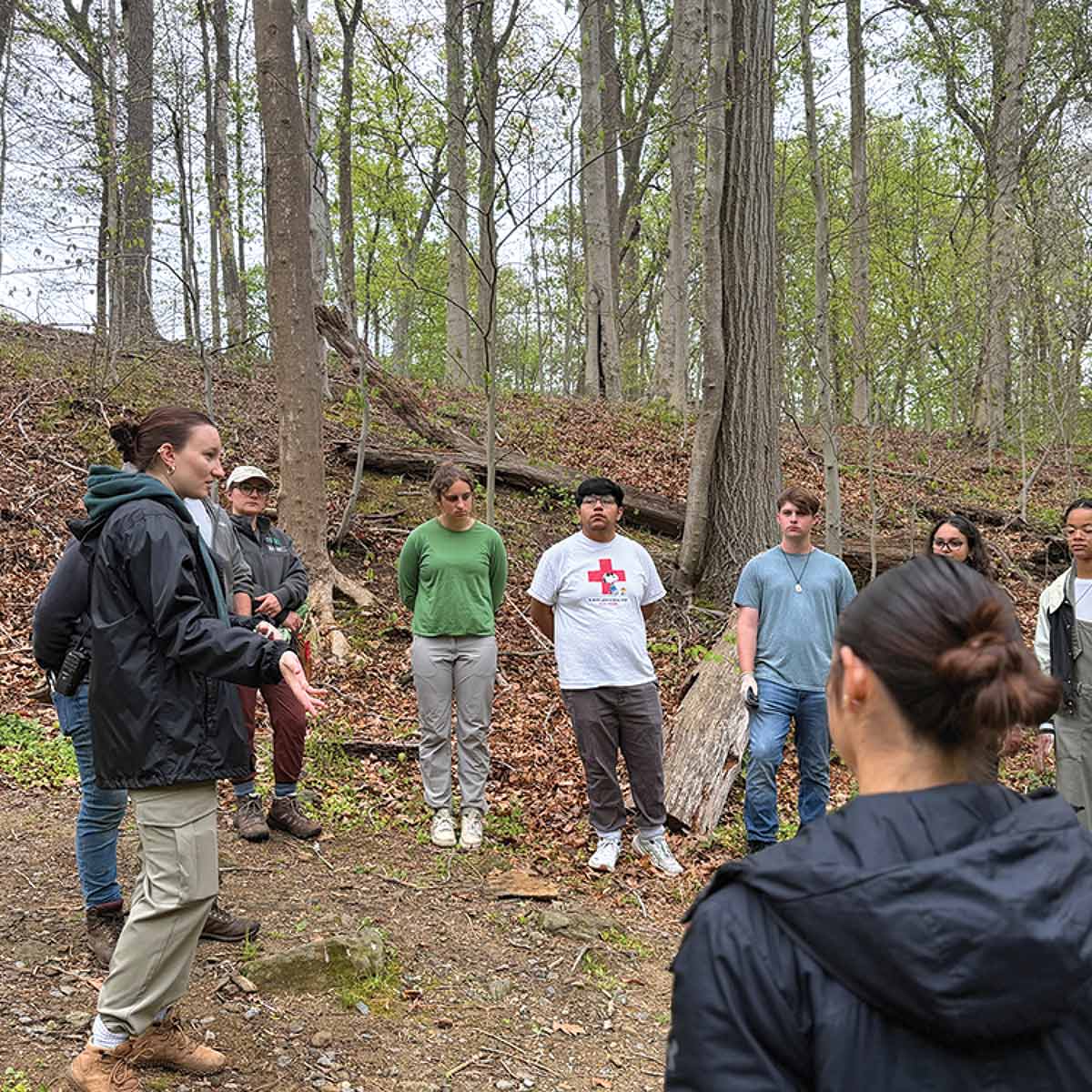
President’s Sustainability Research Fellows stand in a circle in Crum Woods.
president’s sustainability research fellowship (psrf): “The PSRF program was exceptional in teaching me how to not only manage a sustainability project, but make one thrive. It emphasizes creativity, perseverance, and balance,” says Cassandra Conklin ’26 (far left in blue). “Without President Smith, this program would not have been possible. I will always be grateful for the skills it has taught me.”

Saving Over 700 Pounds of Food Waste, Food Recovery Fridge Exemplifies Sustainability Efforts

The Food Recovery Fridge (FRF), located in the Science Center, was spearheaded by President’s Sustainability Research Fellow Saumya Raj ’25 in the 2023-2024 academic year. Its aim: reducing waste on campus and ensuring the safe collection and redistribution of unused food from events. Awareness of the FRF is increasing, as are its benefits — aligning with the College’s growing efforts in sustainability. “The FRF program was created with the vision of reducing campus food waste from group events, personal pantries, and campus cafes while simultaneously increasing food availability for students by providing free meals to all members of the community,” says Green Advisor Alejandro Barragan ’28, who is responsible for prototyping, modifying, and maintaining the food tracking system that quantifies the total food waste diverted by the Recovery Fridge. “The device utilizes a Wi-Fi system to remotely notify of the change in weight detected after subtracting the average weight of plates or other containers,” says Barragan. “Last semester, our device estimated a diversion of 727 lbs. of food waste.”
3
Swarthmore College Bulletin/Fall 2026
A simple line-art icon of an open book with a stylized, leaf-shaped bookmark or decorative element extending upward from the center binding
Mind & Muse
Two men hold bicycles over their heads by the water’s edge.
courtesy of mark duckenfield ’92
pedal power: Mark Duckenfield ’92 completed the 391-mile ride with his twin brother, Paul. The brothers were among 15,000 bicyclists who rode across Iowa on the Register’s Annual Great Ride Across Iowa (RAGBRAI).

two-wheeling

A test of endurance, and some fun, too.
E

very July, 15,000 bicyclists travel across Iowa from the Missouri River in the west, to the Mississippi River in the east, on the Register’s Annual Great Ride Across Iowa (RAGBRAI).

This year, Mark Duckenfield ’92 joined the 391-mile ride with his twin brother, Paul (Carleton College ’92).

“I thought that, as I am not at all athletic, this was a challenging goal that I’d like to accomplish and that it wasn’t going to get any easier to do the older I got,” says Duckenfield.

About every 12 miles, the cyclists passed through a small Midwestern town, heralded by its ubiquitous water towers that became visible from about two miles away.

“The most challenging part was one hill outside Exira on the second day when it was 98 degrees (felt like 106),” he says. “In the scheme of things, it wasn’t really a steep climb, but it was prolonged and the sun was beating down and I just had to pedal along at a meager four miles per hour.”

Each Main Street was filled with stalls selling the full range of Iowa’s agricultural production from the pork to organic vegan options — if it was agricultural, Iowans sold it.

“I thought that, as I am not at all athletic, this was a challenging goal that I’d like to accomplish and that it wasn’t going to get any easier to do the older I got.”
“Iowa is generally flat, but there are hills, especially coming up from rivers and dams,” says Duckenfield. “Fortunately, the weather broke the next day and the most rewarding part was to have traveled so far over a week under my own power.”

Each town had its claims to uniqueness, he says, from a German theme (Westphalia) to baseball (Dyersville of Field of Dreams fame) to a 19th-century dog hit by a train (Colo).

Along the way Mr. Porkchop, a mobile BBQ truck housed in a pink school bus, provided sustenance to riders at farms between stops.

In addition to the community and culinary offerings, Duckenfield researched alternative side quests on his journey — turns out it is possible to hit a high school whose mascot was the Spartans nearly every day along the route.

In keeping with RAGBRAI tradition, Duckenfield dipped his bike into the Mississippi River at the finish line in Dubuque.

4
Swarthmore College Bulletin/Fall 2026
mind & Muse / Hot Type

Hot Type

New releases by Swarthmoreans
Submit your publication for consideration: books@swarthmore.edu
The maroon and blue cover of In Search of Worldviews
Andrea Rugh ’57
In Search of Worldviews: What Anthropology Can Tell Us about the Middle East
Berghahn Books
The Middle East currently dominates the news, often with misleading stories that cast local people as terrorists or oppressed. Rugh argues that in-depth anthropological studies are the best data-driven way to provide accurate information from local perspectives on everyday topics such as women’s roles, why Islam is overtaking other major religions, why democracy has difficulty taking hold, how minorities cope, and formal and informal methods of conflict resolution.
The red cover of A Treacherous Secret Agent
Marjorie Garber ’66
A Treacherous Secret Agent: How Literature Spoke Truth to Power During the Red Scare
Yale University Press
An urgent, probing exploration of the House Un-American Activities Committee, its attempts to bowdlerize and contort facts, and the voices that rose out of history to oppose and subsume it. In narrating the destructive history of the Red Scare, Garber powerfully illuminates the constructive force of literature in opposing political oppression.
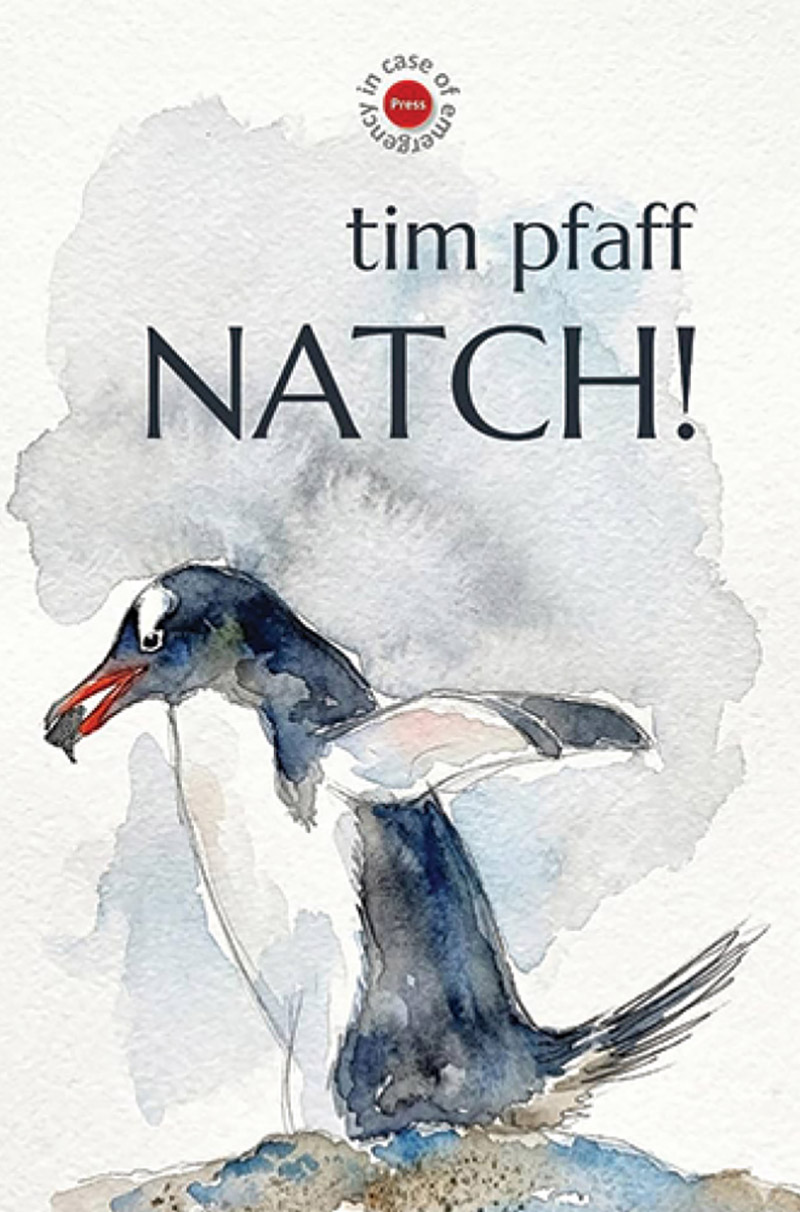
The cover of Natch! Featuring a watercolor painting of a penguin
Tim Pfaff ’84
Natch!
in case of emergency press
You’ve seen the nature documentaries. Pfaff takes you behind the scenes and shows you the wild, bureaucratic chaos that is responsible for our beautiful world. Join the interns, Gene and Jean, as they struggle to find their place in the bewildering maze of petty, noble, whimsical, and mildly crazy personalities working tirelessly (and usually at odds) to mold our planet, its animals, plants, its continents.
The cover of A Multilingual Approach to Educational Linguistics, featuring colorful shapes on a blue background.
Laura Schall-Leckrone ’89
A Multilingual Approach to Educational Linguistics
Multilingual Matters
This book prepares educators for the multilingual classroom, exploring the role of languages in learning across home, school, and community. With up-to-date research and examples from varied K-12 educational settings, it offers accessible introductions to key linguistic concepts while centering social and societal considerations. Practical classroom applications are provided, with discussion questions and online resources for further exploration of topics.
5
Swarthmore College Bulletin/Fall 2026
Line drawing of two open hands with dots and a star shape above.
Common Good
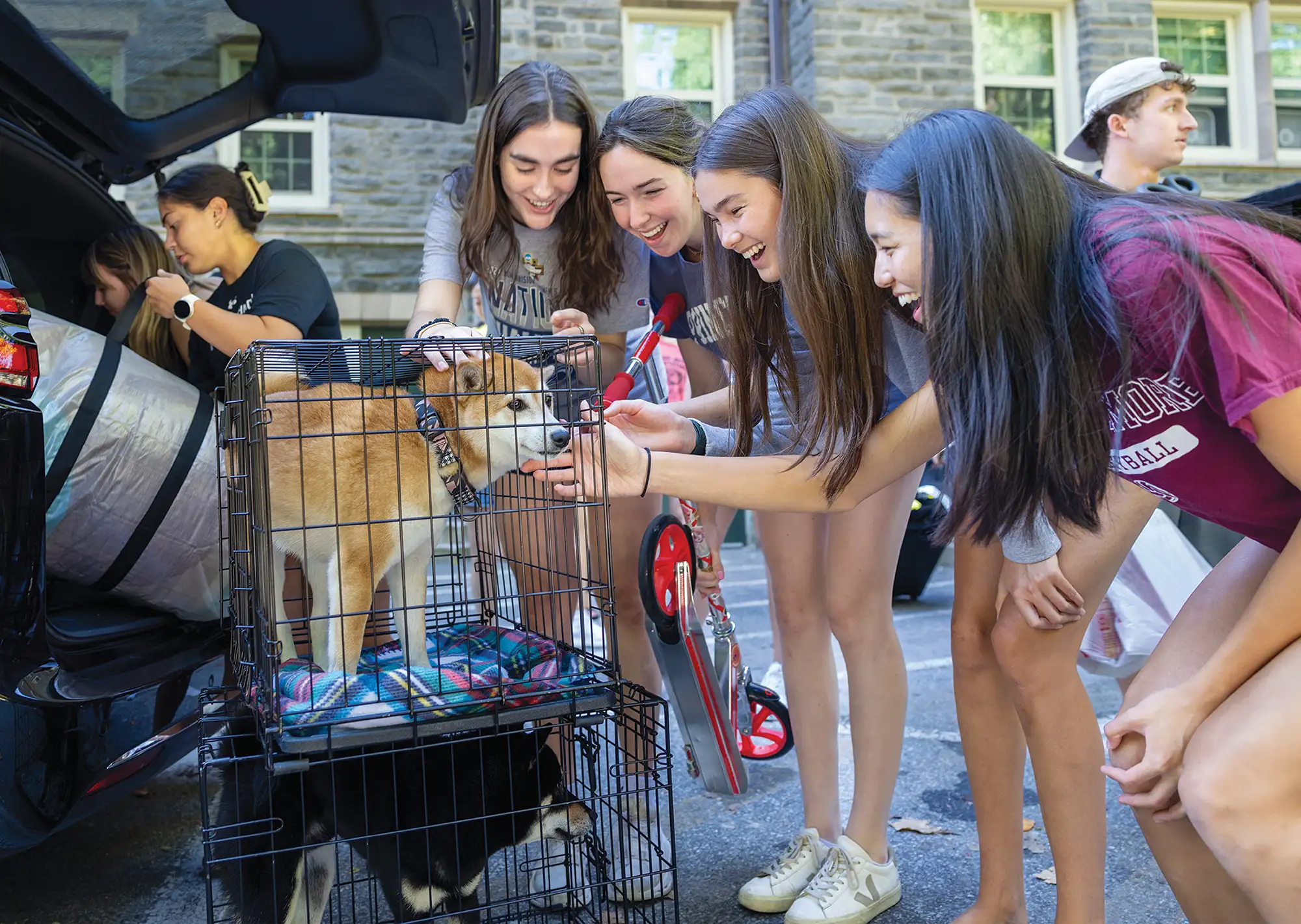
Students smiling and petting dogs inside wire travel crates.
laurence kesterson
a lot to unpack: Two traveling dogs help generate smiles on Move-In Day 2026.

A Wag and a Welcome on Move-in Day

S

warthmore began its 158th year of education on Aug. 31, welcoming 436 first-year students to campus. Students were selected from one of the most competitive applicant pools in the College’s history. The new students represent 46 states as well as the District of Columbia and Puerto Rico. Twenty-eight percent are international, dual U.S. citizens, and permanent residents representing 46 countries. The farthest travel to Swarthmore was from Malaysia.


9
Swarthmore College Bulletin/Fall 2026
Abstract logo with nested inverted V-shapes and a rectangle.
On Campus
Young alumni hold their class banner in the Parade of Classes.
Alumni smile at the camera from a bench by the koi pond.
An alum stops to smell purple flowers.

You Are Here!
Alumni Weekend

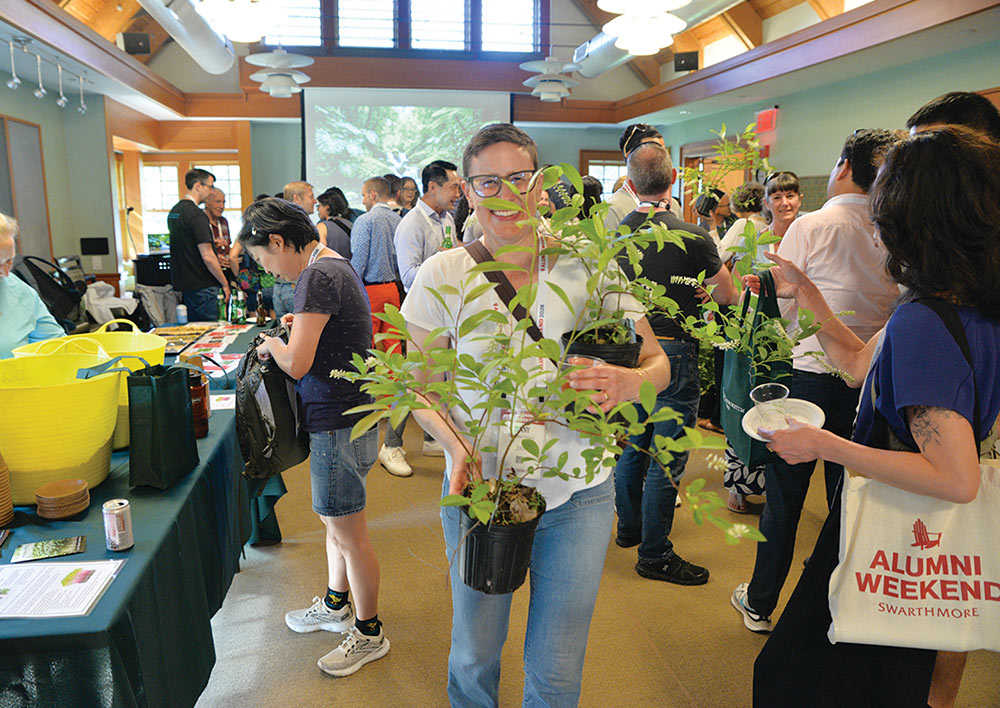
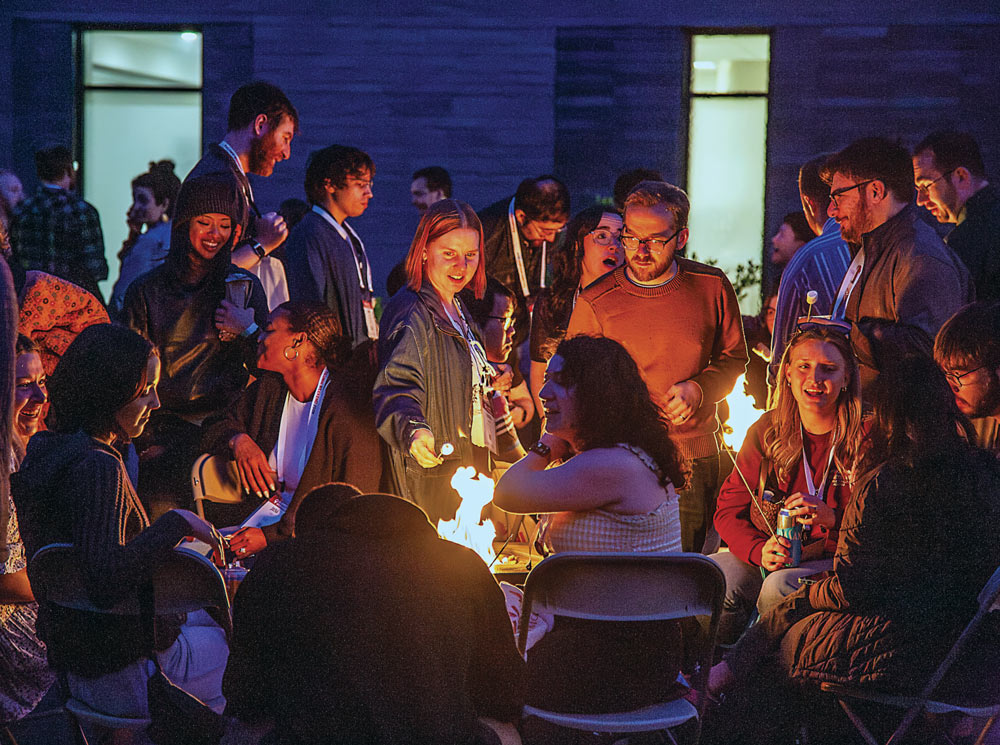
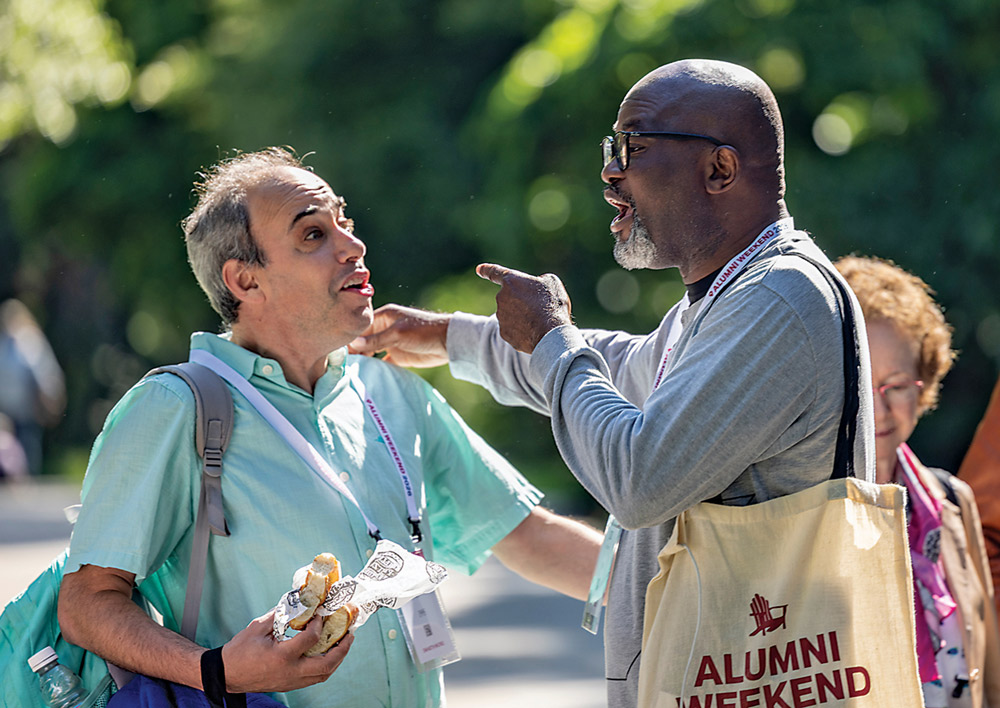
Alumni from the Classes of 1951 through 2026, their families, and friends gathered on campus for Alumni Weekend 2026, May 28–31.

For the more than 1,400 attendees, it was a joyful celebration of milestone reunions and our community’s enduring bonds. They picked up old conversations, reflected on shared experiences, celebrated updates and achievements, danced and sang beneath a dramatic full moon, and even sparked new friendships.

“The really great part of coming to reunion is not only meeting and reconnecting with old friends, but making new ones that you should have known back then,” says Dave Scheiber ’76, reflecting on his 50th reunion.
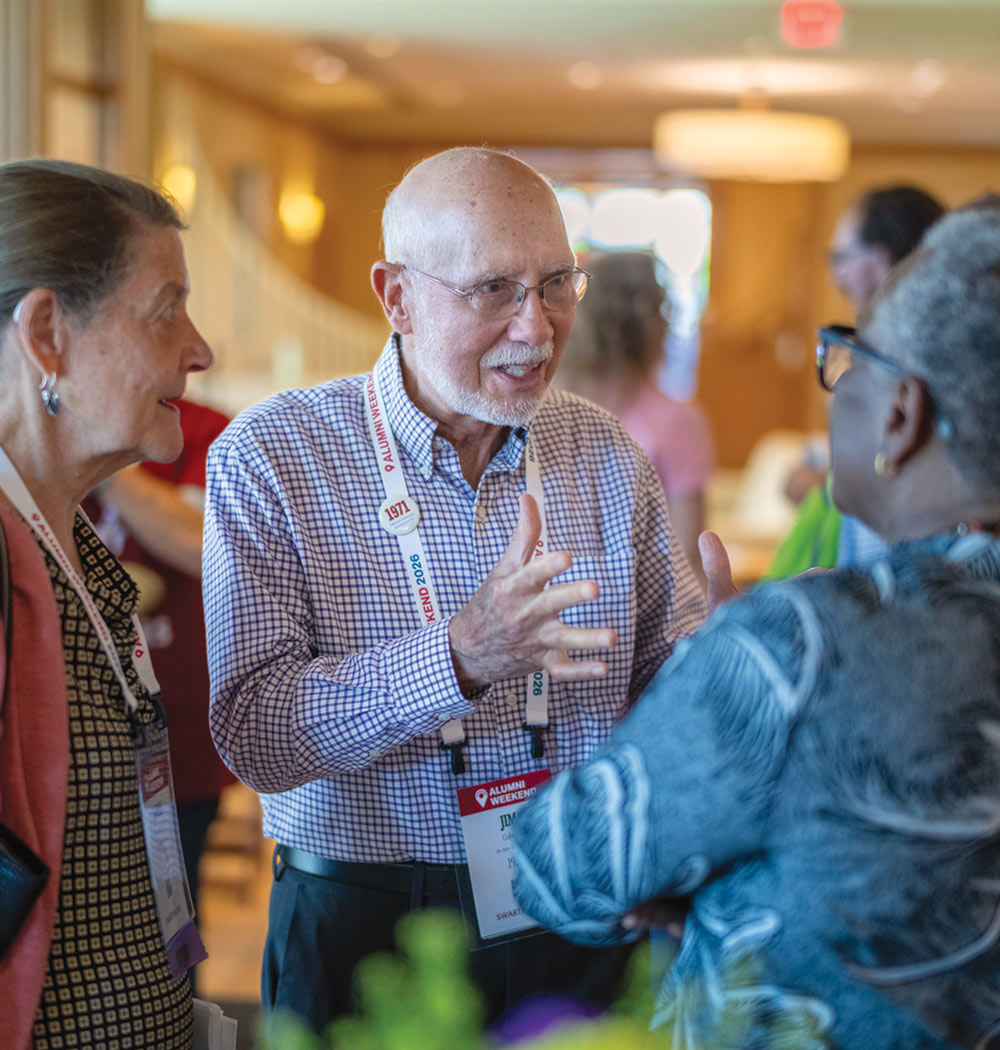
photos by laurence kesterson and robert o. williams
A couple of alumni stop to chat with President Smith.
Two alumni enjoy a spirited conversation outside. One wears an Alumni Weekend tote bag.
A young alumni smiles at the camera from behind a newly potted plant.
Alumni gather around a fire pit to roast marshmallows.
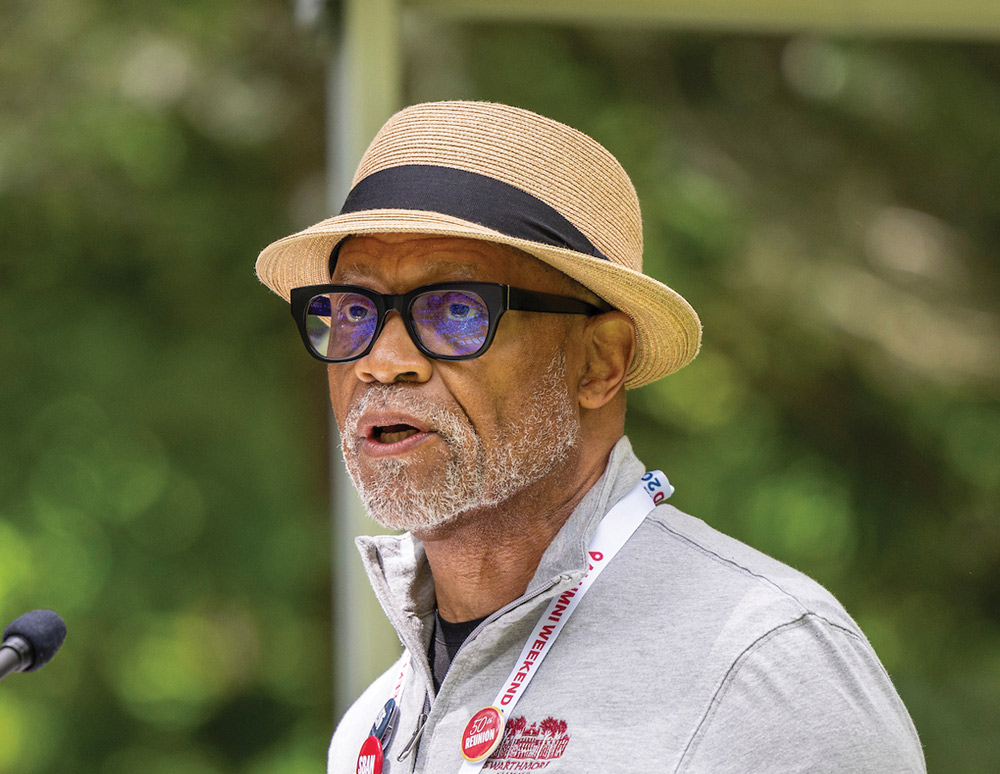
Alan Symonette '76 addresses the crowd.
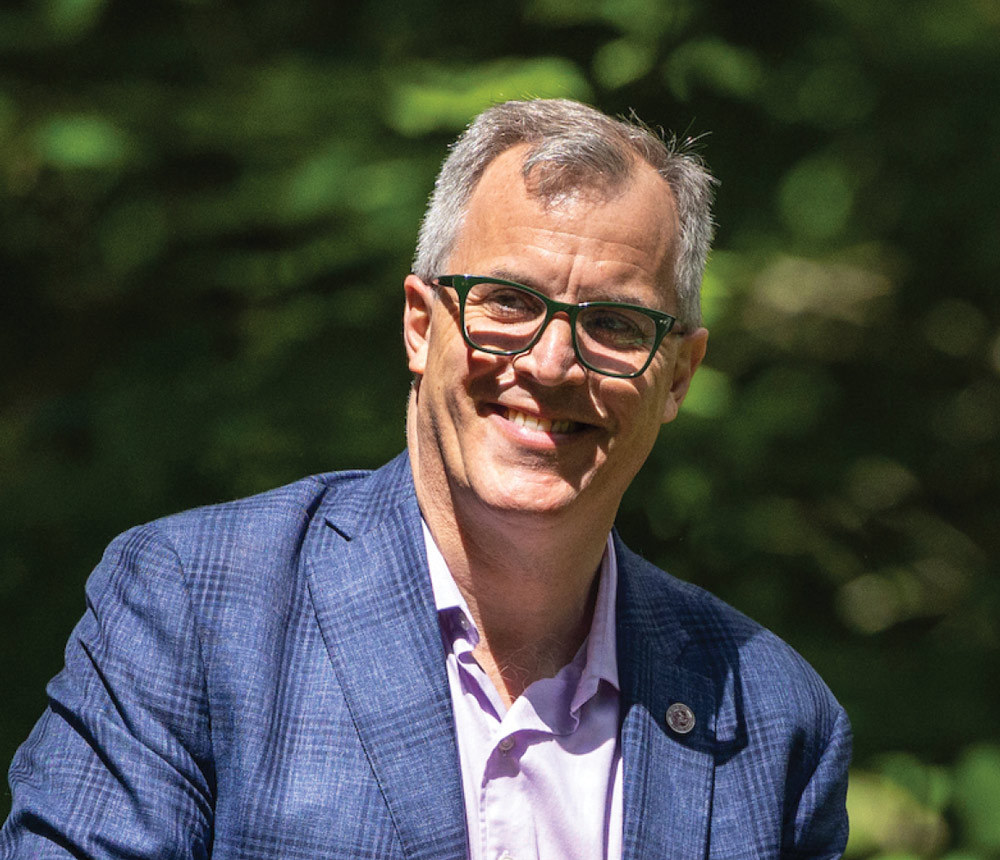
Jim Sailer ’90 smiles at the camera.
Two alumni put their heads together and smile at the camera.
16
Swarthmore College Bulletin/Fall 2026
On Campus / Retirements

A Fond Farewell to Retiring Faculty
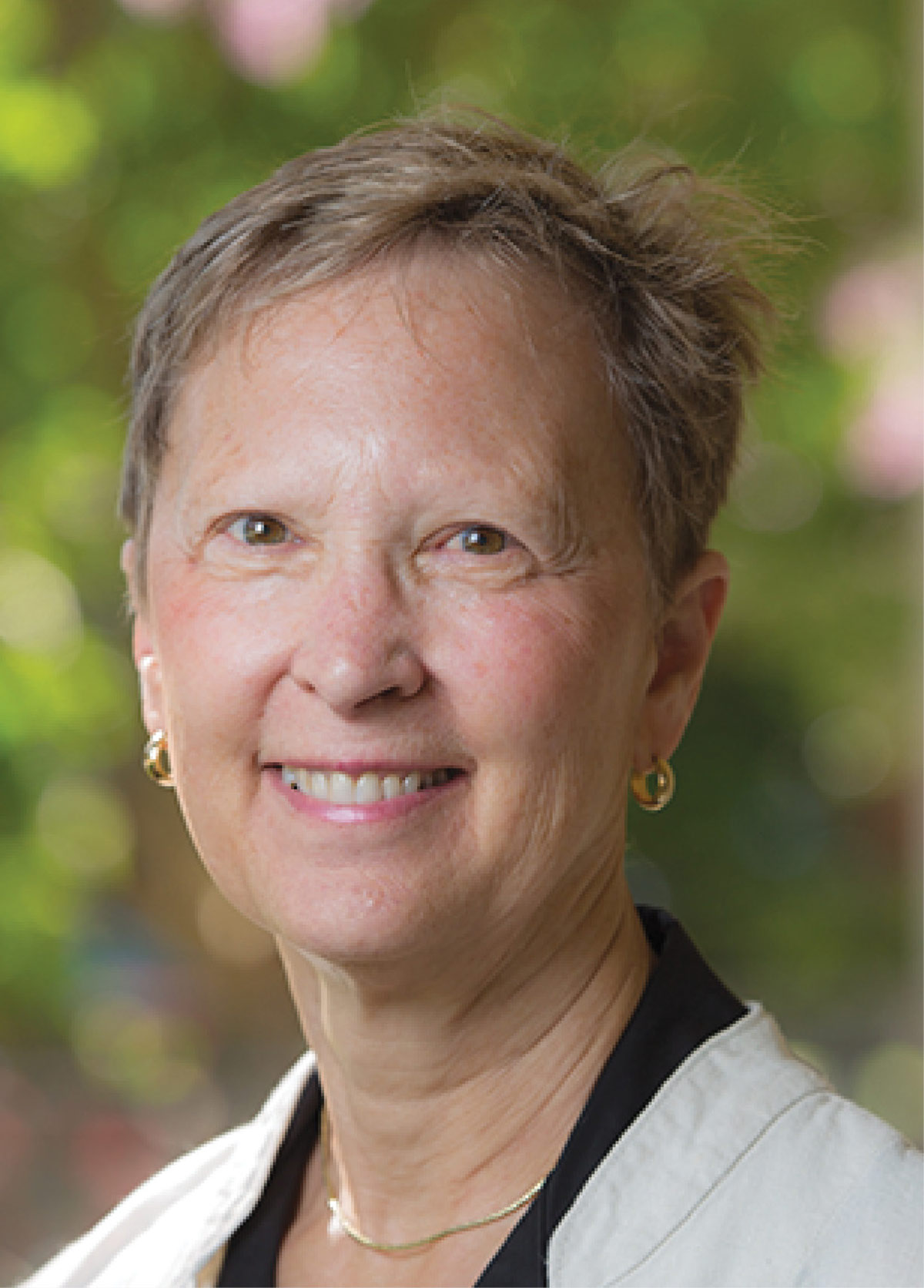
Head shot of Diane Anderson
Professor Emerita of Educational Studies Diane Anderson joined the College in 1990 after working for the New Jersey Department of Education for 20 years. She earned a B.A. from Montclair State College, an M.S. from Drexel University, and a Ph.D. from the University of Pennsylvania.

Anderson served the College in many capacities, including founding the College’s Learning for Life program, serving as associate dean for academic affairs for eight years, and teaching courses such as Pedagogy & Power, Teaching Diverse Young Learners, Literacies & Social Identities, Critical Perspectives on Children and Young Adult Literature, and her Literacies Pedagogies Seminars. Anderson is a self-described “theory nerd,” and an ethnographer of literacy practices. She has written about literacies and identities among both children and adults, in and out of schools. Her most cited works include research into children’s gendered literacy practices, their persuasive writing practices, and children’s numeracy.

She is known for using the practice of knitting to teach students pedagogical empathy and as a common touchstone for learning theories.

18
Swarthmore College Bulletin/Fall 2026
On Campus

New Arrivals to the Board of Managers
Three alumni recently joined Swarthmore College’s Board of Managers: Jeremy Brest ’90 and Colin Convey ’97 are new to the Board, and Tom Hartnett ’94, P’26, is rejoining after a short hiatus. Together, they bring decades of leadership experience across the private, nonprofit, and global development sectors, along with a deep commitment to the values that have long defined a Swarthmore education.
Head shots of Jeremy Brest ’90
Jeremy Brest ’90 established Framework Capital Solutions Pte. Ltd. in 2005. The boutique corporate finance advisory specializes in complex cross-border transactions. He has served on several corporate boards, including Conrad Asia Energy and Pantheon Resources. Brest was a director with Credit Suisse First Boston (2001-2005) in Singapore and previously worked for Goldman Sachs in New York City, Hong Kong, and Tokyo. Brest graduated from Swarthmore in 1990, earning a bachelor’s in mathematics with distinction. He went on to earn a J.D. and an MBA from Stanford University, and to serve on the Reunion Committee from 1999-2001. Brest and his wife Willow live in Singapore and have three children. Brest’s mother, father, and sister all graduated from Swarthmore. The Brest Family Endowment was established in 2004.
19
Swarthmore College Bulletin/Fall 2026
News to Know
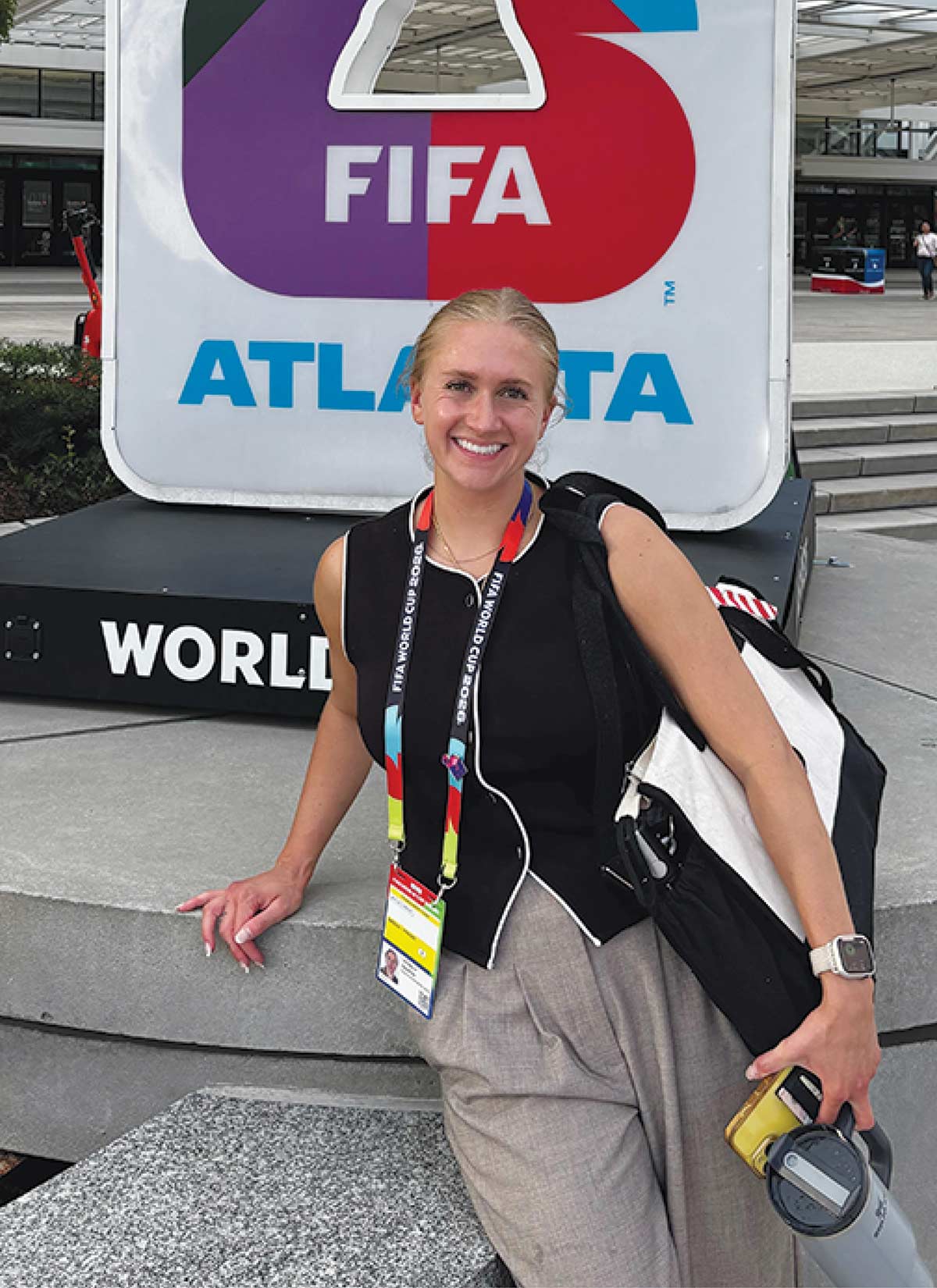
Sophia Vesely ’25 poses in front of a FIFA sign in Atlanta.
Courtesy of sophia vesely ’25

Keeping Score

A writer and editor for Sports Illustrated
As a young, female sports journalist, Sophia Vesely ’25 had the opportunity of a lifetime this summer. She covered the world’s most prominent sporting event — the FIFA World Cup.

“I spearheaded the institution’s coverage of the U.S. men’s national team, who embarked on a fairytale run this summer that captured the hearts and minds of American fans all over the country,” says Vesely, a soccer writer and editor for Sports Illustrated.

Vesely also covered several other matches, including some of the most high-stakes affairs.

“I traveled to Miami for Argentina’s round of 32 clash with Cabo Verde, where the tiny World Cup debutant quite nearly upset the global powerhouse,” says Vesely. Later she traveled to Atlanta for the semifinal match between Argentina and England, and watched as the Argentinians mounted yet another last-gasp comeback.

“It was truly a career-defining experience, and I can’t wait to do it all again for the women’s World Cup next year!”

20
Swarthmore College Bulletin/Fall 2026
On Campus / StudentWise

Across Borders and Disciplines

By Ryan Dougherty
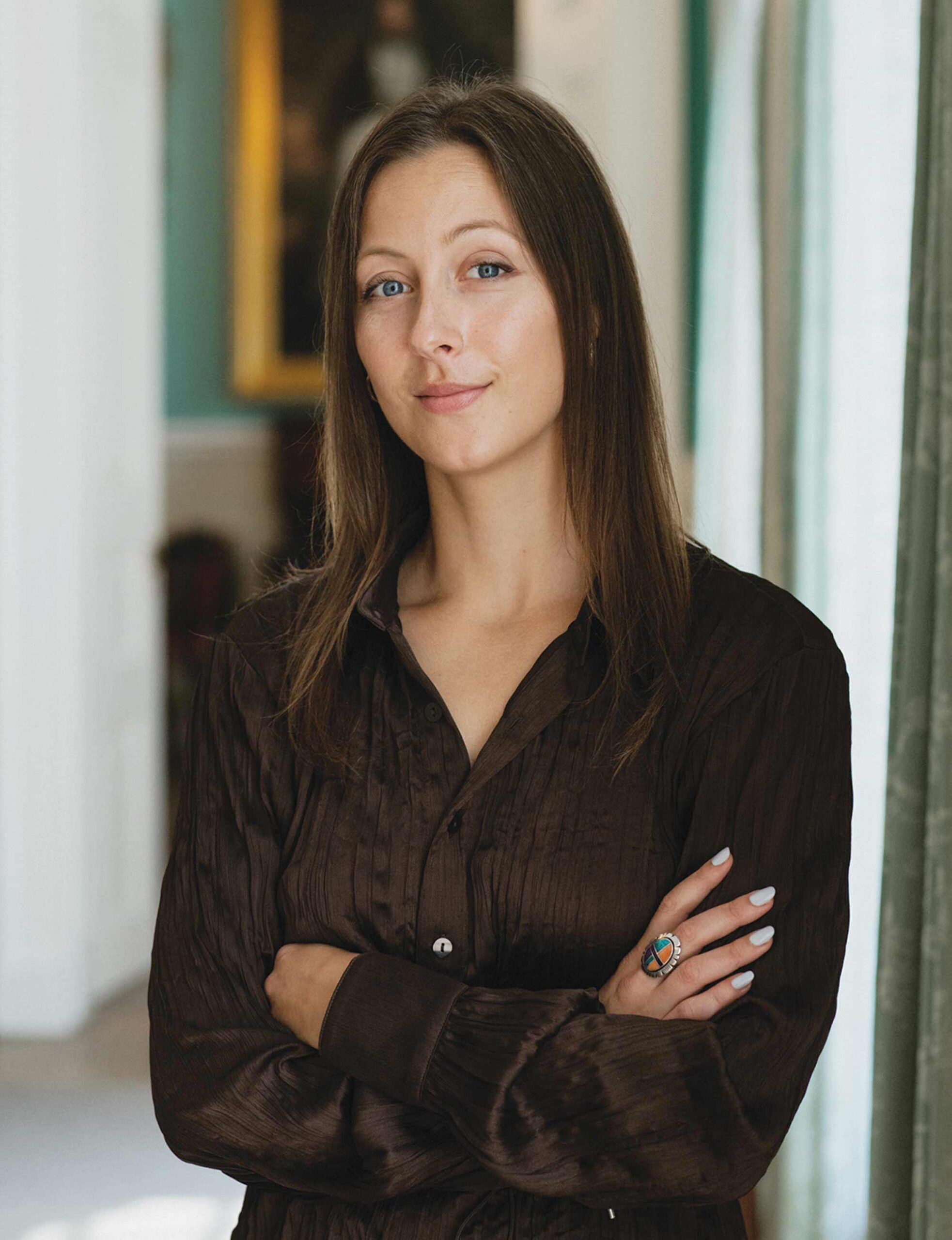
In Bonn, Germany, Gabriella Vasquez ’27 listened as representatives from Fiji and the Marshall Islands described a problem she had encountered in her coursework: Climate commitments can be ambitious on paper, but far harder to carry out on the ground. Weeks later, Vasquez was inside another institution charged with turning policy into practice — the U.S. Tax Court in Washington, D.C.

The two stops made for an interdisciplinary summer for the environmental studies and peace & conflict studies major, linking climate justice, international policy, federal law, and public service, and sharpening her interest in environmental law.

Gabriella Vasquez ’27 poses in front of a sign at the United Nations.
courtesy of gabriella vasquez ’27
studying climate justice: “Both of my experiences this summer helped me grow professionally, but they also gave me role models and relationships that shaped me personally.”
Vasquez’s path to Bonn began a year earlier, when Swarthmore funded her attendance at COP30 in Brazil. There, she connected with Balance Eco, an organization working at the intersection of climate action, biodiversity, and socioeconomic well-being.

That relationship grew into a summer internship, and when Balance Eco traveled to the U.N. climate meetings in Bonn for SB64, the Environmental Studies Program funded Vasquez’s attendance.

20
Swarthmore College Bulletin/Fall 2026
line drawing of key and keyhole
Pathfinders
Elle Bisgaard-Church ’13 poses in a brown button-down.
Kara Mccurdy
GRASSROOTS ENGAGEMENT: Elle Bisgaard-Church ’13 is chief of staff to New York City Mayor Zohran Mamdani. She managed one of the most closely watched mayoral campaigns in the city’s history, notably her first time managing a political campaign.

an extraordinary mandate

From McCabe to the Mayor’s Office.
By Nick Forrest ’08
P

rofessor George Lakey’s course on nonviolent civil disobedience sparked a thesis that Elle Bisgaard-Church ’13 is still testing today: Democratic movements succeed when people are equipped to organize and empowered to participate.

“It’s funny, realizing what a clear through line there is from that class — and that thesis — to my work today,” she says from her New York City Hall office, where she serves as chief of staff to Mayor Zohran Mamdani.

Now considered among the most influential political advisors in New York City, Bisgaard-Church successfully managed one of the most closely watched mayoral campaigns in the city’s history, notably her first time managing a political campaign. But, she’s quick to point out the achievements of others, noting that “the campaign’s massive field program, led by the extraordinary Tasha Van Ocken, was central to our victory.”

This field campaign mobilized over 100,000 volunteers who knocked on upwards of three million doors. It’s this on-the-ground strategy, Bisgaard-Church believes, “where we most clearly modeled our values: democratic participation and equipping people to self-organize.”

“Grassroots engagement isn’t just an accessory to electoral or legislative goals,” she says, “but a constituent element of democracy, and the seeds of that were very much present in my class with George.”

It’s also a fitting example of how Bisgaard-Church characterizes her four years at Swarthmore, a time when she developed the skills and strategies she continues to employ.

Bisgaard-Church arrived at Swarthmore in 2009, drawn to the College’s Quaker heritage and its legacy of feminism, abolitionism, and anti-racism. She also came with a specific ambition: to study Arabic. Having watched the wars in Afghanistan and Iraq unfold throughout her childhood, she knew that she wanted to understand the Middle East on her own terms, without simply accepting media and government narratives at face value, she says.

She went on to major in political science with a minor in Islamic studies, studying Arabic five days a week for three years with lecturer Brahim El-Guabli. In her sophomore year, she joined War News Radio to complement her studies, creating and filing pieces with Iraq war reporter and journalist-in-residence Jim MacMillan.

21
Swarthmore College Bulletin/Fall 2026
Pathfinders

Hiding in Plain Sight

Philip Decker ’18 received the Porter Ogden Jacobus Fellowship, Princeton University’s top honor for graduate students, as well as an Ernest May Fellowship at Harvard Kennedy School’s Belfer Center.
By Tara Smith
A

curious detail in an extraordinary family story led Philip Decker ’18 to explore Nazi-Soviet relations on the eve of World War II — and to reframe the traditional understanding of the war’s origins. Decker’s grandfather, a Soviet Jew, was born in Leningrad in 1929.

Imagine, he says, “You’re 12 when the Siege of Leningrad begins — welcome to adulthood.” The Siege of Leningrad (Sept. 1941–Jan. 1944) resulted in an estimated 1 to 1.5 million civilian deaths, primarily from starvation, cold, and disease. It was one of the deadliest blockades in history.
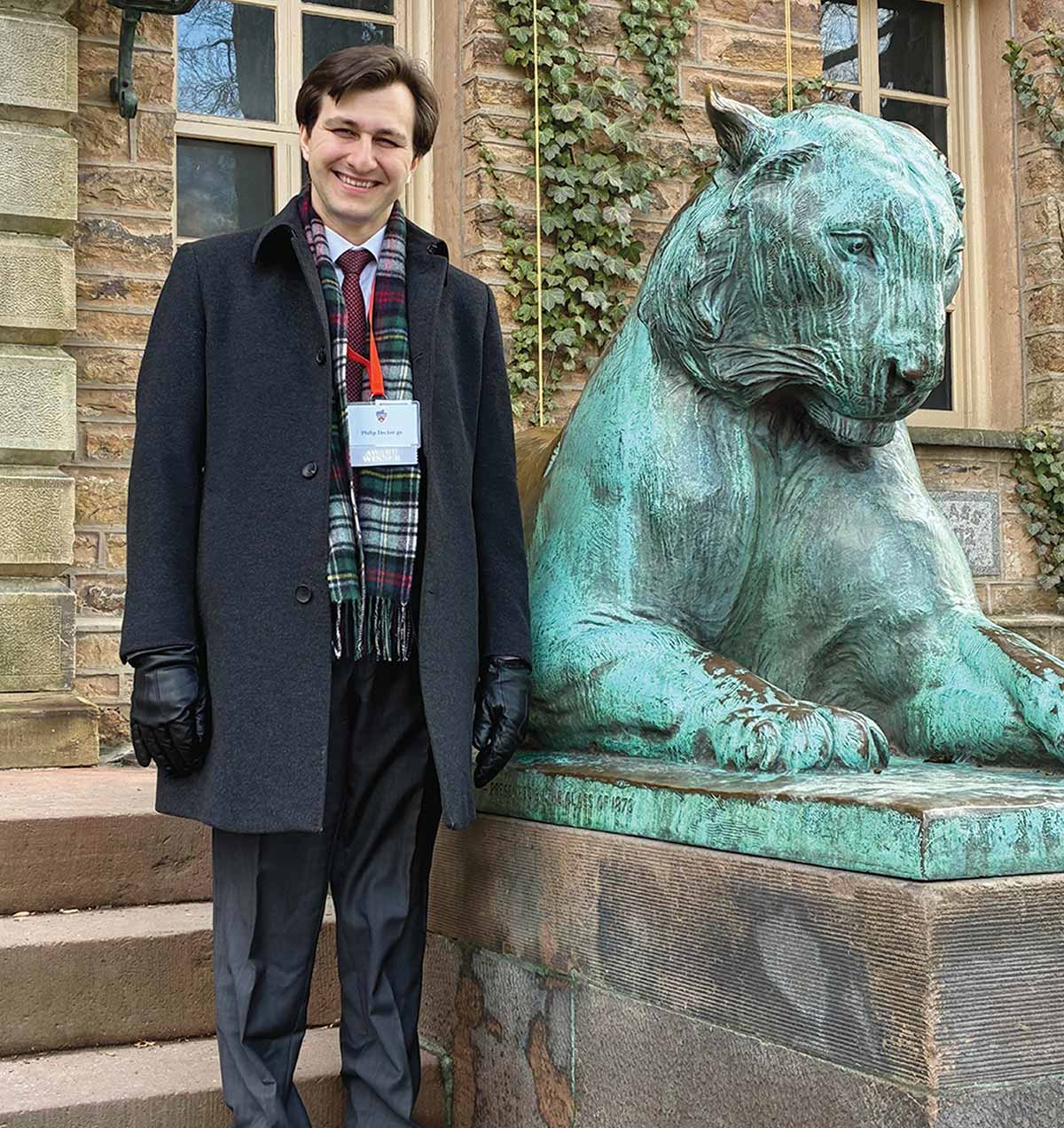
Philip Decker ’18 poses by a green-tinted copper statue of a lion.
courtesy of philip decker ’18
the work ahead: An Ernest May Fellowship at Harvard Kennedy School’s Belfer Center will enable Philip Decker ’18 to spend the next year shaping his dissertation, “The Molotov-Ribbentrop Pact: A Cultural and Diplomatic History,” into a book.
Decker grew up fascinated by the arc of his grandfather’s remarkable story. Survivor. Autodidact. Ph.D. Member of the Soviet intelligentsia. And, later in life, a Russian émigré in Germany.

The latter proved especially intriguing. Why would someone who suffered under Hitler’s deadly blockade choose to live in Germany?

23
Swarthmore College Bulletin/Fall 2026

Fungi For Everyone

Fungi For Everyone

A packed-to-the-gills festival welcomed seasoned mushroom hunters and intrigued newbies to explore the wild and wonderful role of fungi.
by Tomas Weber
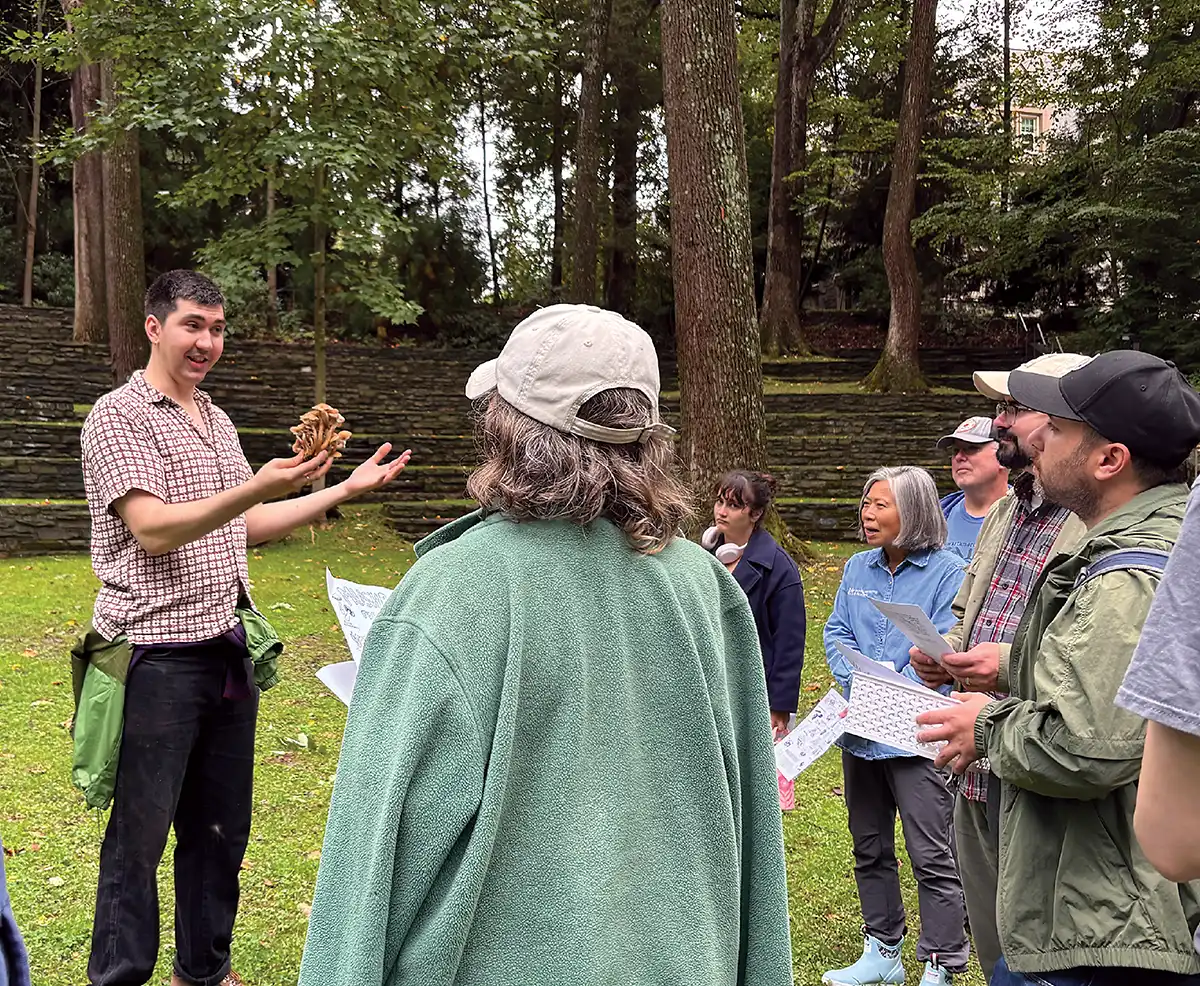
Alden Dirks '16 holds a cluster of Desarmillaria tabescens (ringless honey mushrooms) while gesticulating to the people gathered around them in the Scott Amphitheater.
josie low ’27 and alden dirks ’16
from pastime to passion Mycologist Alden Dirks ’16 shares insights about the variety of mushroom species growing on Swarthmore’s campus. “There’s so much more curiosity about fungi these days,” says Dirks.
Phlebia incarnata (coral-pink merulius), a fungus forming small rosy pink brackets edged in white
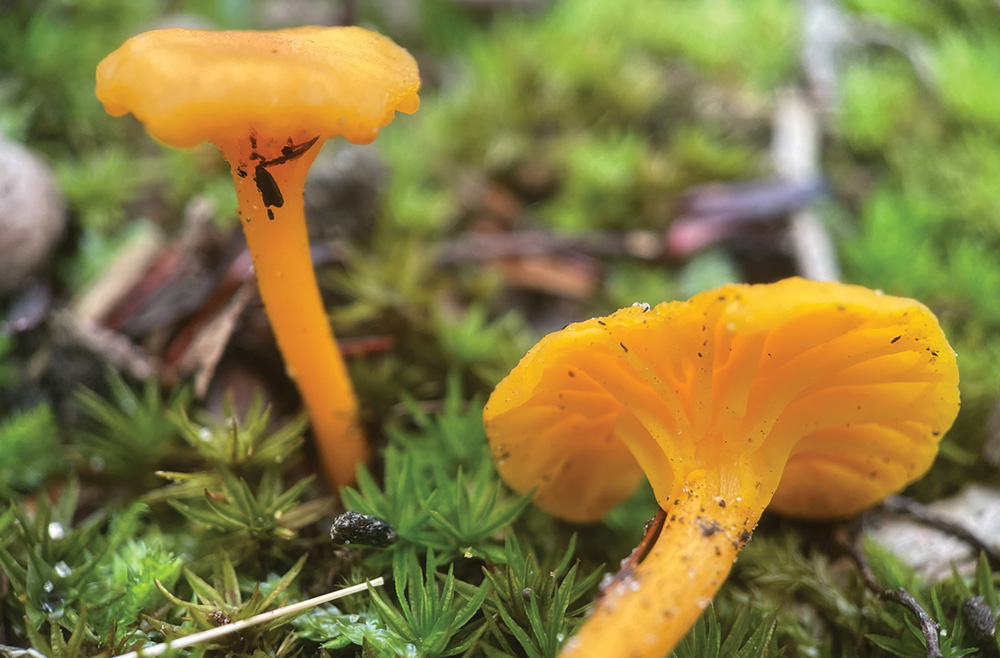
Two Cantharellus minor (small chanterelles) amidst moss. They are a warm, bright yellow in color. One stands upright, and one has been picked and laid on its side to show the decurrent gills on the underside of the cap.
Alden Dirks '16 holds a cluster of Desarmillaria tabescens (ringless honey mushrooms) while gesticulating to the people gathered around them in the Scott Amphitheater.
josie low ’27 and alden dirks ’16
from pastime to passion Mycologist Alden Dirks ’16 shares insights about the variety of mushroom species growing on Swarthmore’s campus. “There’s so much more curiosity about fungi these days,” says Dirks.

Fungi For Everyone

Fungi For Everyone
A packed-to-the-gills festival welcomed seasoned mushroom hunters and intrigued newbies to explore the wild and wonderful role of fungi.
by Tomas Weber
Phlebia incarnata (coral-pink merulius), a fungus forming small rosy pink brackets edged in white
Two Cantharellus minor (small chanterelles) amidst moss. They are a warm, bright yellow in color. One stands upright, and one has been picked and laid on its side to show the decurrent gills on the underside of the cap.
It Was
the opening day of Swarthmore’s inaugural Fungi Fest, a weeklong mycological bash masterminded by Josie Low ’27, and Crum Woods was putting on a dazzling show.

Cinnabar chanterelles were shining in the leaf litter. There were constellations of chocolate-and-cream-colored earthstars. Russulas flashed their rosy caps. It was sunny, but the soil was still nice and damp from the nor’easter — perfect mushrooming weather — and fungi were popping up at every turn.

“Sometimes in between my saying, ‘I’m going to walk this way,’ and actually going there, new mushrooms had come out of the ground,” says Low.

Almost as varied was the crowd of 480 festival attendees who came out to learn more about one of life’s most mysterious branches.

24
Swarthmore College Bulletin/Fall 2026

Night Falls

Evening stillness settles across the campus.
photos by Laurence Kesterson
Sharples Commons and Clothier Tower
As daylight fades, Swarthmore’s campus takes on a different character. Familiar buildings and pathways emerge from the darkness, illuminated by glowing windows, shining lampposts, and the last traces of dusk. Students linger outside, moving between buildings and responsibilities, carrying on with the rhythms of campus life. But while some corners of campus grow quiet, others are just coming to life. On a crisp evening in October, photographer Laurence Kesterson took a walk through Swarthmore. These images offer a different view of the campus we know so well.
30
Swarthmore College Bulletin/Fall 2026

The Advocate

The Advocate
For 25 years, attorney Michael Barasch ’77 has fought to get victims of toxic exposure from 9/11 the compensation they deserve.
by Michael Blanding
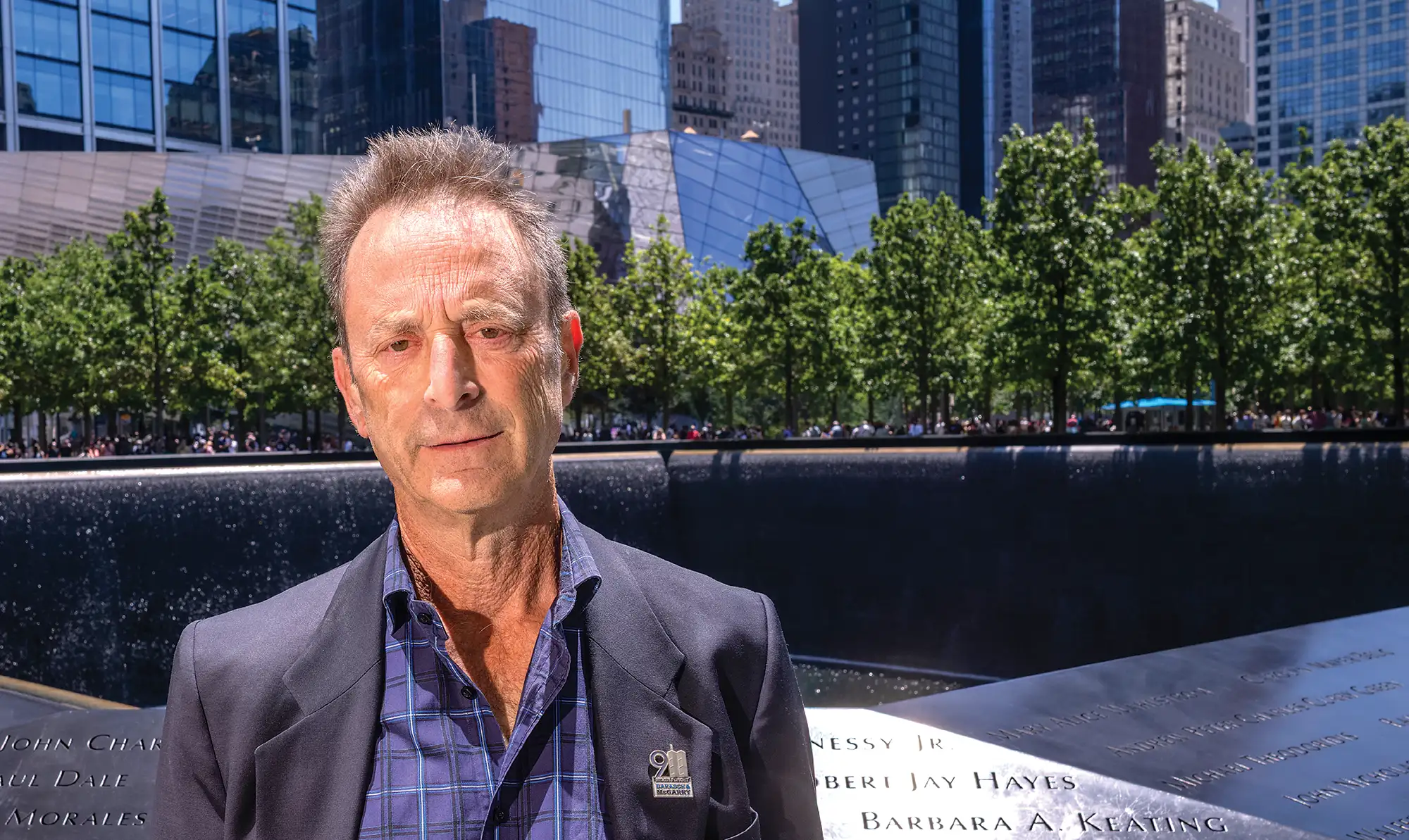
Michael Barasch ’77 stands in front of the 9/11 Memorial in New York.
laurence kesterson

The Advocate

The Advocate
For 25 years, attorney Michael Barasch ’77 has fought to get victims of toxic exposure from 9/11 the compensation they deserve.
by Michael Blanding
M
michael Barasch ’77 was two blocks from the World Trade Center when the first plane hit. As he stood and watched the second, he realized it wasn’t a coincidence. Running back to his office at 11 Park Place, he told his staff to evacuate, then watched from a window as the towers fell.

“The doors to the lobby were open, and the smoke just came pouring in,” he remembers. “I was one of those people you saw covered in dust running uptown, as the real heroes — the firefighters and cops — were running downtown.”

The debris was more than mere dust; it carried a toxic stew of chemicals, including asbestos, lead, mercury, and fiberglass that infected the lungs of anyone who spent time at ground zero. Now, 25 years after the September 11th attacks, Barasch has played a critical role in getting those heroes the compensation they deserve. Along with his partner, Jim McGarry, he helped draw the connection between the exposure and respiratory illness, cancer, and other disabling diseases for police, firefighters, and other emergency workers, making them eligible for the September 11th Victim Compensation Fund (VCF).

34
Swarthmore College Bulletin/Fall 2026

Clay and
Contemplation

He felt most at home in Swarthmore’s art studio, so he made a career as a ceramics artist.
by Emily Halnon
creative flow: An imaginative teapot by Ray Bub ’70 titled Six Parrots, A Goldfinch Flies up Reassembled Ring Teapot. Photo by Jon Barber.
I
n the summer of 1969, Ray Bub ’70 started driving west. He wanted to retrace the route that inspired Jack Kerouac’s The Dharma Bums, when he ventured to a fire tower in the North Cascades.

Bub was about to start his senior year at Swarthmore and was feeling aimless about where else to go in life. He felt pressured to pursue a traditional career. Something with a guaranteed paycheck and benefits. But, that path never appealed to Bub.

He felt most at home in Swarthmore’s art studio, where he worked and started making ceramic art. He learned how to throw, glaze, and fire pottery and loved the satisfaction of creating something with his own hands. He entered Swarthmore as an engineering major and found ceramics married his skillset for building things with his appreciation for art, which he traces back to his love for literature and poets like Kerouac and Gary Snyder.
38
Swarthmore College Bulletin/Fall 2026
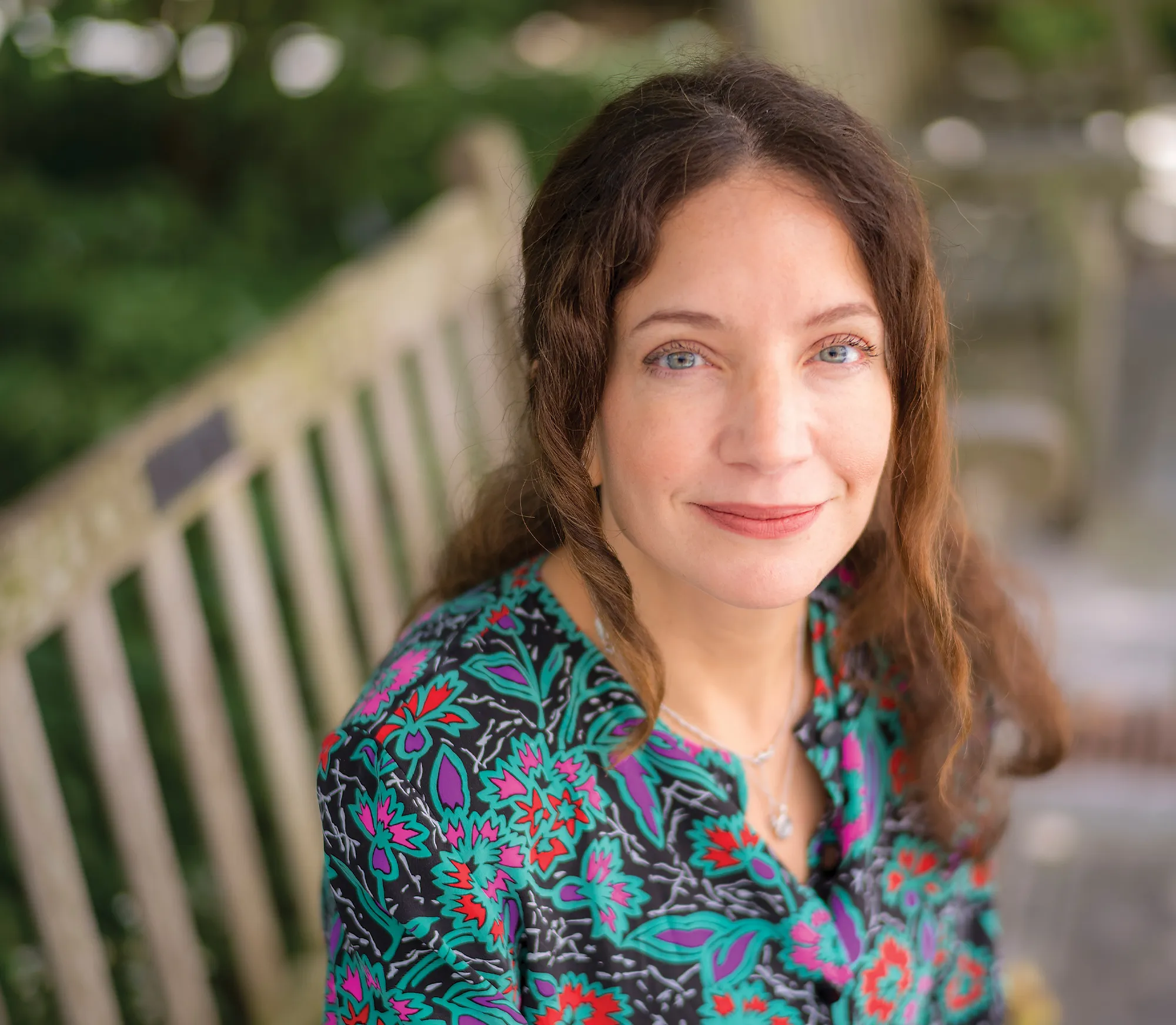
Head shot of Ayse Kaya in a colorful blouse, sitting on a campus bench

The Power of Tariffs

Understanding international trade and the global economy.
by Tomas Weber
For years, Professor of Political Science Ayse Kaya had a problem.

How do you make the architecture of the global economy sound remotely interesting over dinner?

Tariffs and trade regimes. Multilateral coordination and the inner workings of the International Monetary Fund (IMF). Exchange rates and capital flows. Outside of specialist circles, they were not topics that naturally sparked curiosity.

But then, suddenly, they did.

This year, the U.S. stepped back from more than 50 international institutions, many of which it helped build. Trade wars are now policy, and tariffs have skyrocketed. The abstractions that Kaya spent her career studying have become the focus of near-daily anxiety, dominating the headlines and triggering uncertainty around the world.
42
Swarthmore College Bulletin/Fall 2026
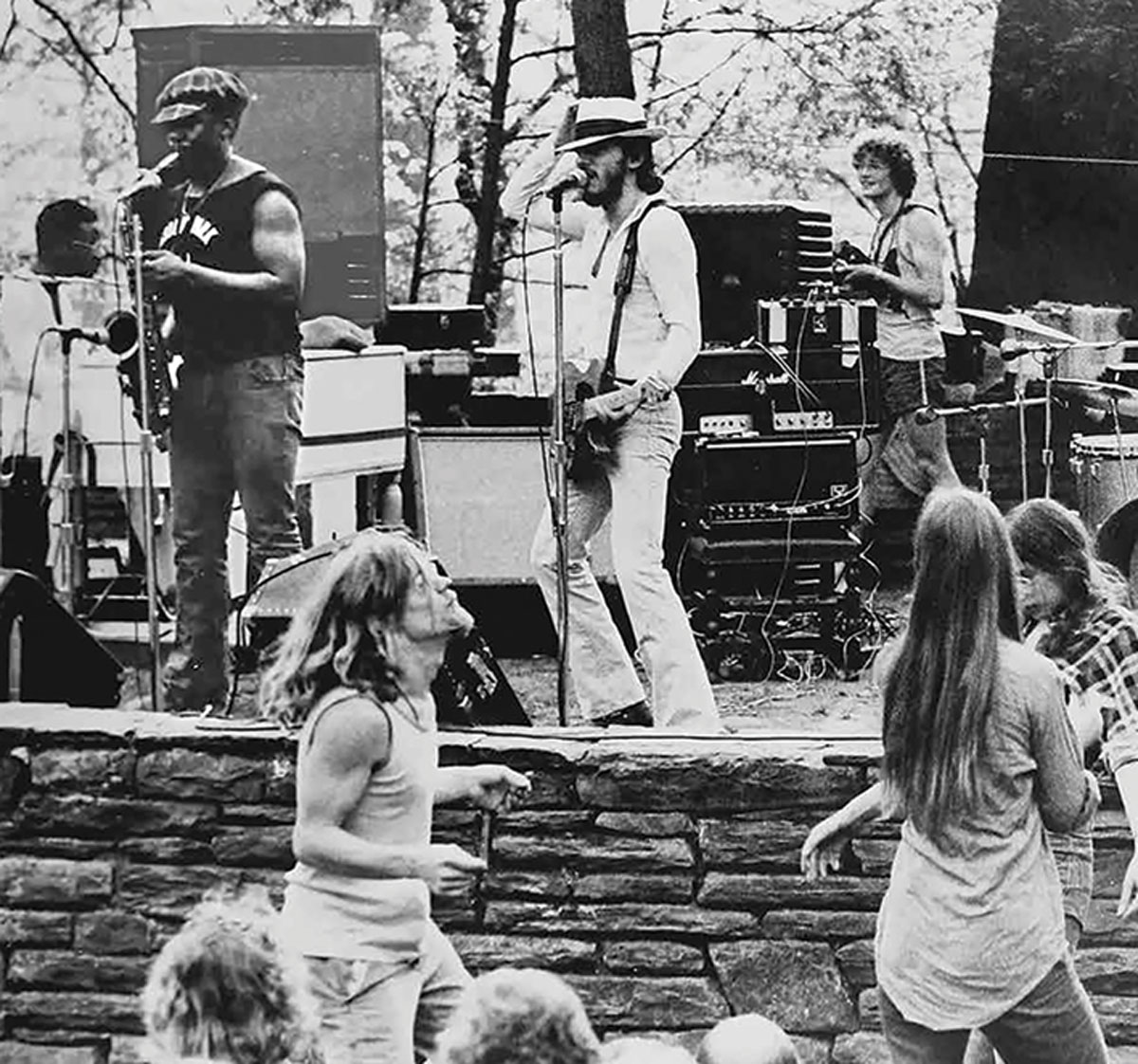
Black-and-white photo of Bruce Springsteen and the E Street Band performing in the Scott Amphitheater
SWARTHMORE COLLEGE ARCHIVES
“It looked like there were 17 people out there,” recalled Clarence Clemons, the late saxophonist of Bruce Springsteen’s E Street Band on the stage of the Scott Amphitheater on April 28, 1974.

Springsteen at Swarthmore

The story behind the College’s date with history as the birthplace of “Born to Run.”
by Dave Scheiber ’76
C

larence Clemons, the late, great Big Man of Bruce Springsteen’s fabled E Street Band, had a distinct memory of a long-ago show with a little-known connection to rock ‘n’ roll history.

On a balmy and breezy Sunday afternoon, April 28, 1974, the legendary saxophonist gazed from the stage of the wooded Scott Amphitheater — shortly before the group’s headline set at the school’s spring concert — and was struck by the sight of the mostly empty venue.

Even with only a smattering of students in the amphitheater, following an opening set by the country-rock group Wire and Wood, Clemons wasn’t overly concerned after three raucous university gigs in New England during the prior two days.

“It looked like there were 17 people out there,” he told me in 1999 during an interview at his home in Singer Island, Fla. “But once we started, the place filled up until it was packed. And we played like it was a crowd of 100,000 — we played our f—king hearts out.”

46
Swarthmore College Bulletin/Fall 2026
chair icon

Class Notes

alumni council

Each year, the Alumni Council recognizes the exceptional achievements of two alums. At Alumni Weekend, we were honored to present the Eugene M. Lang ’38, H’81 Impact Award to Donald Lloyd-Jones ’86 in recognition of his extraordinary efforts to prevent and treat cardiovascular disease, including his distinguished record of clinical research, efforts to ensure equity in reaching underserved populations, and leadership in national cardiovascular initiatives.

We presented the Arabella Carter Community Service Award to Naomi Zikmund-Fisher ’91 in recognition of her lifelong and selfless commitment to advancing social justice, peace, equity, and access, including her sustained work on fair housing, mental health, same-sex marriage, and the National Marrow Donor Program.
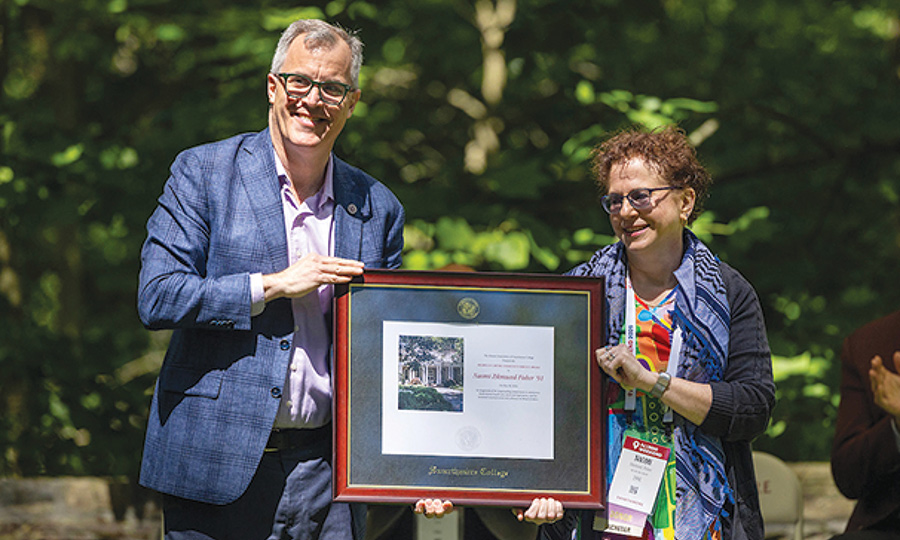

Jim Sailor ’90 hands Naomi Zikmund-Fisher ’91 an award.
We were pleased that the College’s Advancement Office presented the Joseph B. Shane Alumni Service Award to Rich Truitt ’66 in recognition of his devoted service to the College community. Truitt is a past president of the Alumni Council, former member of the Board of Managers, and was a driving force behind the 2025 Football Reunion.
Ted Nelson ’59 uses his body weight to try and move a machine made of concentric rings from inside of it.
courtesy of Ted Nelson ’59
Ted Nelson ’59, seen here in an aerotrim, was recently featured in The Atlantic for his role in the “personal computer revolution,” promoting computer access for ordinary people in the 1960s.

Your support makes a Swarthmore education extraordinary and accessible.

Make your gift now: gift.swarthmore.edu
Gift hand icon

Your support makes a Swarthmore education extraordinary and accessible.

Make your gift now: gift.swarthmore.edu
Gift hand icon
49
Swarthmore College Bulletin/Fall 2026
bouquet of flowers icon
Their Light Lives On
A garden on campus with purple flowers in the foreground and chairs in the distance.
Alexis Bacon
Elizabeth “Betty” Glenn Webber ’43

Betty, who was 104, an educator, and Class Secretary, died July 2, 2026.
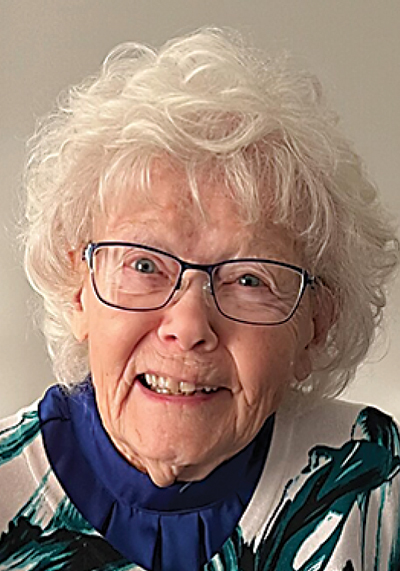
Headshot of Elizabeth “Betty” Glenn Webber ’43She earned a bachelor’s in English literature at the College, where she was a member of the Judiciary Committee, the Drama Board, and the Women Student Government Association, and later served as Class Secretary. Betty was a working mother beginning in 1965 and held a variety of positions, ending her career at 90 grading MEAP test essays. A lifelong Presbyterian, she was involved in her church and enjoyed playing bridge, sewing, reading, completing The New York Times crossword puzzle, and participating in water aerobics.

Elizabeth “Liz” Jones Evans ’45

Liz, a librarian and editor, died May 8, 2026.
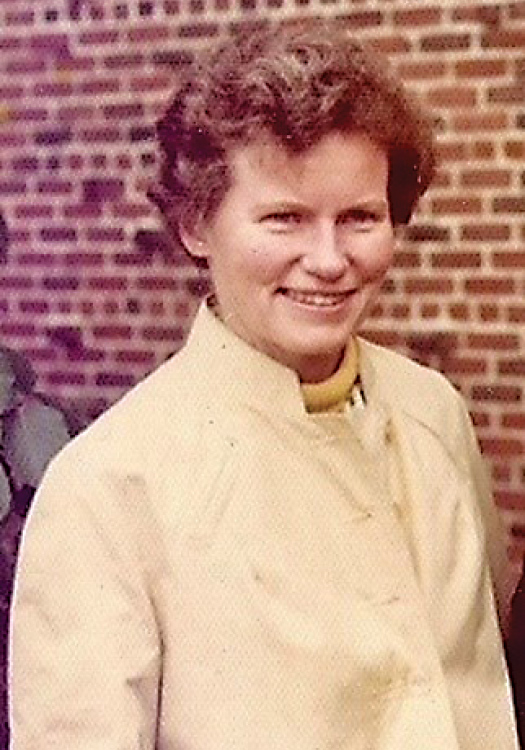
Headshot of Elizabeth “Liz” Jones Evans ’45She earned a bachelor’s in English literature at the College, where she met late husband Daniel W. West ’45, and received a master’s in library science from Columbia University. Widowed in 1961, Liz supported her four children with freelance editing. Later remarrying and combining families with a widower, she was a children’s librarian in Scarsdale and Yonkers, N.Y., retiring in 1982. She was a tennis player, hiker, and master gardener, and was a member of the Unitarian Universalist Congregation of Charlottesville.

Patricia “Pat” Dunham Hunt ’45

Pat, a community organizer, mentor, and writer, died April 6, 2026.
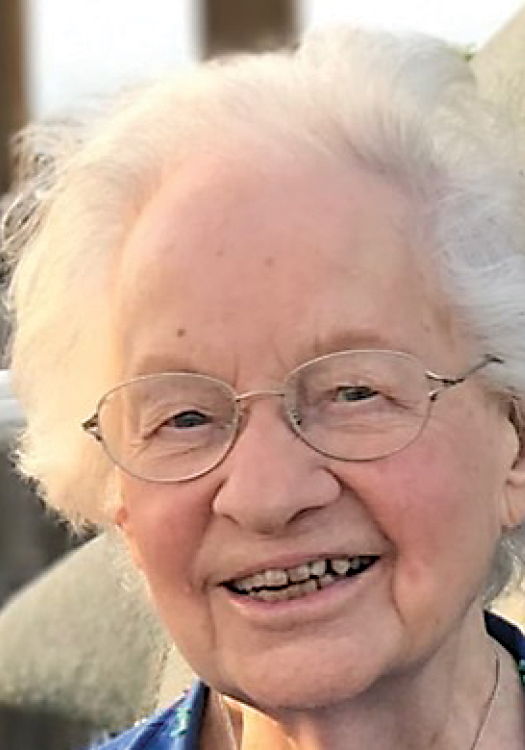
Headshot of Patricia “Pat” Dunham Hunt ’45She earned her bachelor’s with Highest Honors in Spanish at the College and a master’s in social work at Columbia University. Pat coordinated programs for the American Friends Service Committee after World War II. Later, she created and supervised aid and educational programs and coordinated Service Committee aid programs in Africa, retiring in 1986. She also served as a former official at the Chester Housing Authority and the Delaware County Board of Assistance, and authored her memoir, 102 Years of Opportunities: A Life of Love and Family.

Maralyn Orbison Gillespie ’49

Maralyn, a College alumni administrator, golfer, and gardener, died July 17, 2026.
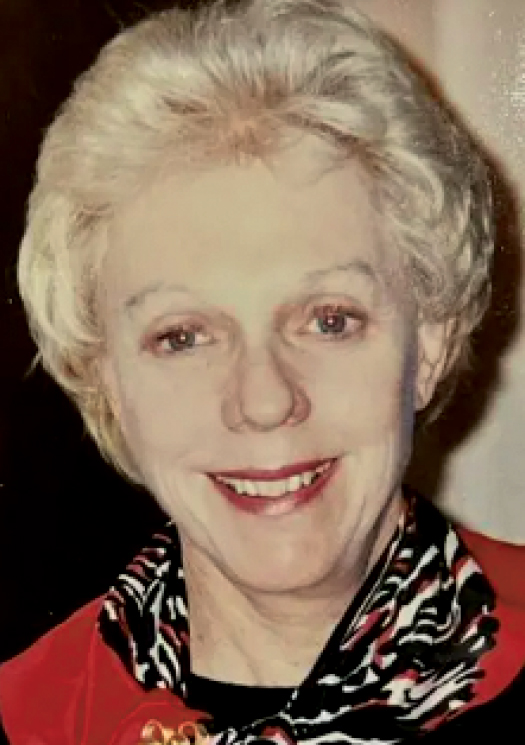
Headshot of Maralyn Orbison Gillespie ’49She earned her bachelor’s in English literature at the College and worked for 37 years at Swarthmore, including as the senior editor of the Bulletin and the associate vice president of Alumni Administration, retiring in 1992. She remained editor emerita until her passing. Maralyn was a member of the Providence Garden Club and The Garden Club of America; volunteered at Scott Arboretum and Longwood Gardens; was a founder of Kendal-Crosslands’s arboretum, where the rhododendron variety Maralyn Gillespie grows; and was a Rolling Green Golf Club member for 48 years.
73
Swarthmore College Bulletin/Fall 2026
Looking back
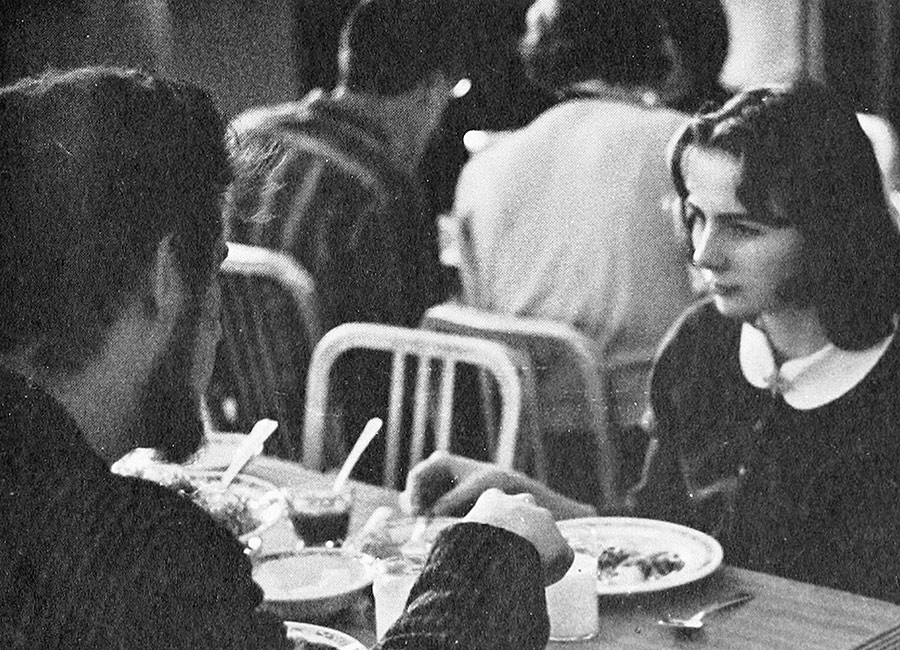
Black and white photo of Swarthmore students eating in the dining hall in the 1960s.
Halcyon
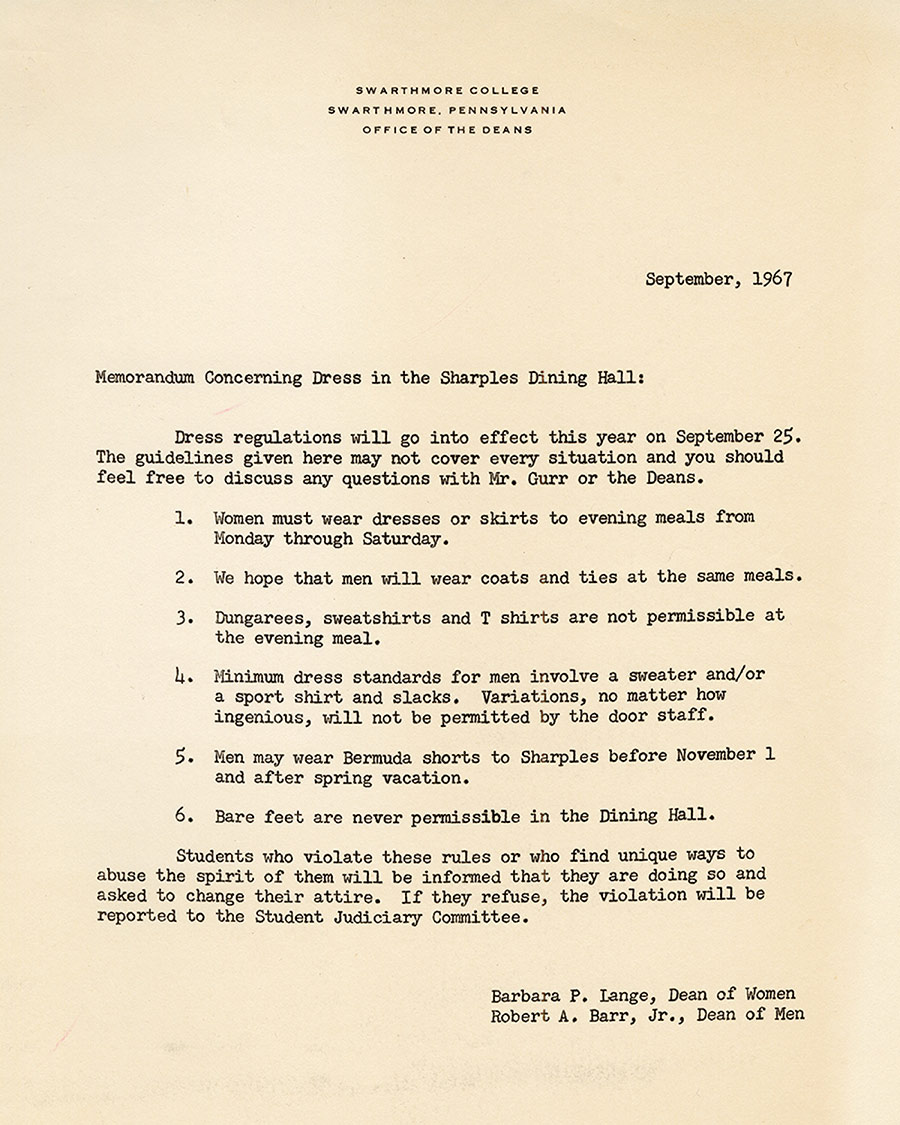
Typewritten “Memorandum Concerning Dress in the Sharples Dining Hall” from 1967.

Fashion, Fringe, and Now vs. Then

Mainstream middle-class fashions of the late 1960s were overall fancier than how people dress today.
By Abigail Weil
When you think about fashion from the late 1960s, you might picture bell bottoms, leather vests with fringe, and groovy braided headbands. But you wouldn’t find that at Swarthmore, at least not in Sharples for dinner.

In the fall of 1967, a memo was circulated: “Concerning Dress in the Sharples Dining Hall.” The fact that it was signed by the “Dean of Women” and “Dean of Men” is just one detail that marks how different our culture is now versus then.

The memo announces the following rules: “Women must wear dresses or skirts to evening meals from Monday through Saturday.

We hope that men will wear coats and ties at the same meals. Dungarees, sweatshirts and T-shirts are not permissible at the evening meal.

79
Swarthmore College Bulletin/Fall 2026
Spoken word

A Feeling of Being Home

Koof Kalkstein ’78 reflects on his deep ties to Swarthmore and why its educational model remains well positioned to thrive.
By Ryan Dougherty
H

arold “Koof” Kalkstein ’78 has been a part of the Swarthmore community for nearly a lifetime. As the son of alumni, a parent of an alum, and serving on the Board of Managers, most recently as chair, he has experienced the College from nearly every vantage point. Kalkstein reflects on what has changed — and what has endured — across generations of Swarthmore students. He discusses the relationships that have made Board service especially rewarding, how his deep ties with Quaker education influenced his approach to leadership, and why he believes the College’s educational model is built to thrive amid rapid change.
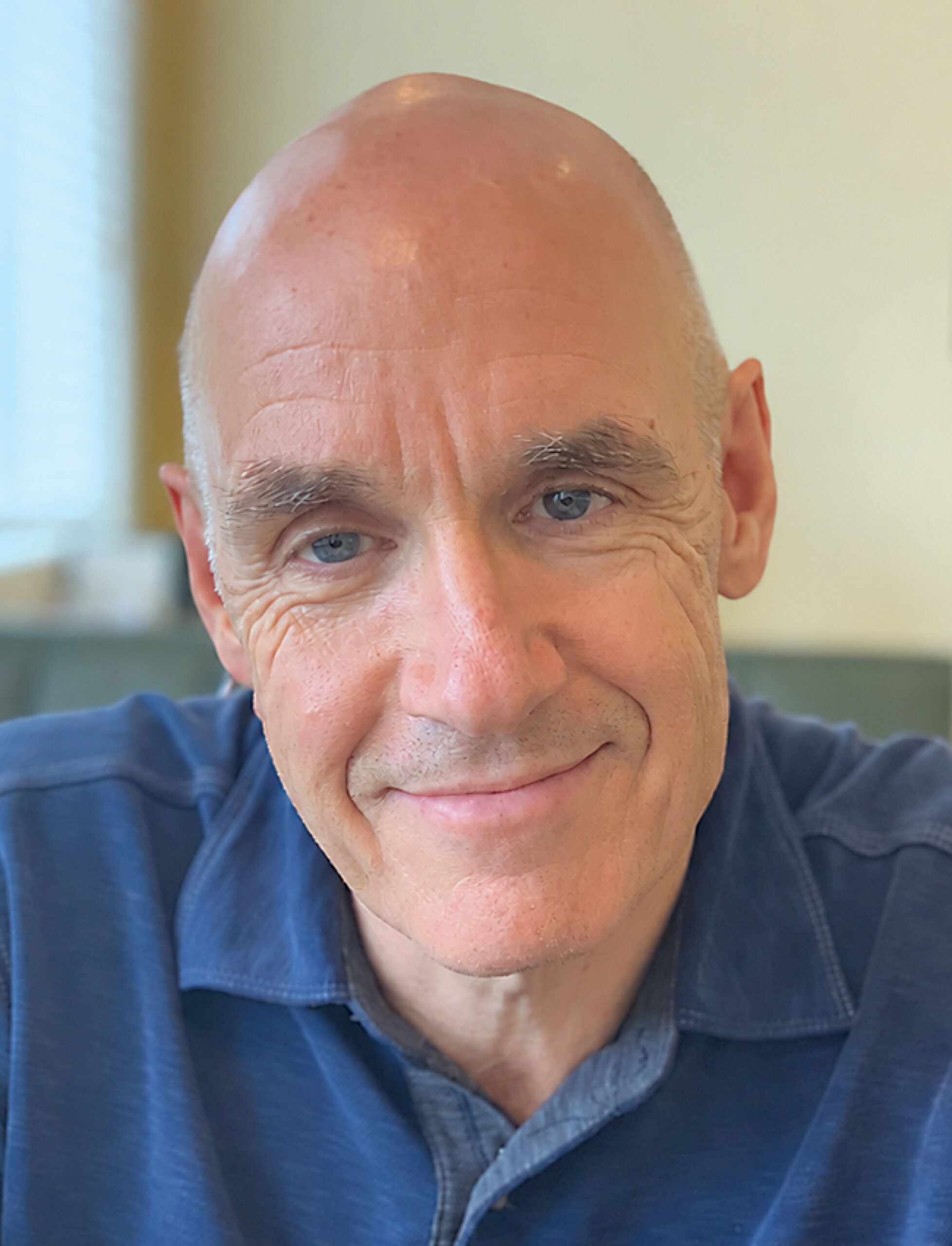
Head shot of Harold “Koof” Kalkstein ’78
Alex Kalkstein ’06
“The Quaker approach is one of the things that led [the Board] to make some decisions perhaps more slowly than with a traditional top-down structure, but in longer-lasting ways,” says Kalkstein. “In particular, the commitment to carbon neutrality, and our strong emphasis on access and inclusion, culminating with the Swarthmore Tuition Guarantee.”
Your family’s connection to Swarthmore spans generations. What has changed the most, and what has remained constant?
One of the most striking changes is the modernity of the campus. The physical infrastructure — the architecture and the number of new or enhanced or upgraded buildings. It’s not that the campus feels bigger, but it does feel more robust in terms of its framework. The biggest change is just the diversity of students. When two of my brothers, my sister, and I attended throughout the ‘70s, you saw much less range of skin color, of background, of geographic concentration. That has changed quite a bit since 1978. The things that feel the same are the ease of interaction with faculty and a feeling of being home. There is a comfort in an environment that is intellectually challenging, yet very communal.

What have you found most rewarding about serving on the Board?
One benefit of board service is being on campus regularly and being sought out by students and building relationships with them on any number of topics. Often, that has been related to their career aspirations and areas in which I might be able to help them think about those steps. Then I have the pleasure of running into them again five, 10, or 20 years after they’ve left and learning more about what they’re up to. Connecting as alumni with people you’ve had some interaction with as students is very satisfying.

80
Swarthmore College Bulletin/Fall 2026
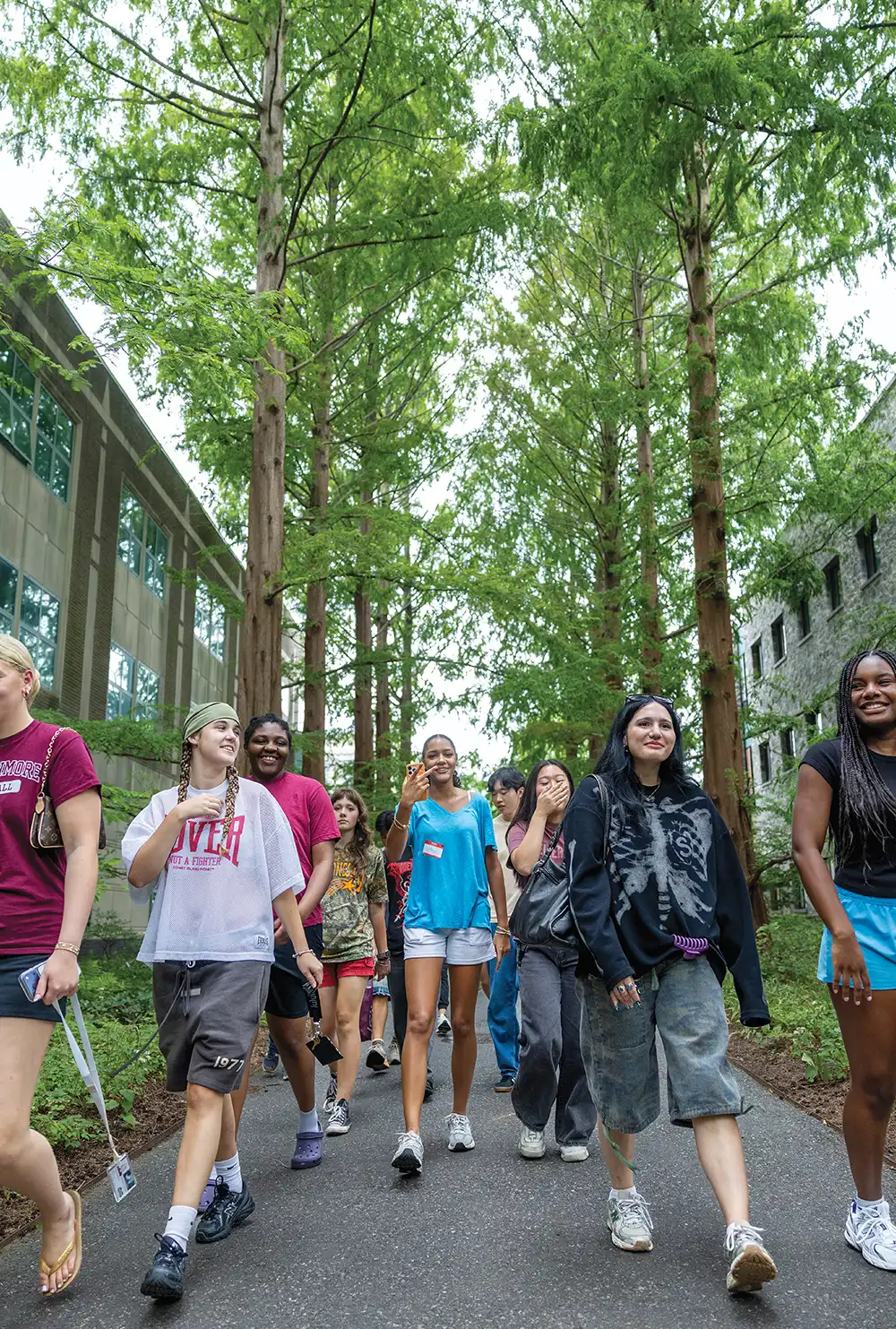
Swarthmore students walk down Metasequoia Allee under a canopy of green leaves.
laurence kesterson
leaf icon

team spirit

Marking a joyful beginning to the fall semester, students walk across campus together. There are 436 new students who represent 46 states as well as the District of Columbia and Puerto Rico. Twenty-eight percent are international, dual U.S. citizens, and permanent residents representing 46 countries.
laurence kesterson

Class Notes Available Online

The Bulletin’s Class Notes are now digital! Alumni can read the Class Notes in the Alumni Portal. Find the online notes, and information about creating your Alumni Portal profile, at swarthmore.edu/AlumniPortal
laurence kesterson