

Fighting a Forgotten Killer
From 2020 to 2024, a new, upstart virus held the top spot: COVID-19. Last year, though, a much more ancient foe, tuberculosis, forced its way back to the position it had occupied for many years prior. The news came as little surprise to Elizabeth Campbell ’92, P ’19, P ’27, a molecular biologist and Corinne P. Greenberg Women & Science Professor at Rockefeller University. Tuberculosis kills 1.3 million people a year. Almost one person in four of the world’s population is a latent carrier. And the victims of the respiratory disease tend to be the poorest people on earth.
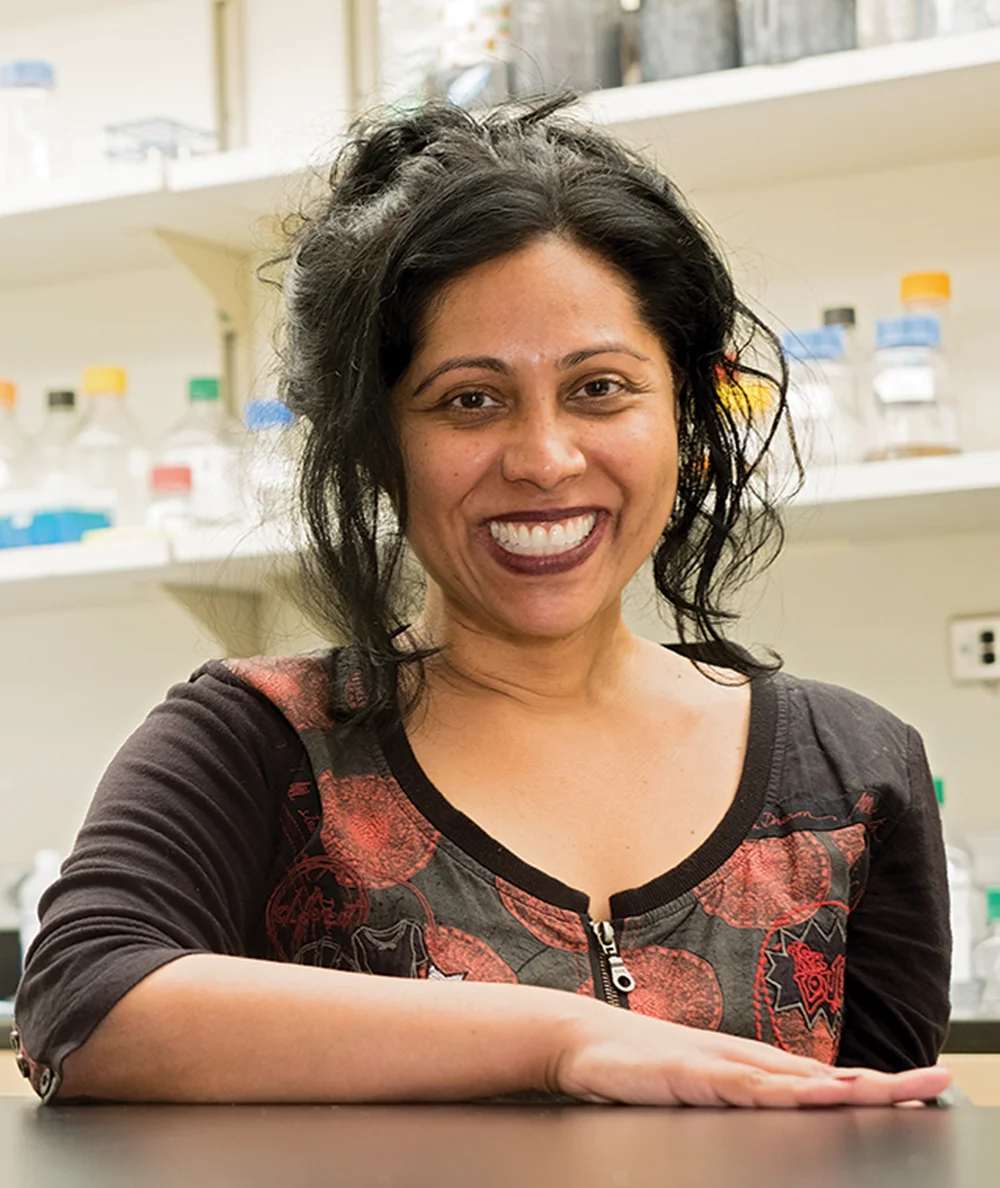
“You don’t make money studying TB,” she says. “It’s not profitable. The patient population can’t afford expensive drugs, and they tend to be neglected.”
But it hasn’t stopped Campbell.
In 2024, she launched the Laboratory of Molecular Pathogenesis at Rockefeller. There, she leads a team of researchers racing to stay two steps ahead of the bacteria’s evolution by understanding how it makes copies of its DNA.
“My role is to understand these processes at a very deep, mechanistic level, so we can think more strategically about drug development,” she says.
Over the last few years, Campbell, who has also studied the virus that causes COVID-19, has been piling breakthrough upon breakthrough.
She has long been drawn to defeating the world’s most harmful diseases. As a young child growing up in Guyana, access to vaccines was still rare. “I saw people die of tetanus,” she says, “at a time when, in the U.S., tetanus shots were easily available. So I’ve always been interested in the human component of science. I try to choose the most terrible diseases as well as the ones that are the least studied.”
Arriving in the U.S. for middle school, she initially thought she would study medicine. But at Swarthmore, her advisor, Amy Vollmer, now Isaac H. Clothier Professor Emerita of Biology, inspired her to explore a different direction.
“Amy Vollmer really took me to another level. She recognized that I love research,” says Campbell. “She encouraged me to pursue research beyond Swarthmore. Today, I try to hold my students to the same standards that she held me to.”
At Rockefeller, Campbell studies transcription, which is the way genetic codes stored in DNA are copied and turned into instructions to the body.
“Transcription is a super-complicated process,” she says. Understanding it in granular detail opens the door to finding new drugs that could stop Mycobacterium tuberculosis in its tracks. Last year, Campbell and her team made an important discovery. In a paper in Nature, she and her colleagues laid out a possible new way to attack TB-causing bacteria that have become rifampin-resistant. She showed that the resistant bacteria seem to transcribe their DNA more slowly. This opens the possibility for a drug that could slow it down even further, to stop the bacteria replicating altogether.
The research is at an early stage. In partnership with the TB Alliance, a nonprofit funded by the Gates Foundation, the next step will be to explore the development of a new drug with the potential to save millions of lives.
“We’re really, really excited,” says Campbell. “I hope that maybe, in six months, I’ll have more news.”
She retains close connections with Swarthmore. Her oldest daughter, Maya Darst-Campbell ’19, graduated from the College; her youngest, Amba Darst-Campbell ’27, is a current student; and Campbell remains enmeshed in a close community of alumni.
She is committed to advancing diversity in science, too. Last summer, Campbell received a faculty award by Rockefeller’s Office for Diversity, Equity, and Inclusion for her work mentoring students from underrepresented minority groups.
“When I would go to seminars and meetings, a lot of times, I was the only woman of color,” she says. “So I’m trying to see if we can fix that, too.”