


Seeds and Sounds
“My father met the lead pastor in Liberia, and when my family immigrated to the U.S., my dad was like, ‘I got to go to Philadelphia, because that’s where this church is.’ ”
The congregation was a mix of Black Americans and African immigrants due to the lead pastor’s Christian missions in Africa, which he used as a recruiting tool.
“Praise and worship was a mix of songs that are a part of the Black American gospel tradition, but then also African praise and worship music,” says Floyd. “Sometimes my aunts would help lead praise and worship, and they would be shaking their saasaa.”
The saasaa is a percussive instrument made from a dried-out gourd. Netting, interwoven with beads or cowrie shells, covers the larger part of the gourd, creating a rattling sound.
“I have a very early memory of my aunt and my mom in my aunt’s kitchen cleaning out a gourd with plans to make it into a saasaa, from when I was 7 or 8,” says Floyd. She now makes her own saasaas as part of a project called Seeds and Sounds.
“Seeds” refers to the part of the project where Floyd grows her own gourds. It’s a specific type, with the scientific name Lagenaria siceraria, known commonly as calabashes or bottle gourds.
“It’s a hard-shell gourd, distinct from what we call pumpkins here in the States, because when they dry out, under the right conditions, they don’t go soft,” says Floyd. “They can last for a very long time.”
Getting the gourd to last requires a fair bit of strategy. You have to harvest it at the right time, waiting until the vine withers, Floyd says. Once it’s harvested, it has to be kept in a well-ventilated area. When the gourd has finished drying out and shrinking, “You scrub off the mold on the surface and then you can make a hole in it,” she says. “Through that hole, you pull out all the fibers and seeds.”
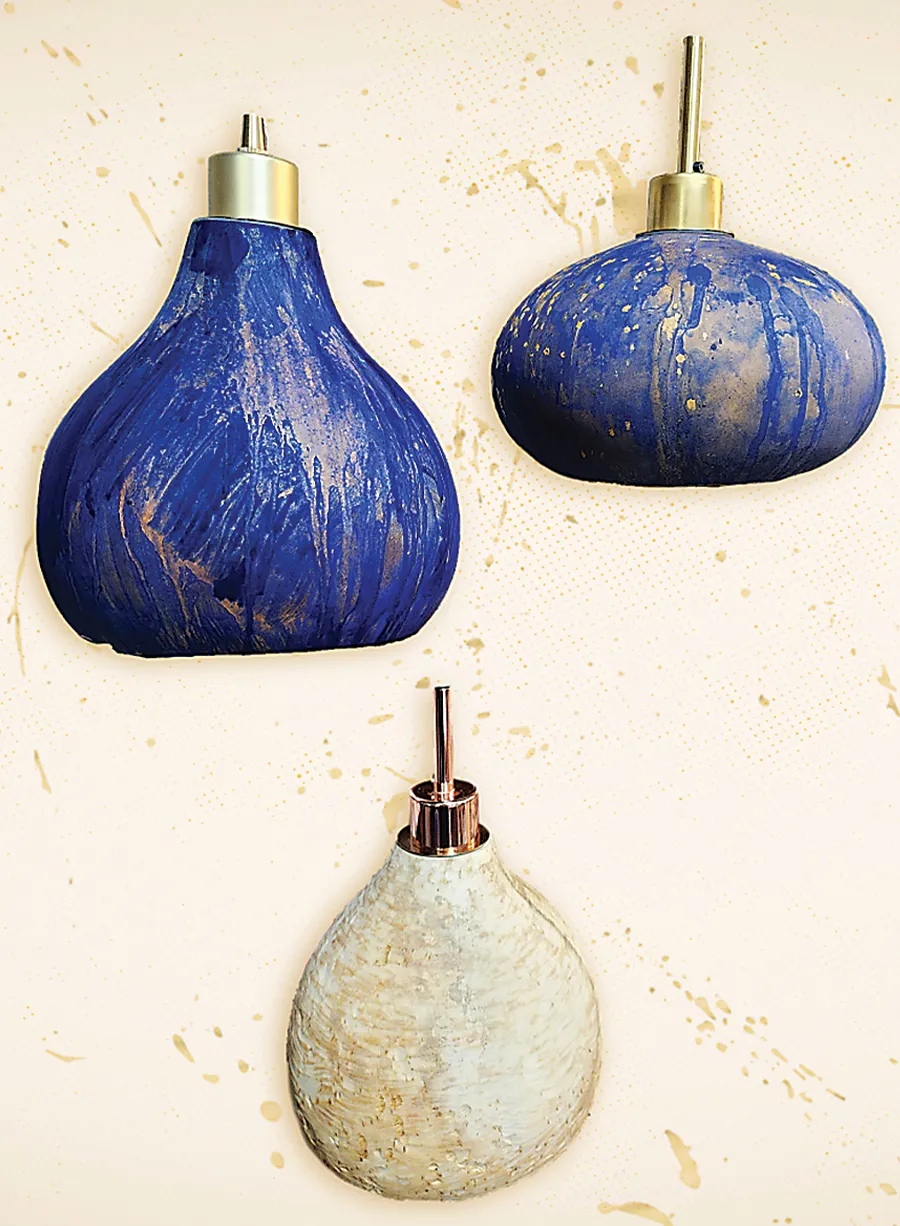
Floyd, who lives in Pittsburgh, has also been using the gourds to make pendant lamps, and working with Monmade’s Green Leap, a local green-business incubator that connects local artists to the building industry.
“It’s cool to be able to sell to different kinds of clients than I have had access to before,” she says. “Builders want a standard product that is predictable. This process helped me figure out where to source things from, how to make a standard product, and to understand the costs a bit more.”
Floyd has held solo exhibitions at Fjord Gallery, the University of Pittsburgh, Airspace Gallery, and more. After completing her B.A. in art at Swarthmore, she earned an MFA from Carnegie Mellon University, where she now teaches.