

life in the fast lane
life in the fast lane
eter B. Meyer ’65 does not seem like the type of person who would be drawn to working the corner at a motorsports track: He grew up in Manhattan in a family that knew next to nothing about cars and has spent much of his career studying the economics of environmental protection.
But Meyer has been involved in the world of racing for nearly 50 years, traveling across the country and abroad, and it all began on a snowy day in Summit Point, W. Va., in 1979.
“I was teaching at Penn State at the time and our neighbors across the street, who were really into racing and flagging, recruited my wife, initially,” he says. “I was pressed into service and ended up at a racetrack in 20- degree weather with 20-mile-an-hour winds blowing snow. I’ve been going back ever since.”
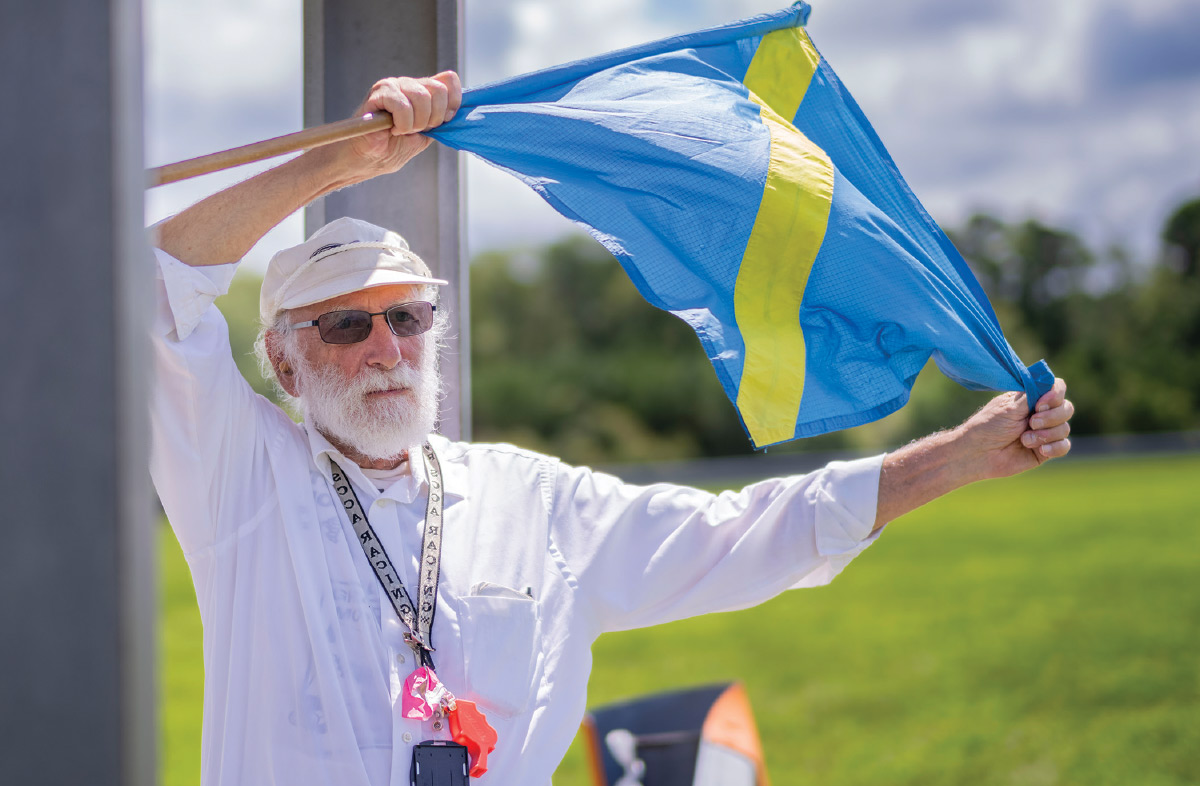
Flaggers or “corner marshals” play an essential part in keeping drivers safe during races around the world by monitoring the track for possible disruptions and communicating them to competitors via flags. It is not a job for the faint of heart. Flaggers, who are typically unpaid volunteers, are stationed as close to the action as possible and have to maintain high levels of focus throughout long days, looking out for drivers and their fellow track workers.
“If I’m on flag yellow looking downstream, watching what’s happening beyond my station, I’m counting on somebody who’s looking upstream to pull me out of the way if a car is about to crash into our station, which happens,” says Meyer, 81.
As a result of this close and cooperative work, flaggers build fellowship and form enduring bonds with people from all walks of life, which Meyer cites as a key reason he still relishes the volunteer gig.
“You work with a bunch of people who’ve been doing this with each other for decades and it feels like summer camp all over again,” he says. “If you were to look at the people who flag, probably over half have nothing to do with cars in the ‘real world.’ It’s co-ed, and you have people of all ages and education levels and everyone is subordinating their ego to the team because none of us could do what we do if we didn’t have other people doing it with us.”
Meyer contrasts this spirit of collaboration and camaraderie with the often solitary life of the career academic. After graduating from Swarthmore and earning his Ph.D. in economics at the University of Wisconsin-Madison, he taught at Penn State University and helped establish the first undergraduate degree in community development in 1968. With nearly two decades completed there, he left for the University of Louisville, where he currently is professor emeritus of urban policy and economics.
At Louisville, Meyer became more involved in the economics of environmental protection. Initially he focused on the risk management and community perception of contaminated sites or “brownfields” (think steel mills, dry cleaners, and coal mines) and worked with the U.S. Environmental Protection Agency as an expert witness to the Environmental Financial Advisory Board.
Eventually, he shifted his focus to climate change and the financial opportunities for cities looking to combat it.
Meyer has also served as a member of the New Hope Borough Council in Bucks County, Pa., from 2018 to 2025. In 2017, he resigned from the EPA science advisory panel to protest cuts to the agency’s budget in the first Trump administration.
Flagging for races with petroleum-burning cars and combating climate change are not at odds with one another, says Meyer.
“Flagging won’t make a hill of beans worth of difference to what happens to the climate or climate change,” he says. “So I may as well continue to do what I enjoy.”
Meyer plans to work at tracks for as long as possible; amid all the chaos of racing and its constant reminders of mortal danger, he finds an opportunity for relaxation.
“When you’re flagging, you forget about everything else,” he says. “Because I’m an academic, I’ll wake up in the middle of the night and start thinking about a paper that I was working on. One of the wonderful things about flagging is you get your butt out there and you can’t think of anything but the cars.”