

Fostering
Family Success
Fostering
Family Success
When Rosemarie Ewing-James ’80 appears on a video call for our interview, she is sitting in a nondescript office overlooking a busy highway — a surprising backdrop given that she retired last year.
“Oh, I still work here two days a week,” says Ewing-James, speaking from the grounds of Forestdale, a child welfare agency in New York City where, until 2024, she was an associate executive director. “I still help out.”
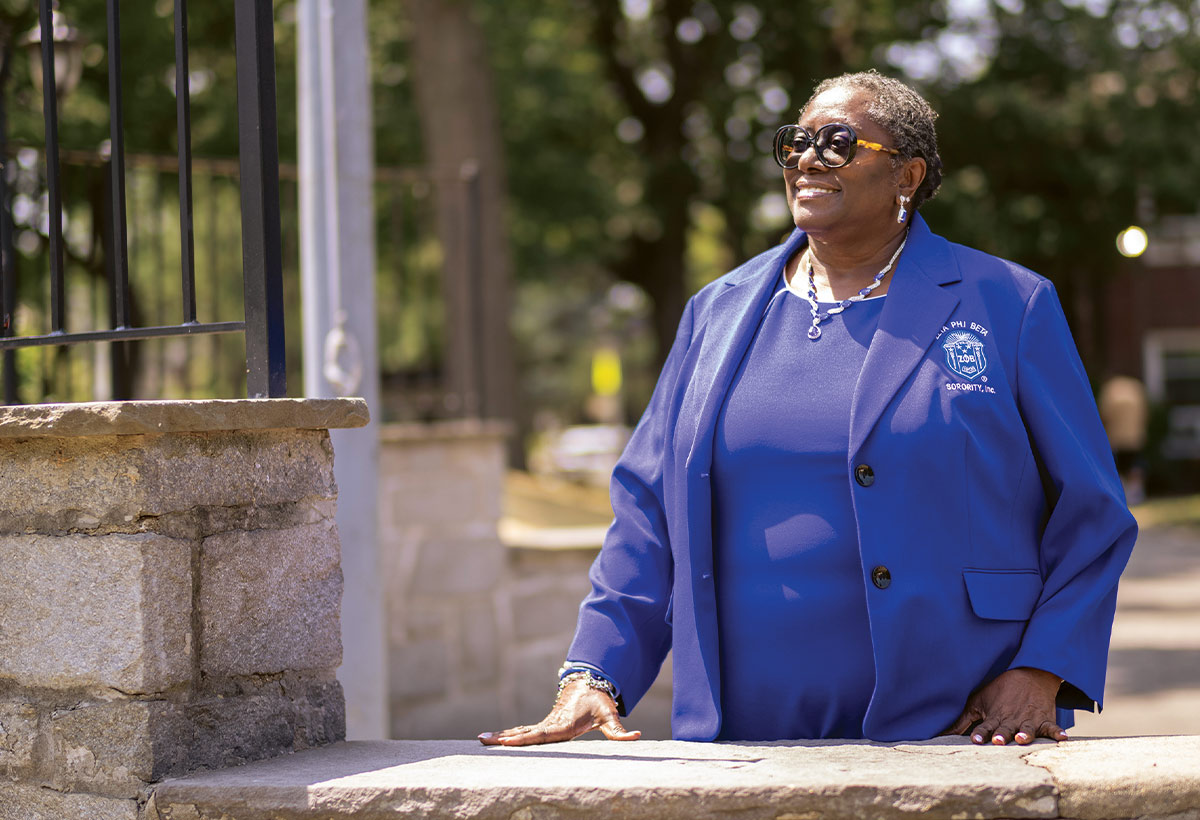
Laurence Kesterson
“Several individuals welcomed me into their midst and created an inclusive environment for me at Swarthmore,” says Rosemarie Ewing-James ’80. “Among them were, Wilma Lewis ’78, Linda Randall ’78, Freeman Palmer ’79, my roommate Mary Plough ’80 (and her family), and Jacqueline Brokaw ’80.”
“All the things they need to become solid citizens,” she says.
When Ewing-James joined Forestdale in 1996, only one or two of the agency’s foster children would go on to college each year. Nationwide, only 3-4% of fostered children get a four-year college degree.
“We’re aiming to increase that number,” says Ewing-James, whose work has been recognized by an award from the New York State Foster and Adoptive Parents Association. “Because people unfairly write off these kids. People think: ‘If you’ve been involved in the foster care system, your life is over.’”
Ewing-James has taken fostered high school students to visit colleges in Florida, Arizona, Georgia, and Texas. Twelve years ago, she even took a group of students to visit Swarthmore’s campus.
“We’re giving them exposure to higher education,” she says, “so they know there’s a world outside.”
Her work has paid off. Today, it’s not unusual to have more than 20 Forestdale kids heading to college each year.
A native of Cambridge, Mass., and the daughter of Jamaican parents, Ewing-James always wanted to be at the heart of her community, serving others. “My mom and my maternal grandmother were helpers — they helped everybody,” she says.
As a teenager, she taught parents in her community to read. “Not only did it help them become better parents,” she says, “but it also enabled them to get better jobs.”
At Swarthmore, she enjoyed studying linguistics, social psychology, and education — and despite a rigorous schedule, she still found time to lift others up. She served on the orientation committee for incoming first-year students, and counseled peers as a resident advisor. She played basketball (a sport that runs in the family; her brother is NBA Hall of Famer, Patrick Ewing) and found support and solidarity, as well as a link to her childhood in the church, in the College’s gospel choir.
After graduation, she got a master’s in social work at the University of Pennsylvania. “I spent two years working in the Philadelphia child welfare system, primarily with teenagers residing in group homes,” says Ewing-James. “I frequently wonder what became of those children; hoping that in the short time I was in their lives, I left an indelible mark.” In 1984, at the height of the crack cocaine epidemic, she moved to New York City to work in children’s services. The racial inequities in the system shocked her.
“Around 70-80% of those entering the [foster care] system were people of color,” she says. It’s a disparity that persists today, with Black children more than twice as likely to enter foster care. That experience hammered home to her the need to address the underlying causes of family breakdown, including poverty, mental health problems, addiction, and oppression. Since then, Ewing-James’ mission has been to strengthen family relationships, avoiding fostering or adoption wherever possible. “Can we raise people’s children better than they can? Should we be in the business of regularly removing children from their parents?” The answer, she says, is no. “So, the next question is: What can we do to help people become better parents?” Along the way, Ewing-James raised two children of her own. “I can say that my family has been successful,” she says proudly — her son is a paralegal and her daughter works as an administrator in a law firm. “My job is to give other kids the opportunity to be successful, too.” The figures speak for themselves: Forestdale’s preventive services — which include trauma-focused therapy and family rehabilitation — are currently enabling 98% of their client families to stay together. Success on that scale brings deep rewards, and Ewing-James, who also spends time volunteering with several community organizations, including the National Council of Negro Women and Zeta Phi Beta Sorority, is in no hurry to give up her child-welfare work — retirement notwithstanding.